We don’t debate the library tax
We're taking a very active break from our Six Senses schedule–next week is TASTE, so don't fill up on bread–because people kept sending us vibe reports that we just couldn't keep ourselves from publishing. You can still become an ORB FOUNDING MEMBER by subscribing here, and we thank you kindly for it! But today's vibe report is, in a way, the most homespun DIY version of ORB, the one where we didn't know we needed nearly 4k words about an El Cerrito library tax measure meeting in a Senior Center until we read it, and were like “Oh this is actually what we do need more than anything else.” Maybe you do, too.
◎
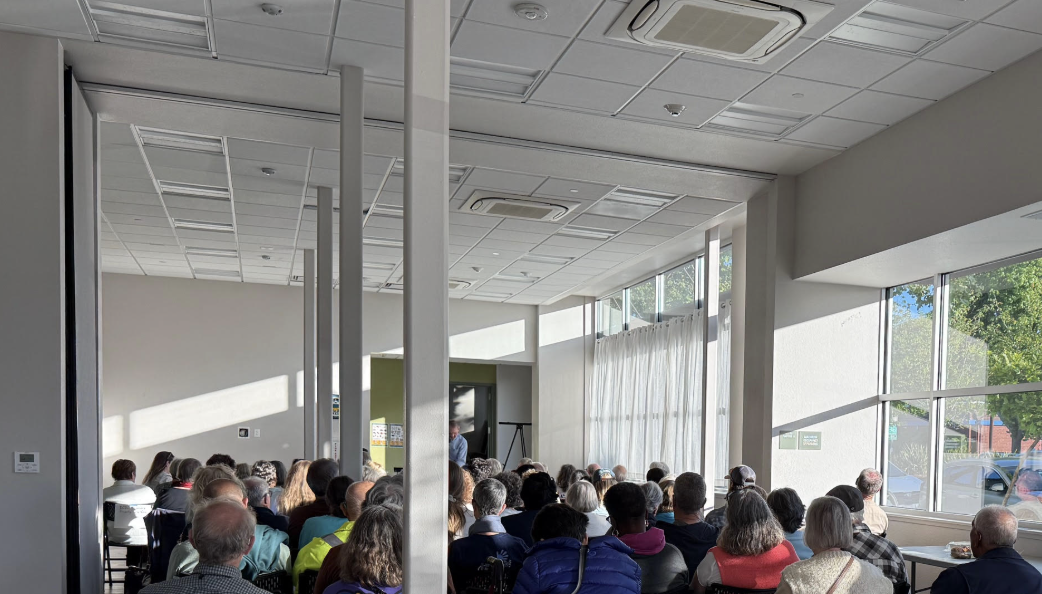
The early evening sunlight is orange, coming over San Pablo Avenue and through the windows of the Hana Gardens Senior Center at a perfect 60 degree angle. It’s 6:34PM on a clear Tuesday night in El Cerrito, California, and we’re willing to bet money that our children (almost two and just four years old, respectively) are the youngest people in the building by at least three decades. We’ve brought our toddlers out after dinner because we’re going to watch The Great El Cerrito Library Tax Non-Debate, a 90-minute discussion of municipal Measure C, hosted by the El Cerrito Democratic Club.
We can tell we’re in trouble when William Ktsanes, the Executive Vice President of the El Cerrito Democratic Club (and one of El Cerrito’s five City Councilmembers) begins his opening remarks. My younger son is saying “Pikachu” over and over in what frankly, for him, is a whisper, though I can tell from the glares across the sea of otherwise emotionless white and gray heads in front of us that, in this environment, it may as well be a shriek. We have once again confused a public event with one where an all-ages public is welcome. Also, William says the event will actually be two hours and go until 8:30PM, well-after our bath and bedtime rituals. Perhaps we should have opted for the Zoom event?
But if we’d done that, we would still be going to bed confused, wondering aloud to one another (as we have many times over the last few months) why the fuck all of our neighbors are tearing each other to pieces over a library tax. Coming here means we might get some answers. Coming here, like voting for a tax, is a way of saying we’re invested in our community. Coming here means we want to see who the people who make up this community are.
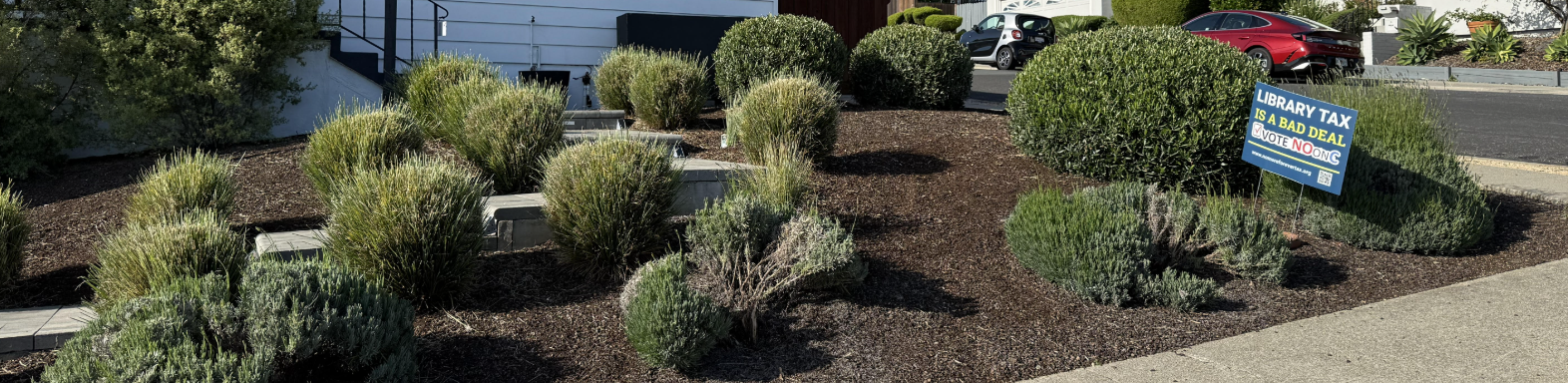
When we enter, there is a not-white man by the door, which is important to us because we are also some of the less than a dozen not-white folks in attendance, at least as far as we can tell. He tries to give us a neon green flyer that reads “NO ON C,” and we wave him off. One already appeared on our doorstep weeks ago. Before Measure C even had a name, signs were sprouting all over El Cerrito, and, often, we noted with curiosity, at the nicest houses, the houses that had clearly been remodeled the most recently, with the kind of landscaping we envy but cannot afford to invest in right now after one of us was DOGE’d and the other is facing an imminent layoff. “LIBRARY TAX IS A BAD DEAL for El Cerrito,” these signs declared.
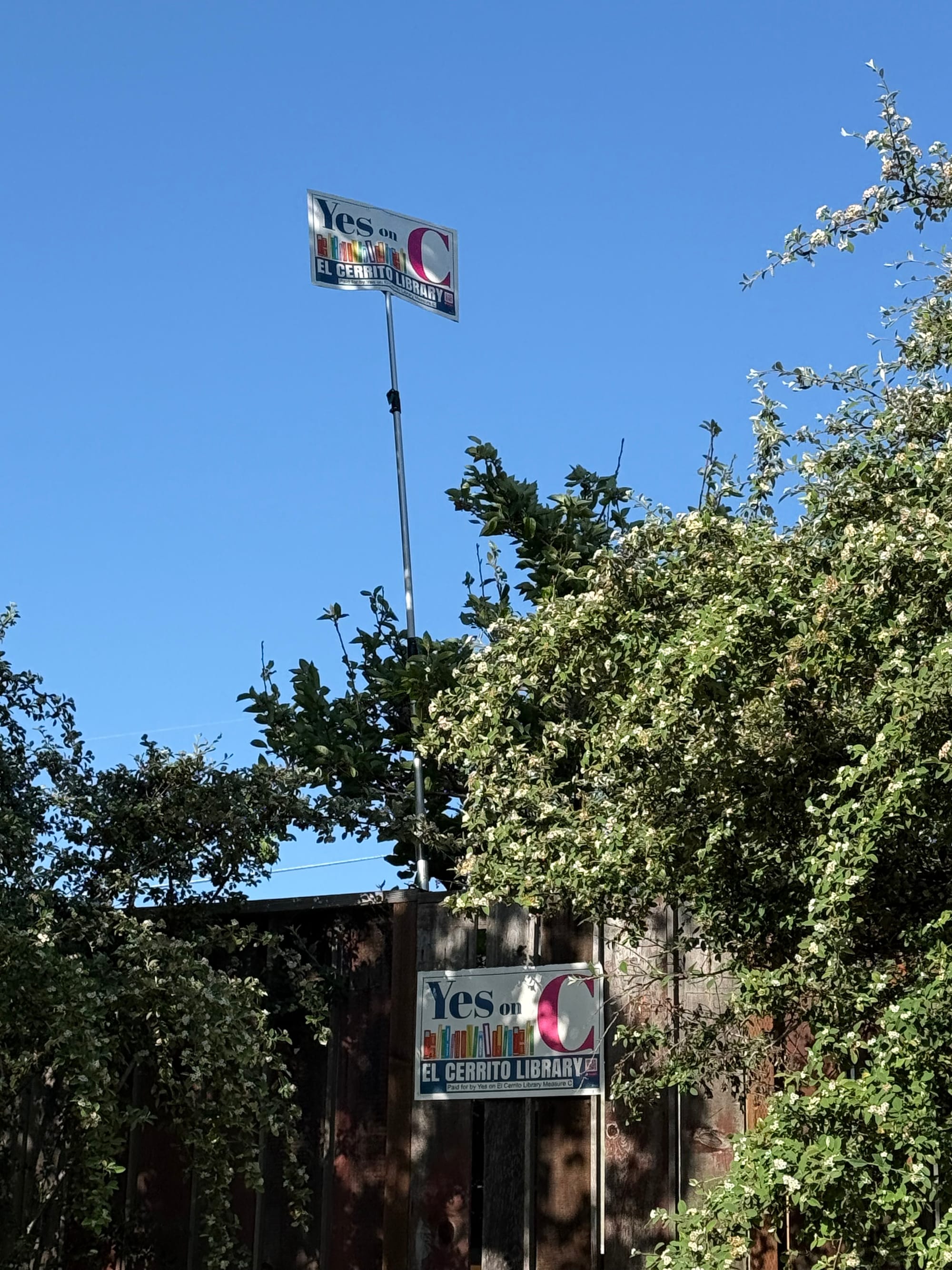
Weird, we thought, as we biked or drove between our house and our BART commute or our house and daycare. We already knew about the ballot measure because a neighbor had knocked on our door months before and explained it to us. It would be a parcel tax, one of the most progressive taxes, because it taxes people based on how much property they have rather than applying flatly to the entire population like a sales tax. It would fund the new library which would probably have to be built near the new BART housing project that the state was mandating be built. Our neighbor cringed when she explained that it would probably cost us around $300 a year in additional taxes.
We laughed. We gestured at our house, which was built in 1959, whose garage cabinets were built by the original owner and are slowly slipping off the wall, but whose annual taxes massively dwarf that figure. What’s another $300? we asked. It’s a drop in the bucket. We signed the petition. We understood that there would be opponents because taxes are unpopular and people don’t want to pay them; not a particularly sympathetic political position, but a predictable one.
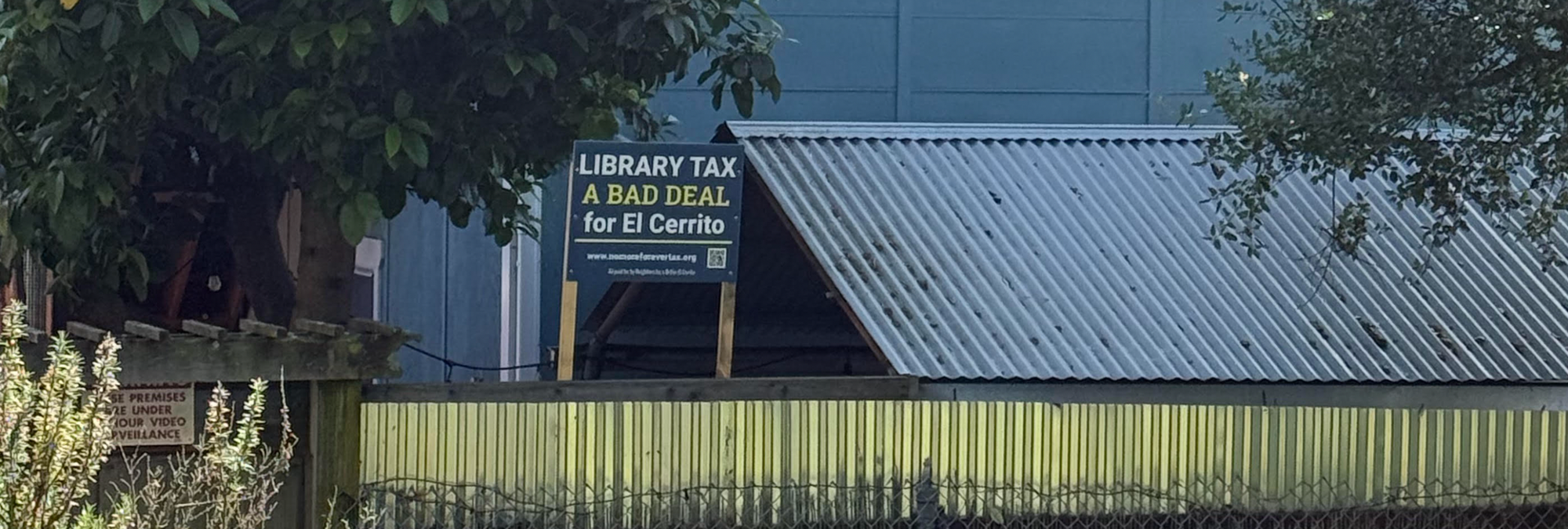
And so, now we are in Hana Gardens, manhandling our toddlers to figure out which one of them may be responsible for an unmistakable stench that’s starting to permeate the backrow. Opponents of Measure C do not say they oppose the tax because it is a tax. On WhatsApp groups putatively about sharing parenting resources, new group members say they oppose it because unnamed El Cerrito City Councilmembers will financially benefit from moving the library to the new BART transit development; at our doors, No on C volunteers say they oppose it because the tax will subsidize unnamed corporations with public money; and, on Nextdoor and Facebook–you know what, best not to bring in what’s being said on social media. We’re here, in this beautiful senior center built with public funds from the state, county and city, to look our neighbors in the eye. To make them say it to our faces.
They don’t. William explains that this will not be a true debate. Instead, Greg Lyman, a longtime El Cerrito City Councilmember, former Mayor, and author of the ballot measure, will represent Yes on C. Wally Nowinski, a Democratic Party party operative and self-described “BigMac Democrat” (Big…Machine? we wonder) will represent No on C.
That’s clear enough, but William doesn’t want the two sides to directly address what the other one says. He also wants attendees to focus on listening so he’s going to ask all the questions instead of opening it up to the audience. And he also wants the new folks in attendance to join the El Cerrito Democratic Club, which they can do by mailing a check. We’ve come here for civil discourse reminiscent of a bygone era, and even as we carry our screaming two-year-old out the open backdoor and into the rose garden that commemorates El Cerrito’s history of Japanese American florists, we still feel hopeful that we might get to hear it.
Greg goes first for Yes on C. He’s wearing a brown cardigan sweater over a blue buttoned down shirt that from the back row looks like it’s the same color as William’s, and he defies his Mister-Rogers-vibe by opening with a jaunty, “Alright, let’s go!” He launches into a well-rehearsed stump speech: “I want a library that hums with life.” He invokes image after image: a job seeker, a remote worker, an entrepreneur, a senior, and also children. Children! One of ours is climbing a mysteriously low table by the back window, while the other watches in wonder as we write these notes. (“You will learn to write soon, okay?” we say, and he nods, saying it’s “pretty cool,” and we realize this is maybe the first time he’s ever seen us writing with a pen and paper.)
At some point, former Mayor Greg started to talk about El Cerrito’s current library, which is, to be generous, a dump. It’s dark, it has no AC, the windows don’t open, it has shockingly few books, and it’s seismically unsafe, rattling each time a BART train passes (this is our opinion, not Greg’s). “A modern library is essential infrastructure,” Greg concludes.
Now it’s Wally’s turn for No on C. Wally’s most Google-able claim to fame had been starting a PAC that ran anti-Trump ads on porn websites, but now he’s a well-known area man, and the instigator of some of the city’s worst Facebook exchanges. He’s wearing a slick blue blazer with a white button-down and thick black glasses. Unlike Greg, he opens not with a vision, but with an introduction: He’s a homeowner, he moved here in 2023, he ran an anti-Trump PAC (he doesn’t mention the porn), and he’s about to have his first child in May. “We’re all Democrats here and–if we’re being honest–in El Cerrito,” he quips. This is not, he maintains, about libraries. This is not, he implies, about whether or not we believe in the vision Greg painted.
Instead, Wally says, this is about trust. (One of us leans forward, while the other one wrangles the two-year-old on San Pablo Ave). But Wally runs out of time before he can get to why it’s about trust. Half the room applauds, which makes William bristle. He doesn’t want people to clap or react loudly to what they say because it’s “disrespectful and distracting.”
Greg starts his second, longer statement, as our two-year-old starts screaming just outside the door, desperate for a change of scenery. The spectacle of the 72 bus rolling down San Pablo Ave (funded by Alameda County Transit but still serving this corner of Contra Costa County because it’s good for the public and it makes sense) gives us a moment of respite just in time for our four-year-old to have a small accident on the way to the bathroom. We split up and find Greg holding up a graph that we can barely make out from the backrow. “Measure C is a phased, responsible process,” he says and then, again, the exasperation audible in his voice: “Measure C is a phased, responsible process.”
As he describes the phased responsible process, honestly, it’s a pretty boring story: the measure funds the process to discuss building a library, not a library location itself; it allows the city council to adapt as conditions change “like tariffs or wars;” and it includes a process for us–the people of El Cerrito–to discuss the plan. “We must fund the process to explore all options,” Greg says.
When Wally takes the mic, he has a much more exciting story to tell about No. “Before I get into why I and so many of us object, I want to step back and think about how we got here,” he says, and we–or at least the we that’s not changing our four-year-old’s pants–lean in again. “The City” and “City Council” are the villains, according to Wally: the Evil City spent tens of millions of city money “message testing for their plan” to build a library on the BART development, and what this means, Wally says in the next breath, is that they ran a “poorly-worded poll.” The Evil City put “their fingers on the scale” by writing shitty survey questions, but it wasn’t enough to get them what they wanted according to Wally, and that’s where the “independent” citizens’ initiative appears. Rather than a grassroots effort by neighbors who genuinely believe that paying a tax is worth it if if means they get a new library, Wally implies that the Evil City in fact manufactured these door-knocking neighbors collecting signatures in order to take advantage of a “loophole” that says citizens’ initiatives only need 50 percent of the vote to pass, not 66. “The same [Evil] City that wanted this is now telling us that an ‘independent’ citizens’ commission made the measure? That undermines trust right out of the gate,” Wally scoffs.
Wally’s an interesting speaker. He’s not polished. He’s nervous, his voice shrill, arching quickly toward a crack that never comes. These technical questions–whether the ballot measure should have been in June for the $80,000 the Evil City spent or in November for free, whether the study the Evil City did to create their estimates is too optimistic about construction costs in a world where “AI CapEx” is building data centers, whether Trump’s HUD is going to fund “Newsom’s California,” or whether a future ballot measure is going to make all such citizens’ initiatives that passed with less than two thirds of the vote subject to legal challenge (“And these guys have never lost a ballot measure,” Wally says of the proposed law’s political sponsors)–are impenetrable to us. We lack the expertise to verify this many things this quickly, but Wally delivers them with the breathy confidence of an insider and the jargon of a lifelong wonk. The vibe is of a trenchcoat opening and a man slick with sweat muttering, Stick with me, kid, and I’ll keep this Evil City from taking advantage of you.
There are many controversies about Measure C, but the most urgent one to the people sitting on their walkers, murmuring to each other, appears to be whether or not it’s possible to get a senior exemption to the tax. “Democrats should be looking out for people,” Wally says, especially the most vulnerable among us. A senior exemption is written into the measure but it “just says senior, it doesn’t say low-income senior” he notes, with disdain, and also it references two programs that are impossible to qualify for. But after Wally and the No on C folks “exposed” the Evil City for writing an impossible senior exemption, the Evil City Council then passed an ordinance ensuring the senior exemption would be possible, which Wally points out, undermines the supposed independence of the independent citizens’ commission and then “raises the risk of a court challenge.”
“And do you know how the [Evil] City is going to pay those legal fees?” Wally asks the crowd, who we’re surprised to see is largely on his side, “With your money from the library tax!”
(Who, we wonder, is going to sue us, and then we realize it’s Wally. If Measure C passes, Wally is promising to sue us.)
There’s more, of course. This is all part of the Evil City’s “playbook.” The Evil City is telling you the tax can fund a library anywhere but “the fix is in,” “the plan is cooked,” and it will be near BART. The Evil City is always creating “forever taxes” even if they explicitly aren’t forever. Wally is mad about the pool tax. Wally is mad about the sales tax. Wally is mad that no one has ever qualified for a senior exemption from previous taxes, and we get the sense that Wally is even madder when former Mayor Greg explains that that’s because no one ever applied for it. “How can you say no one qualifies for it if no one applies?” Greg asks, exasperated again; “In my 12 years in the city, no one ever came to me and said, ‘The taxes are too much, and we’re having trouble paying it.’”
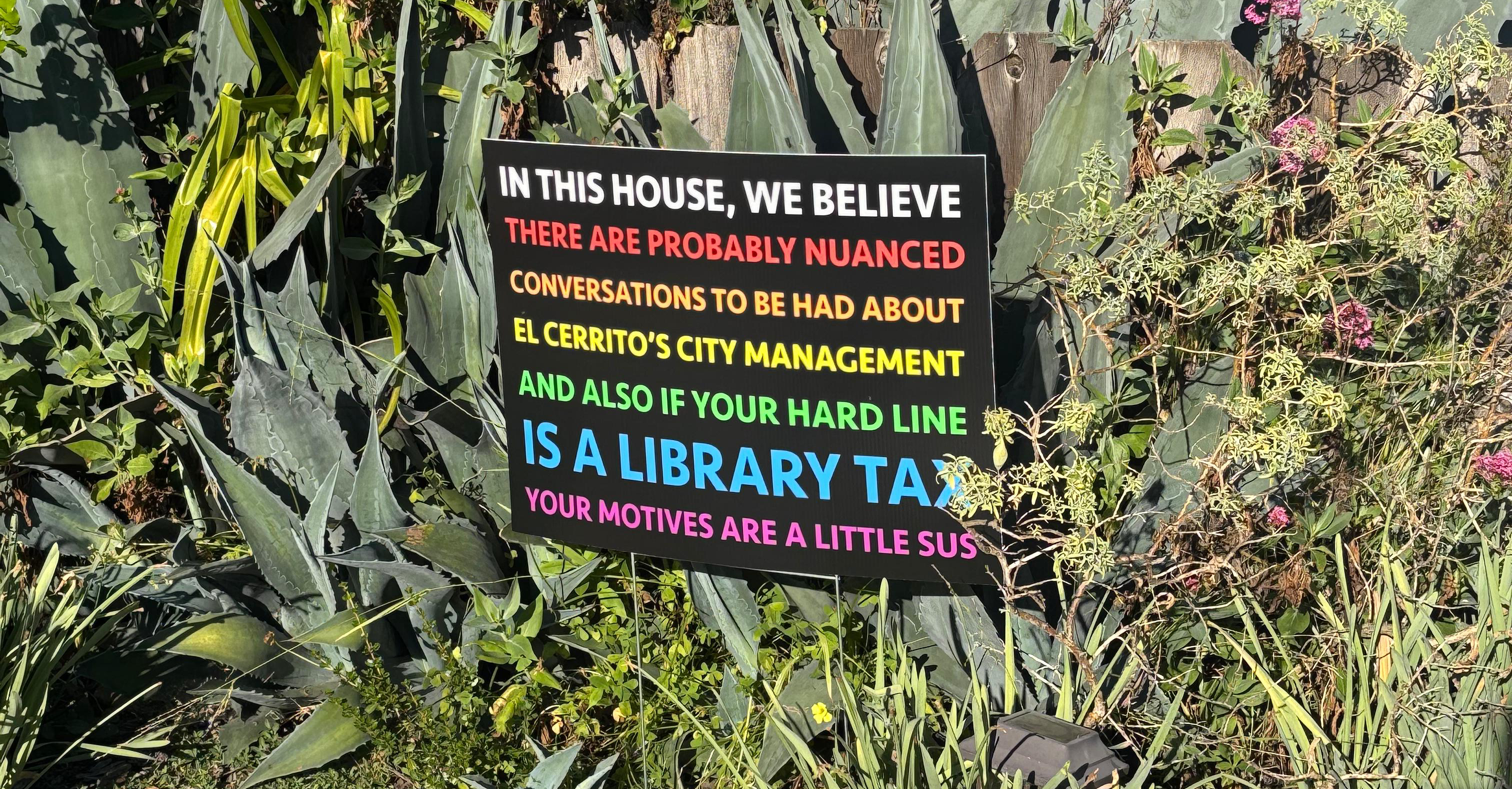
This is the thing about taxes, we think, as a woman in a gray sweater, brown leggings and sunglasses walks out jabbing her thumb down and whisper-shouting, “NO NO NO NO NO.” People don’t want to pay them, but they don’t want to admit they don’t want to pay them. Even in Trump’s second term, we understand that it’s selfish and small to not want to pay a tax, especially for something as noble as a library. So we have to say it’s not about a library; it’s about corruption! It’s not about taxes; it’s about process.
“Measure C could have been great, but the fine print falls short,” Wally says, now smug, now hitting his stride, now feeling that the room is with him: “The right response is to come back with a plan that respects the people it’s asking for votes.”
(What plan? Wally has none. His job is to send the Evil City “back to the drawing board;” it’s the Evil City’s job to come up with this other, better, more respectful and satisfactory plan.)
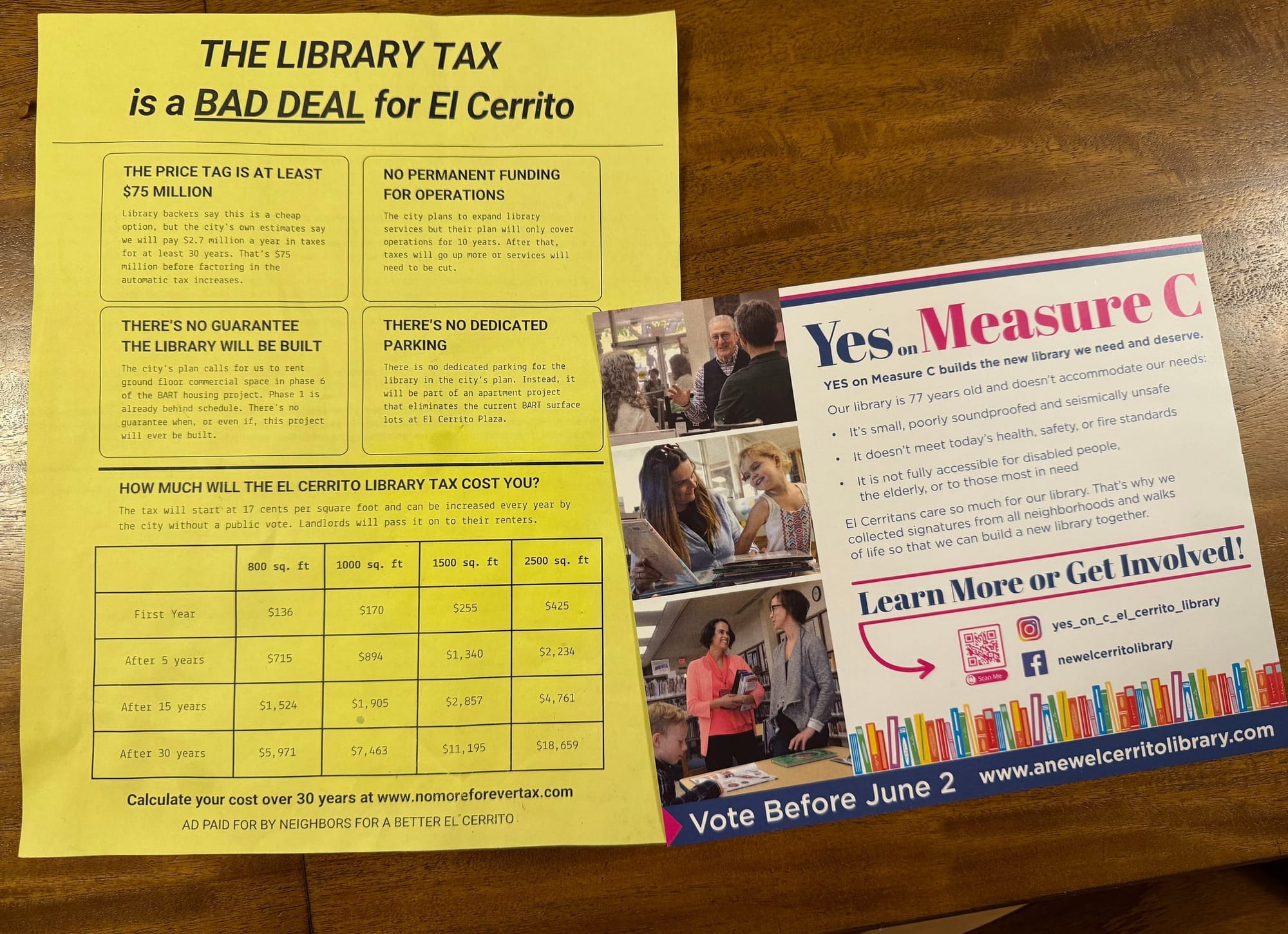
The crowd intuitively understands Wally’s metanarrative, whereas Greg’s arguments elude them. Maybe this is just the demographics of Democratic Clubs. But maybe it’s something else, something deeper. When William asks them if Greg’s answers have clarified the senior exemption, the crowd responds, “No!” and when he asks again, they laugh and say no again, with someone shouting, “It’s a lien!” (even though Greg has just spent three of his precious minutes explaining why there will never be a lien on anyone’s house as part of the senior exemption). When Greg points to charts on pieces of 8.5”x11” paper, we think about Hilary Clinton’s campaign for president against Donald Trump. Greg talks about the City’s “UAL,” and we think about what a terrible candidate she was, how she ran the same technocratic campaign she wanted to run in 2008, and how it was all wrong eight years later. We’re thinking about the terrible, tone-deaf Black Beatles mannequin video Hillary did on her plane the day of the election when Greg says he thinks it is true that the current Stockton St library is at risk of closing because the building is seismically unsound. We’re thinking about how sometimes people just aren’t able to meet the moment, and we’re trying to figure out what exactly the moment is, why would a campaign that borrows a classic Trumpism be so convincing in a city that goes so blue it’s unbelievable.
Greg hesitates before he asks, “Are you really willing to let a child get injured in an earthquake?” Everyone laughs. “Yeah sure!” shouts a man with wavy shoulder length gray hair, a navy blue polo, khaki shorts, and the kind of soft, suede shoes one of our dads used to wear in the 1990s. “Kidding!” he says unconvincingly in response to our shocked faces.
“Asshole,” the woman he came with says. She has a rose tattoo sleeve and is one of the only other people there besides me with natural pigment left in her hair. Every time Greg tries to assuage a concern, she finds fault with it. When he says city council can adjust the senior tax exemption to make it broader, she whispers that they could also make it narrower. When he says it doesn’t have to be at BART, she says it will be. When she’s confused because Greg is talking about how taking over the empty Marshall’s storefront would mean dealing with a private lease, we try to tell her the BART location would be a lease with a public landowner, and she hisses that it’s the same thing, “And anyway, isn’t BART closing stations?”
Not yet! We want to say. Not if we vote for another tax that people are collecting signatures for right now. But it doesn’t feel likely here, in Hana Gardens, where the light is now coming across San Pablo in a perfect horizontal line and Greg, the former City Councilmember, is explaining to the audience how to turn on the lights in the room where he’s attended many meetings and listened to many members of the community. It doesn’t feel like this is a city where we’ll vote for things that inconvenience us and benefit others. As Wally points out, all the studies about what the ideal size for a library is relative to the size of a city “are from when Obama was president. The world is different now.” Truly, we think.
William reads a question from a forty-year-resident of El Cerrito who laments how Measure C has driven a wedge into the community: “How do we heal?” For the first time all night, Greg seems caught off guard. “We all have to serve in this community after this election,” he begins, “we’re all going to have to respect each other when this is over. I’ve been personally attacked. Our volunteers are being doxxed, their addresses demanded. It’s really unfortunate that our national debate has trickled into it–oh is that one minute?”
The crowd laughs, and the timekeeper answers in the affirmative. We have to be able to keep talking to each other, Greg insists; if it passes, we’ll have to talk about what to do with the money. If it fails, we’ll have to talk about what to do next with no money. Either way, “we need to have hard conversations.”
This is the thing we keep thinking about as the crowd thins out and we spot the back of our neighbor’s head and text her asking for a ride up the hill. Our children have long since wandered away from Hana Gardens, playing instead at a publicly funded park right beneath the BART where our son will later tell us he climbed up and down a volcano. It’s time to free them from the responsibility of having to wait for us to figure out…what? Why we’re scared to knock on our neighbors’ doors now that they have “No on C” signs up? Why we spent a full day in a heated WhatsApp exchange with a stranger from a parents’ group, trying to get him to realize that if he wouldn’t dare to put an allegation of corruption against a councilmember in writing then maybe, just maaaaaaaybe it is misinformation? Why we ended up lucky enough to have a Democratic Party insider decide to have his first child in our little city?
Wally doesn’t complain about being personally attacked, though. As far as he’s concerned, the breach of trust and respect begins and ends with the Evil City’s bad decisions: its poorly-worded poll, its clumsy attempts to compensate for the ballot measure’s shortcomings, its embarrassing desire to fund a new library and build it near other public services like BART.
“I would encourage the El Cerrito Democratic Club to vote no on C, or, if you can’t vote no, vote ‘no position’ because this is intensely divisive,” says Wally, one of the authors of the division, in his closing statement, “We should be fighting Republicans, not each other.”
Greg returns to his vision. He reminds us that the City has been talking about building a library for 20 years because for 20 years, citizens have named a new library as one of their top priorities. He lists all the things we’ve paid for with taxes: the senior center we’re sitting in; the recycling center that represents our environmental values; the fire station that shows how much we care about each others’ safety. All these things say something about us and our values, he says: “We care for our quality of life. We care about our children’s future. We pay it forward.” He takes a deep breath and sums up the debate on Measure C: “Are we willing to pay for something that benefits the whole community even if it doesn’t benefit us personally?”
Yes, we think. This is it. And then, the sound of papers rustling. Greg laughs, “I don’t know where the rest of this is.”
“Just say, ‘Vote yes on C!’” someone in the front row shouts. Everyone laughs.
Greg and Wally shake hands. William announces he’s going to ignore the Zoom chat and tries to get someone else to motion to adjourn the meeting as people begin folding up chairs and stacking them against the wall, that last ritual of all large community gatherings. “If you want the meeting to end, raise your hand,” William says, “If you want it to go longer, raise your hand.”
In that last moment of collective laughter, it does go on longer. And we carry the meeting, the sense of being together, of caring even if we disagree, into our neighbor’s car, through the dark, and up the hill where we’re surprised to find there’s still time: time to brush teeth, to read a book, and also, maybe, to think about what it means to invest in a future for the children sleeping in this house and all the others throughout the city.