Just enough so we get a little bit more
I first became aware of Osha Neumann at some San Francisco court case I’d been tracking, around 2016, when I’d been building a reporting beat on the intersection of homelessness and our legal system, on policing, legal definitions, rights, and so on. I had been assigned to write a piece about a change in policy towards sweeping encampments away from tourist areas, as the city prepped for Super Bowl 50, sweeps that led to the largest tent city people had even seen.
Sometimes an assignment will change your life, even though I forget the details of the case now. Osha was representing an unhoused individual against an encampment eviction. But the details of so many of those cases are the same, anyway, and the thing about crossing paths with Osha is that if you hang around long enough in these kinds of Bay Area circles, you’ll run into him eventually.
Eighty-seven years old now, his personal history is that of US leftist protest movements: from helping found the New York City anarchist street gang, “The Motherfuckers” to living in a Northern California rural commune, then delving into the Berkeley protest scene through art, painting the “A People’s History of Telegraph Avenue,” on Haste and Telegraph, as well as creating driftwood and rusted metal sculptures on the Albany Bulb (“a place worth fighting for”). Also, the law. For 19 years, he was a lawyer for the East Bay Community Law Center specializing in cases involving homelessness. (I profiled Osha for the San Francisco Chronicle a few years back.)
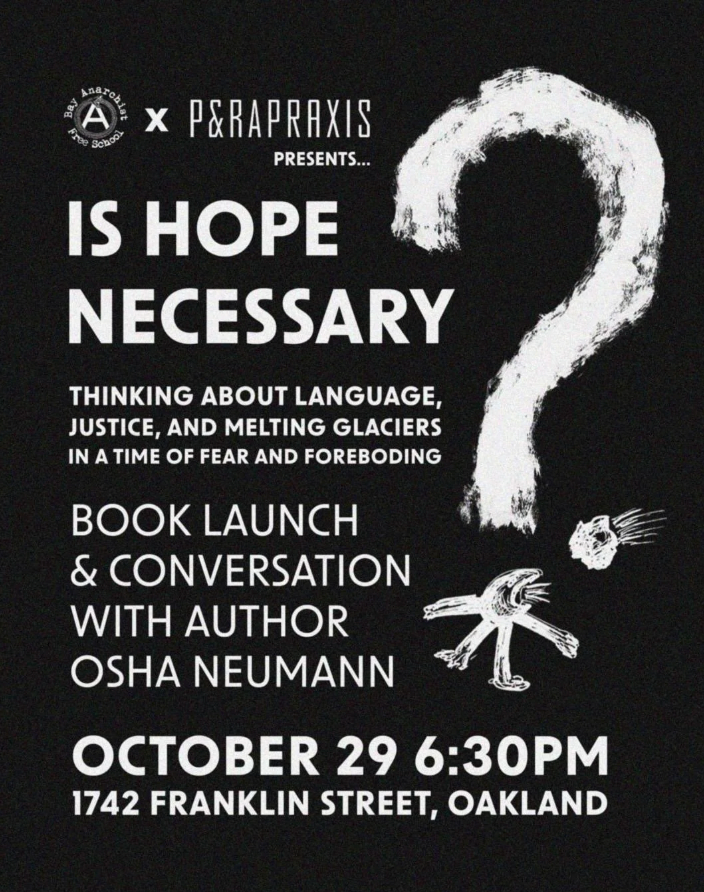
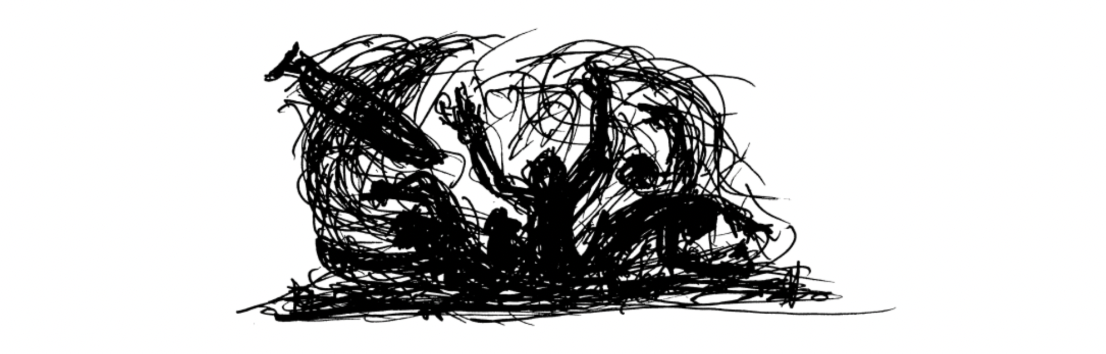
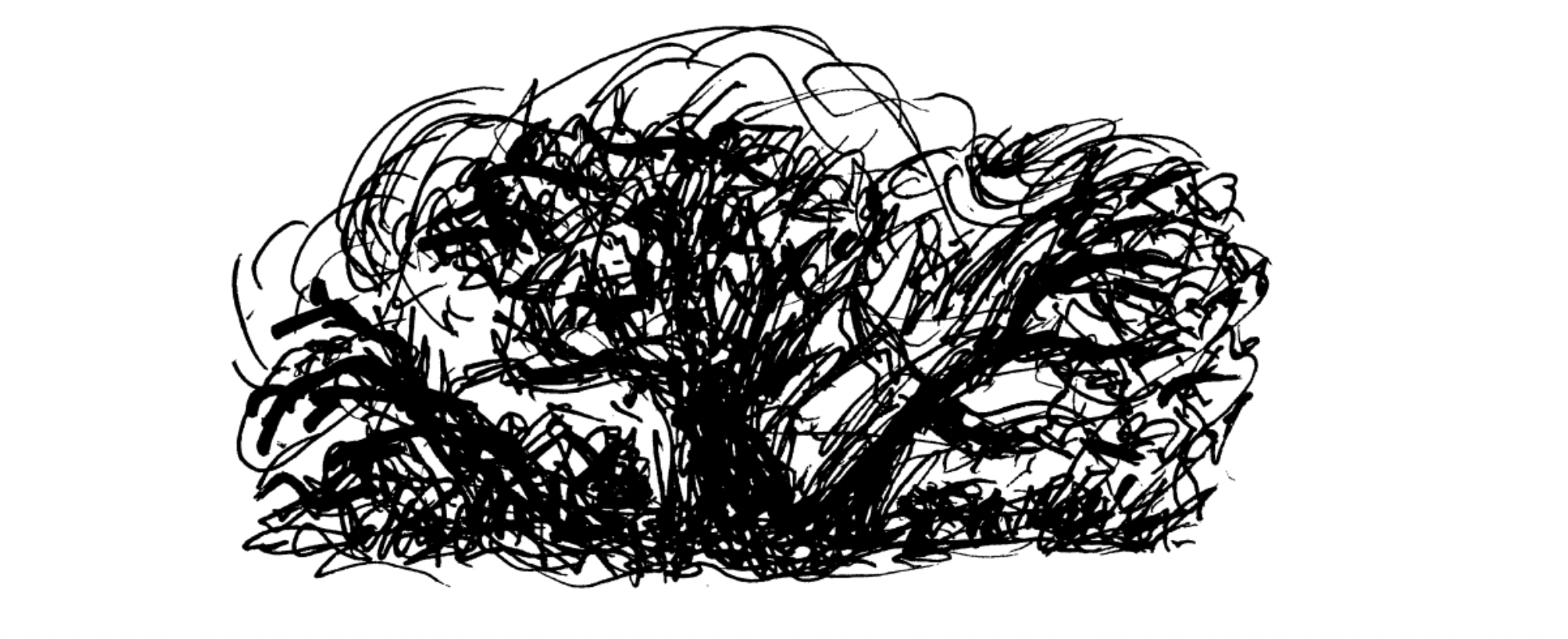
More recently, his protest has been writing. After his 2008 memoir Up Against the Wall Motherfuckers, he self-published Doodling on the Titanic (2014) on making art as the world burns. He extends those threads in his third book, Is Hope Necessary? Thinking About Language, Justice, and Melting Glaciers In a Time of Fear and Foreboding, a beautifully-designed essay collection—filled with Neumann’s own sketches—on how to live, politically and existentially, in these times. This time out, Neumann will be using a novel approach to distributing his book: it will be sold by homeless vendors who work with Street Spirit on the streets. (This is also how I distributed my first novel, Eastern Span, back in 2019.)
The book will be available on street corners in Berkeley and Oakland starting October 23rd, and there will be a book launch at Parapraxis Books (1742 Franklin Street) on October 29th at 6:30 p.m.
I called up Osha sometime in early June. My newborn daughter was seven weeks old at that point, and she had been sleeping well, so I’d just come out of the blur of this new reality. He congratulated me and in a high-pitched exclamation that exuded the life enthusiasm that he’s always shown said how wonderful it all was. Then we got into the rest.—Rick Paulas
\O/
Rick Paulas: So, I’d gotten some texts from Alastair [Boone, editor of Street Spirit] telling me about your new book.
Osha Neumann: It’s getting ready for print. That whole process is really interesting. That’s where I’m at. Plus, events are happening so fast these days. The book was mostly written before Trump’s second term, and I thought, “Shit, I have to write about fascism and what’s going on.” I finished up that and got an edit in, but now I have to stop. I can’t keep adding new things as the world turns.
There’s some artist who famously said something like, “art isn’t doing the thing, it’s knowing when to stop.”
Usually what happens with books is you send it off to the publisher or the book designer and they say, “okay, that’s it. You got to accept what it is.” I’m at that stage now.
Tell me a little bit about the whole project in general. How long have you been writing it, what’s it about?
I started the first draft in the first Obama administration. You know, I’d have conversations with people—homeless people, whatever—different people who’d all say, “it’s all over.” There was a sense of doom. Something so different from the 60s, when there wasn’t necessarily optimism, but a sense that there were possibilities. People say things now that felt hopeless, so I wanted to write about that. Basically my feeling is that we have to keep doing the shit we’re doing, whether we’re hopeful or not. We have no choice. What is the alternative?
It’s the old pessimism of the intellect, optimism of the will.
That Gramsci quote fits into the whole idea, but then, you know, I thought, well, how is it that we’re in this place? You can talk about capitalism, but why do we have capitalism? Capitalism is absolutely the problem, but why is that where we ended up? Where did we begin to get to the point where we were having societies with rich and poor, and states with great conflicts, and slaves and masters. How is it that we are separate enough from nature that we see it as the other?
It’s even hard to find language adequate to our situation. I have a whole section where I read these environmental people, like James Hansen and Bill McKibben and Greta Thunberg, and none of them have a good analysis of what’s going on and why and what needs to change and how to change it? I have a section about reading The Communist Manifesto as the planet boils. Marx said we were going to have the rise of the proletariat, and get rid of capitalism and we’d have Communism, but it didn’t happen. So why didn’t it happen? And I have a section about reading Herbert Marcuse, who happens to be my biological father, so I wrote about him and his answer on why the revolution didn’t happen.
I wrote all of this shit, then we have Trump’s second presidency, and it’s like, fuck, we have fascism.
How did you get the idea for how to distribute it?
I talked to Brad [Penner, then-editor at Street Spirit] and he said, let’s publish it. The idea of this crazy book and the homeless folks selling it on the street brought everything together. It’s wonderful for me. That really made me feel really good.
When I did it with Eastern Span, it made the whole project come alive in a way that I don’t think it would have otherwise.
It’s great. Fuck the publishing system. You have to get an agent, it’s so hard to get anything published. The other thing is, it takes forever before they’d actually do it, and I feel a real urgency to get this out.
I forget when it was that you retired from the [East Bay Community] Law Center.
It was two years ago.
So besides the book, how have you been filling your time?
I’ve kept doing a level of law and working with this organization, Where Do We Go? I have all these personal relationships, and those don’t go away. That’s all still there in my life, just I’m 87 now, and given my various ailments and maladies, I’m not doing that lawyer shit anymore. I haven’t gone into court in awhile, and that’s just fine. I much prefer thinking the way I was just talking rather than thinking like a lawyer. It’s too constricting for me.
You were talking earlier about the sense of hopelessness, and what’s interesting is here where I’m living in New York City, there’s been an upswell in hope over the last year or so.
Yeah, Zohran Mamdani.
My question is, what’s the vibe like in the Bay Area?
People are a little shell-shocked. What happened in Minneapolis has been really inspiring. We can fight back and will fight back. People are ready for the fight, but I don’t know if they have a lot of faith in the democratic process, the electoral process. Maybe it’s just the circles I travel in, but they’re not much into electoral politics, and they’re very dismissive of where the Democratic Party is now. It has the left wing of Rashida Tlaib and AOC and Ilhan Omar, but they are not empowered. Plus the Democrats, when it comes to Gaza, just look where they were at, and still are mostly. And Gaza is not just a sideshow. You can’t be progressive now or imagine how to make this world different unless you deal with that.
On the one hand, people are doing all the shit and keeping their shit together, there’s a whole lot of organizing happening around homeless people. Wood Street Commons, all that stuff. But when it comes to imagining a movement powerful enough to make the kinds of changes we need to make in this country, I don’t know people believe that.
I’d say even here while there’s a certain optimism... I mean, you see changes on a local geographic level. Just walking the streets is different. There are bike lanes up in new places.
That’s not happening here. Berkeley is so gentrified and so conservative, and how they treat homeless people is an example of it. Oakland isn’t much better. Barbara Lee is the mayor, but she’s not really been effective. If you’re anti-homeless and you can’t see the importance for the need for a sanctioned place for people, and your only approach is to sweep encampments and offer these fucked-up services, to me you’re not progressive. You’re not going to be able to deal with the fact that you have this insane housing market and real estate is insanely expensive and rents are insanely expensive… except, I really think we’re heading for the bottom dropping out, and that will change shit. All these realtors who are putting up high rises and charging insane rents and wanting homeless people out, they may not find people who can move in. I think we are heading for a real crisis of capitalism.
In terms of Mamdani’s success here, you saw it come from a DSA infrastructure that’s been built up here, and also perhaps an ease of doorknocking in a way that doesn’t seem possible in California.
Yeah, we have a DSA here, but it isn’t electing people in the same way at all. DSA put out a voter guide [for the primary election] but there wasn’t anybody they wanted to endorse for governor. Their whole position was, we don’t think any of these characters are good.
Okay, one more question. With the book in mind and the message of hope in a hopeless world, or however you’re looking at it—
The message is, we have to keep doing this shit! Hopeful or hopeless, we have to keep doing it. And we will. People are not going to stop. I mean, the arc of the moral universe does not in itself bend toward justice. We have to bend it. And even if we end up not bending it, we can bend it just enough so we get a little bit more of it, so we can save some lives and some of the beauty, and some of the joy and some of whatever we need. That’s the only way it’s going to happen.
I have a seven-week-old daughter, and so I’m thinking about all this generationally now. What kind of message would you give her when she’s in her, say, teens?
That there may not be a wonderful way to live the life you’d want to in this world. We can imagine a way of life, and we may not be able to live in it, but by engaging in the struggle, and being in the opposition, that’s the best possible way to live. That’s where joy is, that’s where beauty is, that’s where love is. And preserving that is absolutely worth it, no matter whether we end up winning finally or not. How beautiful it is to have comradeship and to be in the struggle!