Six people you meet in Oakland while reading Manuel Betancourt’s “Hello Stranger”

I picked up Manuel Betancourt’s Hello Stranger at the Alameda County Library’s New Nonfiction shelf, because I liked the title and was curious about the subtitle: “Musings on Modern Intimacies.” To have the words “stranger” and “intimacy” pushed together like that: What is that about? Is he just talking about a new version of FWB and NSA and all the other acronyms of hookup culture? On the other hand, I’ve been thinking for a while now (like a long while, like “moderating online groups in 2010” long while) about community building and its reliance on weak ties, in the anthropological sense, and along with that, the economy and capacity of our attention, and of how deep you can go with how many and actually sustain those as meaningful supportive connections.

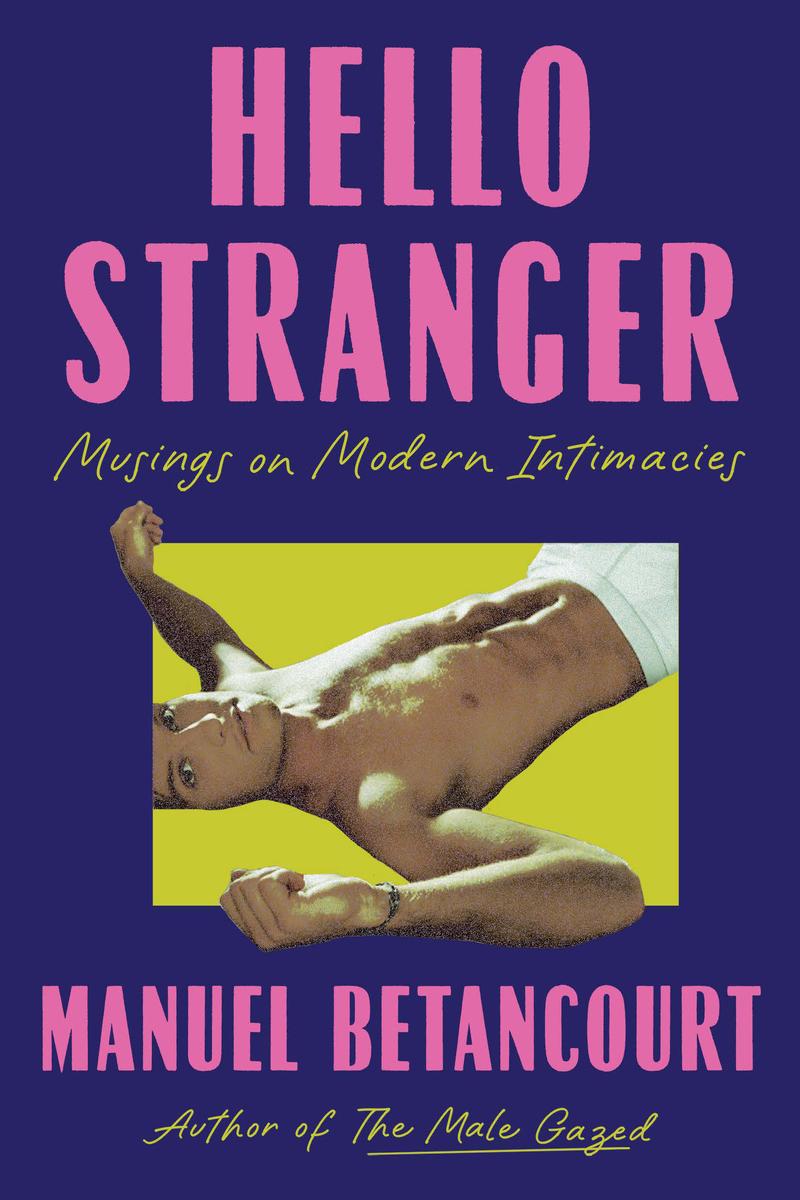
Despite the occasional eye-fucking that turns into real fucking in Betancourt’s work of cultural-criticism-cum-memoir-cum-cumming-theory-and-praxis, and his post-divorce romps through desire’s layers and facets, most of this book looks at all the intimacies that don’t fit into solid social categories, and which don’t end up becoming any recognizable form of established relationship, but which still matter. That was what was most delightful and thought-provoking for me about Hello Stranger. My favorite thing in the world is to run into people I know out in the city. And the best alternative to that is to turn people I run into into people I know. A place comprises both the environment and the people in it, strangers who through the sheer happenstance of living in one space start to cross paths until their desire lines are a mesh. We’re drawn into patterns of encounter by larger systems and forces of history and power, drawn into making some kind of sense of these knots in the weave.
This is also how books enter our lives—a book exists fully only once it’s reached a reader’s mind and meddled with it, made a new knot in their weave, a connection. And really the best way to fully absorb what Betancourt’s up to, at least as a reader unlikely to follow his path to polyamorous cuddle puddles on the playa (YMMV), is to go read the city I live in through the pages of Hello Stranger.
◎
Lucas, twining Algerian ivy vines around stakes into fencing along Sausal Creek. He didn't want me to take a picture of him even though his hands working the vines were so beautiful, because his point is not to aggrandize himself, he explained, but to do the work, let it stand on its own. And to keep the dogs out of the newly planted ecological zones. I watch his hands work, his arms threading through the web of twining vines to thicken it. I learned that what dangles from the oaks and bays in Dimond Canyon isn’t English ivy, but Algerian. The leaves are bigger. My son raced ahead, so I headed out.
◎
Betancourt: “[Simmel] suggested what made ‘the stranger’ such fertile ground for sociological investigation was the way it functioned as a synthesis of closeness and distance, of detachment and engagement.”
Betancourt: “[A]ll I had to do was pay attention. I had to be aware of my surroundings. Everywhere could be a cruising space if you were attentive enough.”
◎
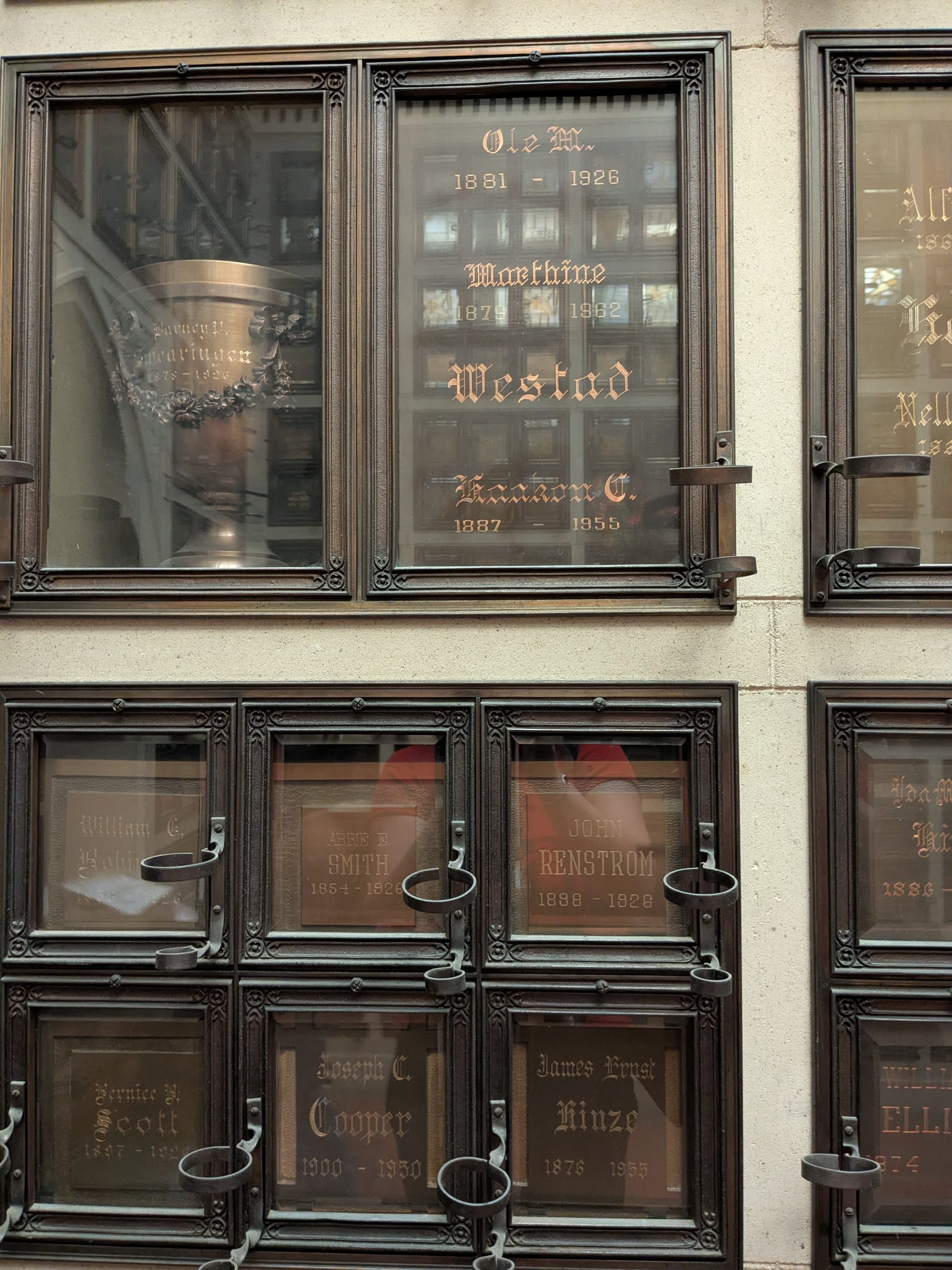
Dennis T., at the Columbarium. His grandparents are interred there. His father is at the Chapel of the Chimes. We were heading out on a drizzly day, having looked futilely at the Columbarium for my namesake great-grandmother. Dennis had retired and then, getting far too bored, decided to go work in maintenance at the Chapel of the Chimes so he could be close to his ancestors. That was about three years ago—his kids are grown, so this is how he feels close to family. He tells us, Just walk over to the chapel—they’re open, they can look it up. We do, and finally locate the Westad corner in the Chapel. All Blackletter labeled and permanent looking. Like we all have been here a long time.
◎
Betancourt, quoting Garth Greenwell: “Both poetry and cruising have a structure that is essentially epiphanic, offering the sudden, often ecstatic revelation of a meaning that emerges from the inchoate stuff of quotidian life.”
Betancourt: “[I]ntimacy is an emotional architecture whose designs help delineate the public and the private. What’s allowed within it is as important as what’s left outside. When you grow close to someone, you invite them into your privacy.”
◎
Getting on BART from The Mission, right around Dia de los Muertos, I saw a man in a fine cowboy hat playing guitar, a song I know, a song everyone knows, De colores....And Hermán patiently put up with my rusted Spanish so he could sing to me. The 74-year-old Salvadoran guitarist played folklorico songs just for me from SF to Oakland, with occasional entreaties for me to kiss him, received and deflected with the same gallant spirit in which they were offered. At some point, another man sitting close by decided to join the conversation, and that’s when I realized how much my connection with Hermán had become buttoned down, in those twenty minutes or so of making an effort to learn who he was and our shared commitment to try to overcome the trickiness of not having much of a shared language. I had learned he lived in Fruitvale, that he was done for the night, ready to go home, maybe more that I can’t remember now. I listened to him sing through the tunnel. Enough of a shared appreciation had emerged that it could be disrupted by this third voice—who was not trying to speak Spanish, who was dragging my attention away from Hermán for whom I then tried to translate, very badly, so he would be part of it, too. I noticed the ease of listening to and communicating with this man from the South Bay, who was perhaps more like me and for whom English was easy. I also saw Hermán retreat to his phone while I politely engaged the new person until I got off at my stop. I thanked Hermán for the songs, and I thought again of his elegant, large-brimmed white hat when I drove past Tierra Western Ware in Fruitvale a couple months later.
◎
Betancourt: “Simmel was...fascinated by the social possibilities of flirtation, especially when uncoupled from, say, seduction. There’s a gleeful aimlessness in flirting that, as he argued back in 1923, pushes back against the teleology we ascribe to romantic love.”
Betancourt: “Cruising has, over the last few decades, emerged as a kind of utopian practice that requires us to dream up more generative modes of relating to the other, to the stranger,” And quoting McCann’s Park Cruising: the “defining characteristic of cruising is its porousness. Cruisers show deliberate vulnerability toward strangers.”
◎
Walking home from BART that same evening I met Hermán, a man had fallen down into the street from the sidewalk on Park Boulevard, and looked like a drunk stretched out and faded. He reached up, asked for help—I walked by at first, but then, thinking of what it can mean to show up for the people around you in ways you can easily afford to offer, and how much I’d enjoyed talking with Hermán, I doubled back and helped him up and back into his wheelchair, and he told me about having epilepsy and a stroke. A stroke, he shared, brought on by drug use. There was more, about the woman he’d been with, but mostly we focused on the logistics of getting his uncooperative body back in the seat of his folding chair and all safely on the sidewalk. He was so shaky. I can’t remember if he gave me his name. I hope I asked. He lives in a halfway house now, and he was a neighbor just trying to get by and get moving on his own. And he was so on his own, so down and out.
◎
Betancourt: “[Samuel R. Delany] understands the distinct aspect of cruising, as ‘contact’ rather than ‘networking.’ This is why cruising is a concept inextricably linked with urban planning for Delany. Cruising is a practice that flourishes most acutely in densely populated areas where public spaces allow for such encounters to happen. The cruiser is an attentive observer of the urban world. And a rather active member of it as well. He moves through spaces with wide-eyed conviction that what he’s looking for is out there, ready and willing to be enjoyed. What could we gain, then, by being open and opening ourselves up to strangers this way?”
Betancourt: “Friendships are sinuous and slippery. They can be short and intense or lifelong and comforting....This is why friendships can feel more expansive than romantic or familial relationships; the fact that they can’t be easily described means they also can’t easily be constrained or constricted. They can balloon out of your life with the swiftest of winds or they can grow heavy enough to anchor you to the ground.”
◎
Danush was wearing an A’s hat and sitting in the couch nook at Local Economy, a coffee shop/shoppy shop/community gathering space. I overheard him saying he was a new member, and so I went up to say hello because I think (I said to him) that a friend had told me their friend Danush had joined in. But I couldn’t remember who. I still can’t. So instead we started listing out neighbors and neighborhoods, where we worked and all in all, we ended up with a colleague of his two doors down at LBL who worked in the same lab as my husband a decade ago, and finding out that his parents are from the same city a few continents over as my in-laws. And then he remembered that we’d chatted at the ORB holiday party at LE, which I’d forgotten, and we talked about how much we both admired Arundhati Roy’s outspoken, empathetic politics, because he’s reading her new book—the one that my husband just gave me for Christmas. So in the end perhaps we’d never been strangers at all, just people about to meet again and recognize each other.
◎
Betancourt: “We are social beings and thus our sense of self is constantly being interpellated by others; there’s no way to know oneself without the help of other people.”
Betancourt: “What better way to find (or forge or excavate or illuminate; you pick whatever ontological metaphor works best) than to find new people—strangers, more like—who could and would see me in a different light? And thus, who would make of me something I’d not yet become.”
◎
A couple weeks later, back along the same path at Sausal Creek, it’s dusk and my children and I reached the oyster mushroom tree that was our destination, and it’s already been scraped pretty clean. Our small delicate early season harvest was it. So it goes. We turn back into the gloaming, cones and rods doing their best to make shapes in the dark so we don't slip and fall. And hey, there’s Lucas, with a spool of sisal twine, talking to someone else. I say hello, he recognizes my son, who is, again, booking it to the car (“You are too social, Mama! you have too many friends!”), and we talk mushrooms for a minute, then he beckons me over, come here, there’s rainbow trout in the creek! He shows me two little slivers of silver ducking into a broken pipe to hide from his flashlight and our splashing feet. There’s fish in Sausal Creek! I saw them! Because Lucas did, and shared what he knew with me.
◎
Betancourt: “Flirtation hinges on a moment where your life could suddenly splinter into any number of outcomes, into any number of stories. Flirtation, thus, is a site of possibility; it’s a kind of suspended state of animation where your world sits at a standstill.”
Betancourt, on Closer: “Maybe this isn’t a film about the fun act of flirtation, about reveling in the possibilities of meeting strangers, about the exciting ways you can find yourself in someone over and over again....Maybe it is, instead, a piece about how the search to be seen and loved and desired and coveted solely by strangers is (and always will be) a futile way to maintain any semblance of a coherent self.”
◎
Hello Stranger, the clubby bar in Downtown Oakland, is very empty on a Thursday. Drink a glass of wine that might’ve tasted good if there were food, or company. I'm the only white person here, until the white girl bartender with amazing cat-eye eyeliner comes in.
On my phone, catching up on emails. Bruno from Hayward says he likes the bandana catching back my hair. Wonders why I'm here alone. I try to explain vibe reporting. He makes another attempt, I think you're really pretty. Aw, sweet move—I am also the only woman sitting by herself in here and he’s seen me only from the back until that point. I'm married with two kids, I tell him, and he fades away. Braces and all.
Weird fucking layout in this place. Eight bar stools, a long slot of a building, some booths that say “table service.” It is a bar that only makes sense if it is full and people are packed in to dance (etc.). Tonight it’s an empty bummer, especially when a guy sits down near me, props up his phone on the bar, and watches TikTok. So I pay up and head out, walking by two of the folks who had been inside, they're sharing a cigarette, laughing, having a great time. Opposite of my mood.
I smell something good just past them and am very hungry, so I walk down to the guy frying chicken. He gives me a free sample to try, and it is amazing, so I give him a twenty for more and there's a ten-minute wait, which is fine with me. I start asking him questions, but it's not fair to treat this as one of the stranger encounters because he's in a service position, we’re in the middle of a transaction, and it’s emotional labor (meaning the original, real definition, as explained on this chart, not the “I feel obliged to remember to buy a present for your mom” social wheel greasing too many women take on), but just so you know, his name is Lamar, and he started cooking because his mom worked a lot, so he spent a lot of time with his grandmother, who is from New Orleans. He has stuffed the chicken with mac and cheese and greens, then breaded and fried it, holy god. He is from Oklahoma City but has fam in Oakland and they said, Come to Oakland if you want to make it in food; people here in Oakland know food. If you can make it here, you can really get it going. He wants to expand: San Jose, Las Vegas.
But there's another group of people waiting for their food, and one woman is joshing with Lamar the chicken man, and I'm getting a kick out of it. Her to him: “So are we like building a friendship or am I just a fan?”

Joanelle sees me grinning and listening and starts to talk to me. She asks how I'm feeling. Well, how Becky is feeling. I'm like, I'm having a good time now! I was at Hello Stranger and the vibes were not good. But this is better!
Joanelle says you have to go to bars with programming during the week. She and her friends went to Theory Bar, where there was R&B bingo, and they won! Hello Stranger is good for dancing on the weekends, when they have guest DJs. People really turn out for that. Sometimes it gets too crowded—she likes having room to move.
She asks, what flavor of white are you. I list off all the European countries that came here and married each other to give me this here & now. “I'm Irish too!" She says, “Do you believe me?” I do, I tell her, I believe it!
She says she knows she's getting wiser because her kid’s dad texted and she just turned her phone over instead of responding. She's 27, was married at 21, divorced now. Missed all the partying, and after going a little too hard on the back end trying to make up for it, is trying sobriety. Ready to meet her second husband!
She’s from Oakland, lives in Antioch now, “like so many people from The Town." And, I add, same thing in Sacramento. “I love Sac!" she says. Tells me, in The Town, the real vibes are out on the street.
My chicken is ready! I pack it into my carrier on my bike, get home. I flourish my prize to my husband, Do you want stuffed chicken? YES!
◎
Betancourt, on Frank O’Hara’s poem “Homosexuality”: “The joy of a summer’s day for O’Hara necessarily required scouting the scorching streets of New York City for a throng of boys eager to see and be seen, to feel and be felt, to want and be wanted.”
Betancourt: “A flaneur just looks, but a cruiser notices invitation, and then reaches out to touch.”
◎
Isn’t belonging, in the end, a feeling of being wanted, of someone welcoming you in, saving you a seat, showing you the way, leaning in to hear what you have to say, sharing their treasure, trusting you to help, inviting you to talk, offering you chicken, taking the chicken you offer. Being known both as you already know that you are and seen as a splintering of possible future selves, someone who is becoming part of a street scene, a habitat, a public, a place.
Hello Stranger: Musings on Modern Intimacies
Manuel Betancourt
Catapult; 240 pp; January 2025