Can Oakland have a Zohran of its own?
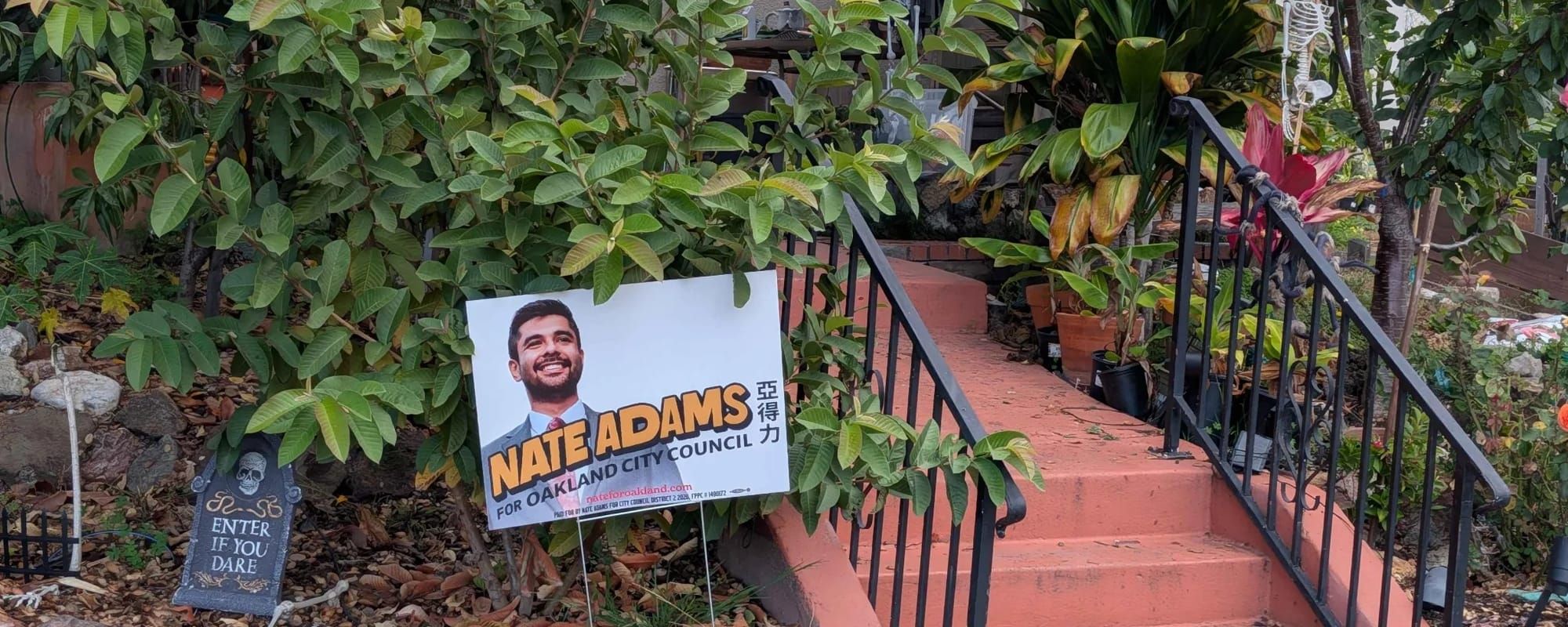
When I meet Nate Adams for coffee on a sunny morning in Cleveland Heights, he is looking the part. The democratic socialist running for a seat on Oakland’s city council is dressed in a charcoal gray suit and floral red tie. His dark hair is parted. His beard is faint but neat.
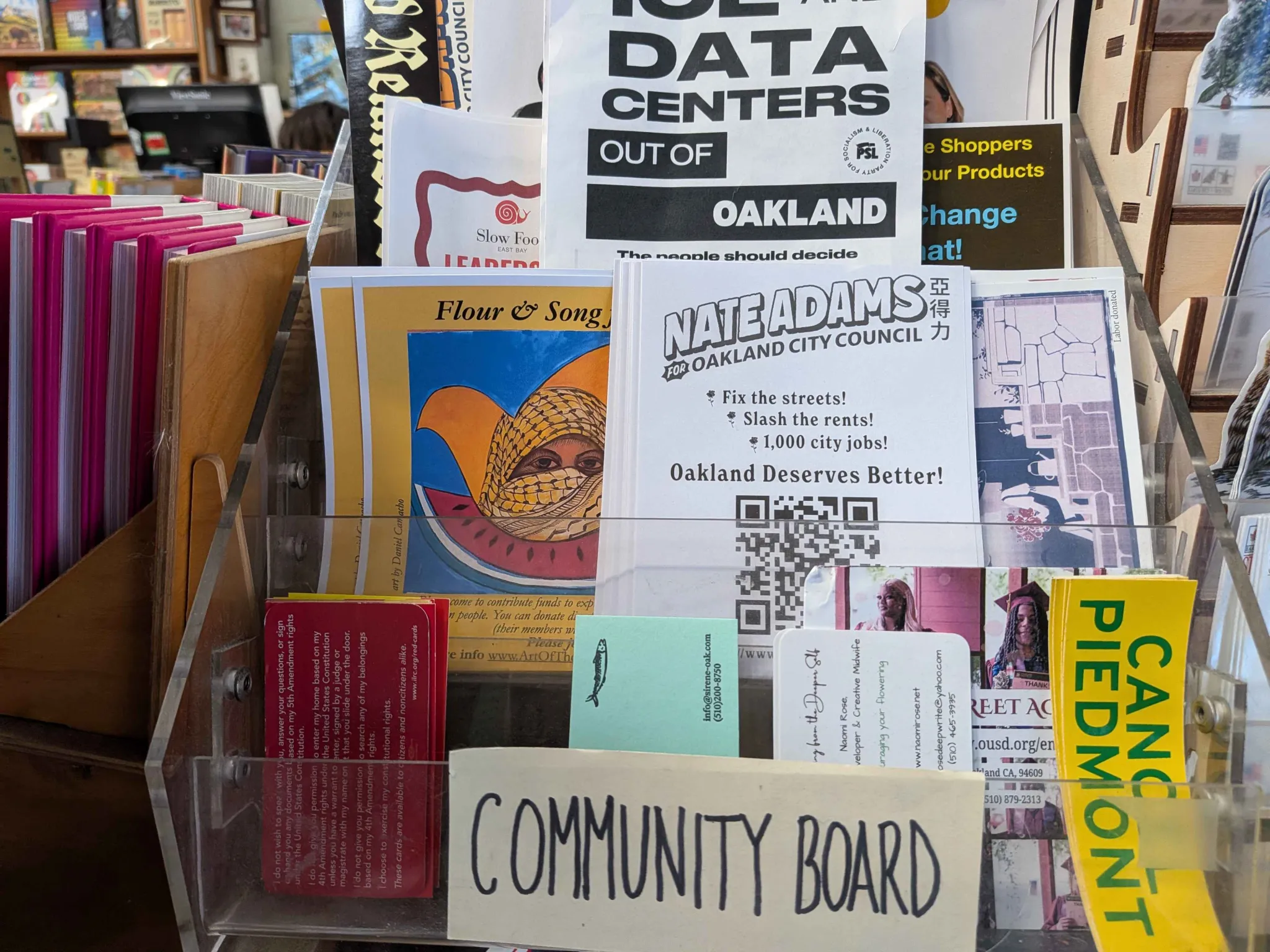
“You can’t really escape it,” he says. He means the comparison he’s received to New York City Mayor Zohran Mamdani. I try not to laugh, because it seems to me that Adams is less interested in escaping the comparison than he is in deliberately evoking it. His campaign has a warm-hued retro comic book–style typeface, and it’s built on a platform with three signature, easy-to-remember policy proposals: “Slash the Rent, Fix the Streets, 1000 City Jobs.” Sound familiar? Then there’s Adams himself. Like Mamdani, he is a bright, handsome, besuited young man of color (Adams is Japanese on his mother’s side) casting himself as a happy warrior in the fight for the dignity of working people. At 29, he’d be the youngest councilmember in Oakland’s history.
If the campaign branding seems a little copy and paste, one can hardly blame him. After all, the prospect of an Oakland Zohran is the reason I’m sitting with him in the middle of District 2, where Adams thinks he can upset the incumbent Charlene Wang, a former Biden administration appointee who won a special election for the seat last year. Since Mamdani shocked the world in his primary win in June 2025, fellow democratic socialists were elected in Seattle (Katie Wilson), and they are the presumptive mayors in Washington, DC (Janeese Lewis-George), and Providence, Rhode Island (David Morales). Nithya Raman has a shot in Los Angeles as well. By the Brookings Institution’s reckoning, 123 candidates backed by the Democratic Socialists of America this election cycle have won primaries at every level. In seemingly every city around the country, socialists and fellow travelers are searching for their local Zohran.
 Oakland Review of Books
In the Bay, the insurgency is subdued. (The notable exception is Richmond, where DSA member and city councilmember Claudia Jiménez is the favorite to be mayor.) San Francisco held onto one socialist on the board of supervisors when Jackie Fielder won a seat in 2024. In the same election, Dean Preston was bounced, and City Hall was taken over by the moderate establishment. The left has not fared much better in Oakland, electorally speaking. District Attorney Pamela Price and Mayor Sheng Thao (neither of whom was DSA-affiliated, but both of whom came from the left) were recalled by 20-point margins in their first terms—but not before Thao was indicted on federal corruption charges. Barbara Lee finished Thao’s term after she staved off a challenge from the same revanchist formation that ginned up the recalls. Lee has no formidable challenger this cycle, but she’ll oversee an austerity budget after voters in June rejected a measure which would have raised taxes to fund basic city services. Moreover, the lack of an opponent suggests that Lee’s tenure has been tolerable for the recallers. (Maybe more than tolerable: Over the summer, the Oaklandside reported that Lee was talking with one of the key recall funders, Isaac Abid, a real estate developer, about starting a downtown development corporation; it was launched last month, with Abid’s wife, Puja, as CEO.) And looming over all of Oakland politics is the specter of Thao’s trial, which began last week.
As I lay this all out before Adams, he zeroes in on the failed tax increase, known as Measure E. It was voted down less than a month after he launched his campaign. As he knocked doors, he heard the same thing, again and again. “‘I’m paying so many taxes and I’m not seeing any services being delivered. There’s still trash in the streets. There’s potholes all over the place,’” he recalls people telling him. The pragmatism of the “Sewer Socialist” mayors and city councilmembers who ran Milwaukee through much of the first half of the 20th century is often invoked in present-day discussions of the DSA. Mamdani recently spoke about the importance of reclaiming ideas like efficiency, waste, and quality of life from the right, an idea he has called “public excellence.” Adams’s version of this is “effective governance,” a phrase he repeats no less than seven times over the course of an hour. “A lot of people don’t trust our city council or trust our city governance. So for me, it’s a question of taking care of our basics,” he says. He’s been nerding out on the minutiae of trash pickup and the state of Oakland’s sidewalks. “When we have infrastructure that is well maintained, it tells us how to treat our city,” he says. “When there’s trash on the street, that tells people how to treat our city.” Broken windows, but leftishly.
If effective governance is one guiding principle of the Adams campaign, organization is the other. Organizing helped him make sense of his life, he says. He was raised in Sacramento by a single mom, a state government worker whose father had been incarcerated during the Second World War. Adams grew up in the Evangelical church, and the exclusion he felt as a self-described queer man provided a lesson: “If any of us are left behind, then we’re all left behind.” But his politics weren’t clarified until he found himself in an economics class at UC Berkeley, taught by the former Clinton administration labor secretary and public intellectual Robert Reich. Reich presented a series of graphs. One showed decades of soaring corporate profits; the other displayed how wages had completely stagnated over the same timeline. It gave Adams clarity. This is why he and his mom had to keep moving from rental to rental, no matter how hard she seemed to work.
When Covid hit he joined the Emergency Workplace Organizing Committee, a project started by DSA during the pandemic. There Adams saw everyday workers forming organizing committees, escalating their demands, and winning concessions from the boss, even without formal union backing. “It was like, oh, that’s real power,” he says. He joined East Bay DSA, became a paid staff organizer, and eventually served as the chapter’s cochair. Like Mamdani, this makes Adams a “cadre” candidate, as opposed to politicians who may join the DSA and run with its endorsement but weren’t politicized within the organization.
Adams believes that organization, or a lack of it, is behind much of The Town’s political malaise. It’s an urgent problem, he says, because “there actually is a group that is very organized, that is becoming more and more organized.” That is the alliance of real estate developers, big tech and finance executives, and police union lackeys that is pushing politics rightward on both sides of the bay, largely through scapegoating the left. The most prominent on the east side is Empower Oakland, an organization founded by former councilmember and two-time mayoral runnerup Loren Taylor. “Elected officials are too scared to fight for Oakland,” Adams’s campaign website declares. “Too scared of corporations, too scared of big money developers, too scared of tech lobbyists, and too scared of Empower Oakland.”
\O/
The immense power of the tech sector—its wealth, its concentration in the Bay Area, its pronounced rightward shift over the last decade, and its relatively recent entry into the local political scene—is the first of several factors that have constrained the possibility of a Zohran-style candidacy in Oakland or San Francisco. Empower Oakland is a mirror image of GrowSF, the most prominent of the new tech-backed political organizations in San Francisco. Their presence is inescapable; every registered voter in either city gets their voter guides, which come with their handpicked endorsements. These pressure groups present as community organizations formed by concerned neighbors, even as they are financed by some of the wealthiest people in America. Where they are most effective, says Jeremy Mack, executive director of the dark money watchdog group The Phoenix Project, is in controlling the narrative.
Over the past five years, “the astroturf network” as The Phoenix Project terms it, has been able to knit together a story about civic decline in the Bay Area. “San Francisco is a shadow of its former self, and that really has to do with the permissiveness of certain members of the board of supervisors as well as the district attorney’s office,” one of the astroturfers’ main mouthpieces, Sam Singer, said in 2022 in a typical rant. “They’ve created a situation where there are no consequences, and when there are no consequences of doing wrong, wrong just proliferates, and right now it’s out of hand.” The trick is directing the indignation that people feel in the face of social disorder toward the effects of the crisis—property crime, people priced out of housing and living on the streets, and so on—instead of its causes.
This lends itself well to the mechanism that they have found most effective for political change: the recall. “If there was a Zohran figure in either San Francisco or Oakland, the recall would be filed the moment they begin,” says Shanti Singh, legislative and communications director at Tenants Together and a member of San Francisco DSA. The recall inculcates a form of “antipolitics,” another impediment to left insurgency in the Bay. It’s a lot easier to say this guy sucks than to campaign on an affirmative vision, and the consequences can be corrosive for local political culture. “When you’ve spent so much time with a flashlight under your chin saying nothing works, everything’s corrupt, and public services aren’t worth it, what do you expect when you ask people to vote to pay more money to fund public services?” says Singh.
Singh also pointed to another older and more structural reason that there is no Bay Area Mamdani: the state legislature. A potential mayoral candidate could use a state senate or assembly perch as a springboard, just as Mamdani did for two terms representing parts of Queens in the New York Assembly. But California’s particularly unrepresentative legislature makes that more difficult. The state has had forty senators and eighty assemblymembers since 1879, even as the population has grown by tens of millions. That means the average California assembly district is around five times the size that Mamdani’s was and would require a level of resources and fundraising that is more comparable to a congressional race, and far higher than a grassroots socialist candidate would need to win a district in another state.
In addition to a dramatically imbalanced state legislature, the Bay suffers from a problem of fragmented geography. As opposed to New York City, the region is sliced up into nine counties and 101 different municipalities, even though many people may live in one and work full-time in another. This “balkanization” is “a major structural constraint against having a big flashy breakthrough electoral moment,” says Justin Gilmore, a political scientist at California State University, Stanislaus, and member of East Bay DSA. The decades-long displacement of working-class populations out of San Francisco and Oakland into the further reaches of the region like Antioch, Modesto, and Stockton, is also a factor. “There’s a tricky arithmetic for electoral projects because of the mismatch of municipality and class formation across the entire Bay Area,” says Gilmore.
Finally, we have to talk about the politics of homeownership in California. In the late 1970s the activist Howard Jarvis led a homeowners’ revolt against property taxes, culminating in the passage of Proposition 13, which severely limited how much a municipality can raise from those taxes. By tying net worth so closely to property values, Prop 13 helped make California “older, less mobile, less dense—and therefore less easy to organize—and more tied to the status quo,” says Jake Grumbach, a political scientist at UC Berkeley. Though there are different routes to progressive taxation, there are a number of political obstacles downstream of Prop 13. If a hypothetical socialist politician were to be elected, their ability to pass policies backed by big public expenditures would be curtailed by Prop 13. If they tried to repeal or weaken it, or foreground renters the way so many of NYC-DSA candidates successfully have, they might risk alienating a portion of their coalition. (Oakland is 56 percent renter, a slim majority; New York City is a stronger supermajority at 67 percent.)
Yet that may be what’s necessary for a breakthrough. One consequence of a policy like Prop 13 is that it’s created a generation of Californians locked out of homeownership. As noted in a recent newsletter from the Bay Area Current, an East Bay DSA–affiliated publication, there is untapped potential in organizing a coalition on the basis of who pays rent. For proof of concept, one can look at Los Angeles, where Nithya Raman had been so successful at mobilizing tenants that her rivals on the city council were caught scheming about how to redraw her district so she’d have fewer of them. If Prop 13 was a homeowners’ revolt—what Mike Davis called “the Watts Riot of the middle class”—Singh proposes that the Bay Area left counter with a renters’ revolt. In the midst of Mamdani mania it is easy to forget that the first plank of his platform was to freeze the rent, she says.
These factors have all informed the political strategy of the region’s DSA chapters. East Bay DSA does run candidates—Adams is one of seven endorsements the group has made this cycle—but its focus has been more on extraparliamentary campaigns: assisting striking workers, base-building through labor and tenant organizing, and lobbying institutions to divest from Israel. “Voting patterns and voting bases are very fickle,” says Gilmore. “Historically what has cohered people to voting a certain way has been organizations. Whether those are political parties, cultural organizations, associations, labor unions, the Black church—it’s these dense networks of relationships,” he says. Another initiative East Bay DSA has taken on is the formation of “a popular left-wing culture,” through projects like Current, where Gilmore is an editor.
The internal politics of respective DSA chapters also matter. Every chapter is steered toward a different electoral calculus based on the composition of the leadership and membership at any given time. (In an extreme example, Morales, the democratic socialist mayoral candidate in Providence won his primary without an endorsement from Providence DSA.) Which brings us back to Adams, nursing his iced coffee on the sidewalk patio. I’d heard rumblings that the idea of Adams’s candidacy had faced stiff opposition within the chapter. He concedes that it’s true, and at this point in the conversation, I agree to turn my recorder off to allow him to speak candidly about the chapter’s internal debates.
One good reason for healthy skepticism is that his opponent Charlene Wang beat a challenger from the left by double digits in the special election last year. Another is that in that race, Empower Oakland “went all-in” for Wang, but the group hasn’t spent as much against Adams, which means it might not see him as all that much of a threat. Still, Wang has outraised him about three to one. “I’m outfunded by my opponent, but the thing that we have is people,” says Adams. Field operations are the hallmark of DSA campaigns, and Adams contends that his can close the gap. He rattles off the numbers: 300 field volunteers have knocked over 10,000 doors; they’re making 2,000 phone calls every phone bank. He’s also picked up important union endorsements from SEIU 1021 and the Oakland Educators Association, which provides more volunteers on the doors.
And he thinks Wang is more vulnerable than it may appear. She has made “massive missteps,” in the short term. He points to her support for Flock surveillance cameras, the all-seeing eyes of our Silicon Valley overlords that have been hailed as a technological breakthrough in crime fighting, but that everyone in America seems to fucking hate. As chair of the council’s public safety committee, Wang leads policy on the city’s relationship with Flock. And while she has said that she added pioneering safeguards into the city’s contract, the contract is in a mysterious limbo, which would make those safeguards null and void.
Wang, for her part, has attacked Adams on public safety, arguing that District 2 needs experience and what she frames as a hardened realism regarding crime, particularly on the stretch of International Boulevard that is the site of much of the city’s sex trade. Wang pushed through a number of temporary street closures designed to thwart buyers in the area. It’s a strange sort of “realism” that drives sex work more deeply underground, or simply to another block, but also a reminder that so much of the common sense surrounding crime is shaped by the desires of small business owners, a powerful constituency in the heavily commercial district.
In this respect in particular Adams is working against the grain. He mentions that he recently read the book The Riders Come Out at Night, Darwin BondGraham and Ali Winston’s investigation into the gangbanging Oakland Police Department of the early 2000s. The infamous Riders scandal landed OPD under federal oversight for 23 years, which ended after a judge’s decision last month. The need to strengthen systems of accountability for a historically corrupt police department is another tally on the long list of challenges facing city government. The same goes for NYC, where Mamdani thus far has shrunk from taking on cop power.
Perhaps a better analogy for Adams is not the Mamdani of 2025 but the Mamdani of 2020, when he narrowly defeated an incumbent to win a seat in the New York Assembly, when democratic socialists there were still building up both the electoral muscle and a broadly left-wing culture that could nurture it. The one needs the other. That’s how seemingly discrete issues—Flock cameras, tenant rights, police reform, a more humane policy toward the unhoused—get bound together into a coherent movement. It’s not as if Oakland lacks the material conditions that socialists have historically sought to address. “We’re in a state where everyone is a passive observer of a system that we all feel is in decay,” says Adams. “If we ever want to win transformative policies, whether on the local level or on the national level, it can’t be through just voting. It has to be through building power through our neighborhoods and through working people.” The challenge is political, as it always has been.
\O/
Eamon Whalen is a writer and reporter in the West Bay.
Find our voting guide here.