OAK vs. SFO: What the airport naming death match was really about
.jpg)
It’s Vibes Week, the last stretch of our “Six Senses of Oakland” membership drive. If it’s cool with you, we’re gonna just chill for a bit, maybe let things spill over into a second week, who knows. Read more about the drive here. Check out other Six Senses stories here. Bask in ORB’s inner light by subscribing here.
◎
The conclusion of the blitheringly stupid legal battle between San Francisco and Oakland International Airport was, depending on who you asked (and how closely they read the coverage, or if they read it at all), a victory, a defeat, or a stalemate.
If you haven’t heard, in 2024, amid disappointing traffic and some bizarrely widespread bad press coming out of the nearby In-N-Out, Oakland Airport renamed itself “San Francisco Bay Oakland International Airport,” and then later “Oakland San Francisco Bay International Airport.” In response to this factually accurate rebranding, San Francisco sued, claiming the name change would confuse travelers and unfairly “capitalize on San Francisco’s brand.”
After the two sides hammered it out in court, a federal judge ruled that Oakland could retain “San Francisco Bay” in its title so long as it put “Oakland” first (as it had already decided to do) and excluded phrases like “San Francisco Airport” from its ad buys. As is customary with civil suits, both sides declared they had won, though perhaps to some glib West Bay observers, what was more important is that Oakland didn’t get everything it wanted.
Regardless of its declared motivations, San Francisco’s legal challenge was always less of a public service than a pissing contest in a courtroom. As locals know but visitors are so often surprised to find out, SFO isn’t in San Francisco, either. The airport of the city that is seven miles in either dimension is a solid twelve miles from that city’s nearest edge, in an area of San Mateo County so remote that the land is unincorporated. For that reason alone, San Francisco’s insistence that it and only it could ever use the phrase “San Francisco”—let alone the phrase “San Francisco Bay”—was legalistic without being grounded in reality. In that sense, it was also only the latest attempt to undermine OAK’s geographic advantage with some chintzy bullshit.
◎
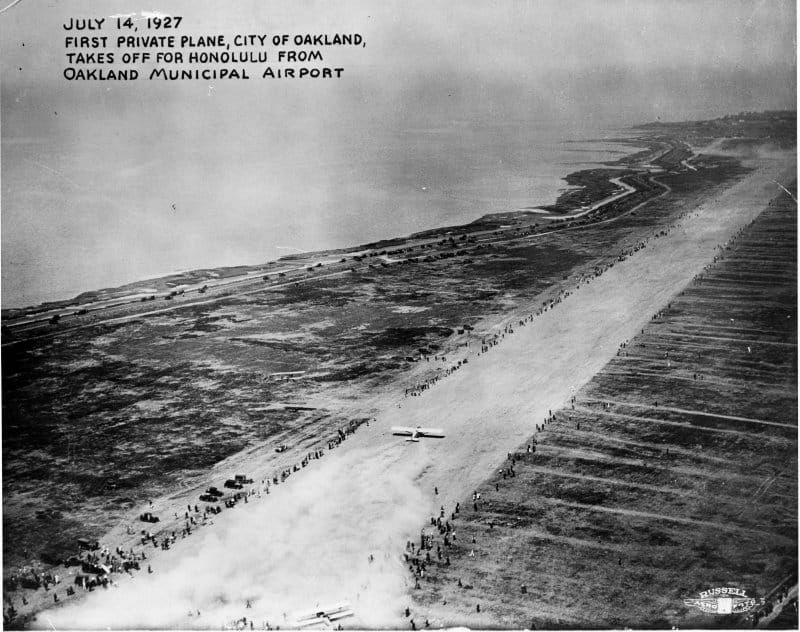
San Francisco boosters may laugh at it, but in its earliest days, OAK was one of the most important and most advanced airports in the world. The history isn’t irrelevant to the current strife. At a time when air travel was new, and one could still shock people by saying that it was on its way to becoming a daily affair, Oakland Airport positioned itself to take advantage of the new era. Blessed with weather so perfect that flying was reliably safe for all but five days of the year, the airport added features like long, tarred runways and flood lights so that planes could land at night. By 1931, the 845-acre Oakland airport was the largest facility in America, and the busiest in the world, handling more than a million passengers per year. Berlin’s Tempelhof Airport, then the busiest airport in Europe, took in slightly more than 650,000.
Across the Bay, aviators derided Mills Field, the bucolic airport named after the cow pasture it was leased from that would become SFO. As one flight attendant of the era put it, the whole place was a “mudhole.”
Mills Field’s boosters still insisted that theirs was the better airport. “It is a notorious fact that air mail pilots are often compelled to land at Mills Field,” the manager for a campaign to raise bonds for the airfield’s expansion said in 1928. The manager claimed that Oakland was hard for pilots to locate in the fog and insisted that federal regulators would soon agree. They did not, and Oakland remained the Bay Area’s aviation hub of choice.
“The romantic and rapid development of commercial aviation in America has brought to the city of Oakland in the space of very few years the position of being the recognized hub of aviation on the Pacific Coast,” read a 1937 article in The Shopping News. The achievement owed “almost entirely to the foresight and initiative of both the people of Oakland and their city government.” Oakland, it added, was “among the first major cities in America to recognize the tremendous potentialities of commercial flying.…While other cities were bickering over bond issues or haggling over possible airport sites, Oakland acted.”
Oakland was different at that time, of course and so was airport planning. There was a lot of room, and planners had options for places to stick such enormous infrastructure that they have never enjoyed since. In the marshlands of San Leandro Bay, they had chosen just about the perfect place in the region to stick an airport.
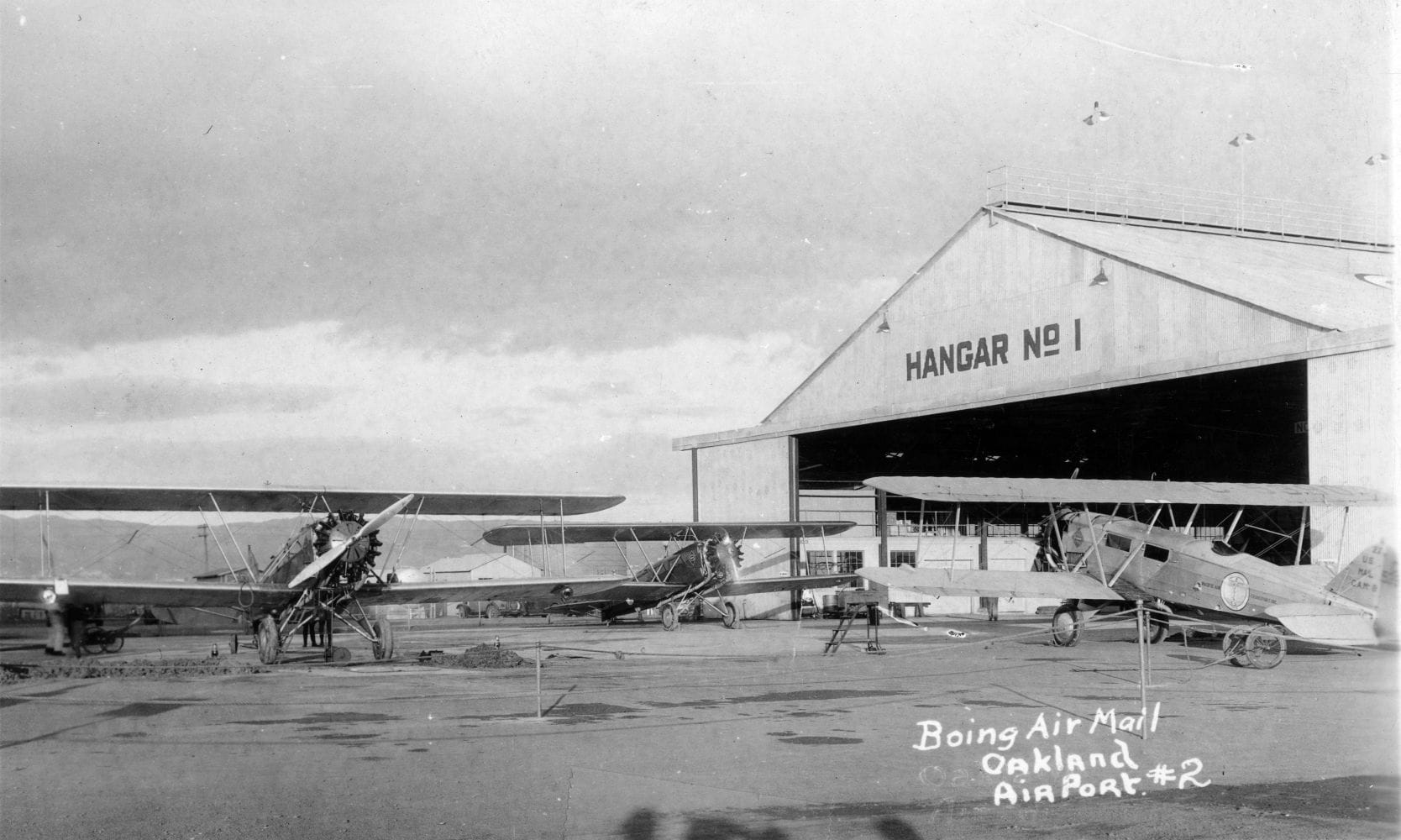
The forces driving airport construction were different as well. Since passenger airlines were barely extant, airports were utilitarian operations, built to service professional flyers who chose airports for practical reasons and didn’t care how close they landed to Fisherman’s Wharf. Oakland became the air mail depot of the entire Pacific Coast (OAK is still UPS’s only air hub in the Bay Area), and Boeing added an internationally renowned flight school. Celebrity aviators, like former mail pilot Charles Lindbergh, who dedicated the Oakland Airport personally in 1927, were another influence, and they routinely extolled the airport’s modern attributes. That same year, Army lieutenants Lester Maitland and Albert Hegenberger left Oakland to complete the first nonstop flight from the U.S. mainland to Hawaii in a mere twenty-six hours, bringing even more acclaim. The budding passenger business followed: Soon after United Airlines, the nation’s first national passenger air carrier, made Oakland its Pacific hub.
But during the Second World War, the airport hit a major snag. As Mitchell Schwarzer writes in his book Hella Town: Oakland’s History of Development and Disruption, upon entering the war, the nation largely curtailed commercial aviation, including in Oakland, though not at that comparatively minor Peninsula airport. By the end of the war, the airport now known as SFO broke the million-passenger mark.
After the war, the passenger air industry began to come into its own, sent aloft by booming incomes and a surplus of repurposed wartime aircraft. Consumer preference drove the industry now and could make or break an airport. Airlines competed on amenities like waiting lounges, and the architecture of an airport terminal was enough to render it a destination in itself. SFO had already invested heavily in making itself look good, with a Mission-style terminal that was reminiscent of California train stations of the time, and the choice secured its place ahead of its drabber East Bay rival.

When the industry deregulated, and budget carriers started carving a niche in the sky by swamping “legacy” airlines like United, OAK enjoyed some success as the bargain alternative to SFO. For years, OAK was the exclusive Bay Area destination for Southwest Airlines—the forebear of all budget carriers. But the high-water mark surely came in 2014, when Norwegian Airlines—a carrier that brought the budget model to transatlantic flight—pulled up on the tarmac. For a brief, shining moment, you could fly to Copenhagen or Barcelona from Oakland, and for notably less than you could out of SFO.
Yet even if OAK was the more practical choice, and even if practicality seemed paramount among consumers in an era dominated by budget carriers, passengers struggled to see the airport’s virtues. To what lengths were people willing to go to save a few dollars? the airlines asked. Were they willing to put up with less legroom and seats that didn’t even recline? Yes, it turned out. Were they willing to go to Oakland? Not so much.
It didn’t help that getting to BART required first taking a bus through East Oakland to the Coliseum station—the kind of added complication that can so easily throw off jet-lagged tourists with tired kids nagging them to make their lives easier. For people wanting clam chowder bowls and cable cars, you could say the vibes were off. But even with the BART Connector in place since 2014—infrastructure that allowed a person to go from the front door of the airport to downtown San Francisco via transit without setting foot on Oakland ground outside the airport—the passengers never quite came in the numbers that airport leadership needed. San Francisco–bound passengers still preferred SFO, and before long, even the budget carriers followed them there. One exception was Spirit, which flew out of SFO but generally preferred Oakland up until its bankruptcy and dissolution. But by then, the boundaries between “budget” and “legacy” airlines were more or less gone for passengers, anyway (at least for those passengers who don’t fly twice a week, every week, and have no idea what a “medallion” is).
Name recognition trumped practicality, not unlike how glamor had trumped it decades before.
◎
There is, perhaps, an allegory of San Francisco–Oakland relations in this saga. One of Oakland Airport’s problems, like one of the problems facing the Town’s reputation more generally, is that Oakland has always been a minority player in its region. Oakland might be the forty-fifth–largest city in America, ahead of Pittsburgh (sixty-seven on the list), Cleveland (fifty-three), New Orleans (fifty-four), or Minneapolis (forty-six), but, unlike those cities, Oakland can’t claim a metro area to itself. What, other than possibly San Leandro, could rightly be called an “Oakland” suburb, as opposed to a Bay Area one? (Certainly not Piedmont.)
Serving as a vital component of a rather large, rather important region has always suited Oakland well for a few reasons. One is just a matter of self-identity: It beats getting reduced to a mere auxiliary to San Francisco. Another is that Oakland is indisputably the region’s transportation hub—the historic endpoint of both the Transcontinental Railroad and the Lincoln Highway and now the home of the largest container port on the West Coast north of Los Angeles. But being such a team player has also made it easier to kick around
“Little-known Bay Area city will keep San Francisco in its airport’s name,” the San Francisco Standard offered us in a trolly headline. A cute parochial gesture from the Standard—quaint, almost, like some hayseed town’s daily shopper guarding the primacy of the local covered bridge.
The funny part is that OAK, in adding “San Francisco” to its name, was actually being honest where the industry tends toward a kind of geographic disingenuousness—particularly in an era characterized by an evermore desperate scramble for cheap airfare. In Europe, Southwest protégé Ryanair cut costs, brought down fares, and won the day not just by selling lotto tickets at 30,000 feet but by flying people to smaller, oft-neglected airports in towns like Hahn, Charleroi, and Bergamo and telling them with a straight face they were going to “Frankfurt,” “Brussels,” and “Milan.” People complained about that trick and plenty of others, but they kept buying tickets. The city and county of you-know-what has been playing a version of the same game since they first staked a claim on that far-off Peninsula terminus and confidently declared it the “San Francisco airport.” But, sure, guys. It’s our side that’s confusing everyone.
It bears repeating that OAK’s chosen name was “San Francisco Bay Airport”—a distinction that it emphasized in legal filings and in the press. In a real sense, the name was an attempt to reify the airport’s service across the wider region to the benefit of travelers. OAK was taking up its historical role, the one it had played before the war, because travelers apparently couldn’t make the connection for themselves.
And why not? San Francisco residents and visitors aside, the 2.8 million residents of the East Bay (that is, the east side of the San Francisco Bay) also deserve an airport that caters to them. Still more people reside in San Joaquin County and would surely like to go to see their relatives in New Jersey or get to that conference in Dallas without having to pay a bridge toll just to get to the starting gate. San Franciscans are more than welcome, too, of course, and, with more traffic out of OAK, they would benefit from some competition to keep prices down even at SFO. (Surely, they know that Oakland is close, right?) Oakland was always the more practical place to stick such vital infrastructure for the region, and, regardless of whatever the San Francisco city attorney wants to tell us, this is a whole region we’re talking about.
And yet, at least in the near term, that’s not how it will work. The seven-by-seven city will still direct every visitor it can to its namesake airport ten miles to its south, as the jet flies, no matter how congested the highway connecting it to anything else gets. The view of OAK from the West Bay isn’t of an airport that’s here to help out but of one that’s here to leech off a flying cash cow that’s theirs by rights. SFO for the region, OAK for Oakland. At least now a judge says our airport can call itself what it wants. Long live Oakland San Francisco Bay Airport.
Alex Park is a writer and researcher in the Dimond. He’s currently wrapping a book on the global history of the fast food industry. Find more of him at his website at www.alexcpark.com and follow him on Bluesky.