How to hide a tax revolt
I’m interested in how it came to be a fact that Oakland residents pay some of the highest taxes in California, how this came to be a thing so many people on social media reference (and complain about) as confidently as they do.
You may or may not hold this opinion, yourself. You may only be aware of it if you haunt particular, cursed corners of Reddit, Nextdoor, Facebook, or Substack, where some of the angriest people rage about the injustice of being taxed by the city. But in those particular spaces, at least, that “fact” has become something that can be taken for granted, a truism to be cited rather than argued, and something simple, clear, and unmistakable. To reference the singularly high tax burden that Oaklanders’ labor under is, like California weather, just something we all take ourselves to know about already, like saying Lake Merritt smells or Oakland is overrun by crime. Your audience starts nodding before you finish the sentence.
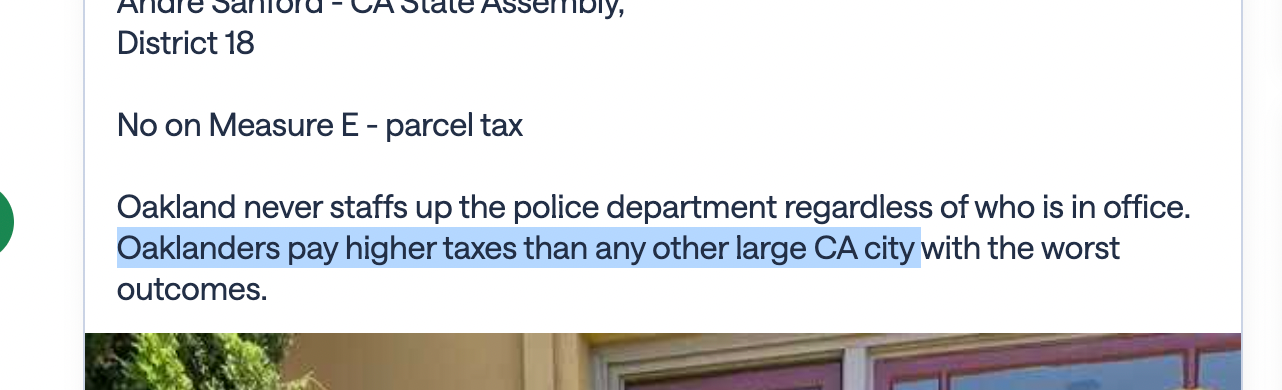
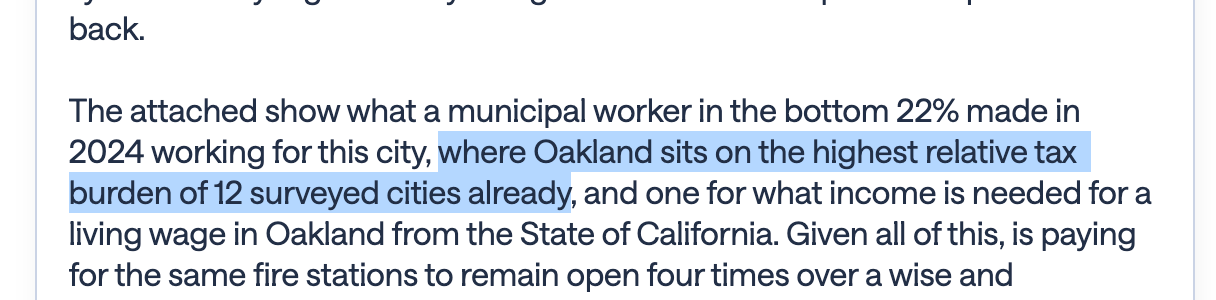
The main place you will have read that the city of Oakland “now collects some of the highest taxes per capita in the state compared to similar cities” is in the virtual pages of Oakland Report, if—at almost any time this April—you made the excellent life choice to have read Oakland’s preeminent reactionary Substack. Oakland Report’s “mission is to provide reasoned, fact-based, well-sourced reporting and analysis on local government issues in Oakland, California,” as they put it, “focused on observable and verifiable evidence free from implicit bias.” In practice, they publish advance two main ideas: that union-dominated progressive municipal government is ruining the city, and is bad, and also that our taxes are too high, and are bad.
(It would be hard to overstate how consistently Oakland Report advances these two arguments, an ideological frame so complete and all-encompassing that they can’t get through an article about how great the Friends of OPL’s Bookmarks bookstore is without a diatribe against parcel taxes. That’s not a joke: They turn a story about a community enterprise devoted to giving money to government-run institutions into a rebuke of government-run institutions—and an argument against giving it money—while including a multiparagraph complaint about the very same parcel taxes whose passage FOPL’s website frames as an accomplishment. This is, in a nutshell, appears to be Oakland Report’s function in the media ecosystem: to carve up reality in ideologically congenial ways, while applying a veneer of journalism, to produce content for people to post on Nextdoor, Reddit, and places like that.)
Oakland Report has worked hard to establish that Oakland pays singularly high taxes, in the minds of its readers. If you read Oakland Report in April of 2026—and kudos to you for your good choices—you’ll have been told that “After years of cumulative tax increases, Oakland collects the highest taxes per capita in the state compared to similar cities,” and will also have read about “Oakland having the highest taxes per capita among comparable cities.” You’ll have seen them make the same claim on KTVU (that “Oakland has the highest taxes per capita among similar cities in the state”) and learned, in the first line of “Broken Promises,” Oakland Report’s “comprehensive policy analysis and voter guide for Oakland residents,” that “The City of Oakland charges some of the highest taxes per capita in California compared to similar cities.” The more you read in Oakland Report about how “Oakland charges among the highest taxes per capita in the state compared to similar cities,” I suspect, the more natural the idea that Oakland’s taxes are “high” will come to seem. And in Oakland Report, in April, in 2026, you will have read this claim many times, that “Oakland charges the highest taxes per capita in the state compared to similar cities.” For much of April, advancing the claim that “Oakland residents now pay the highest taxes per capita in the state compared to similar cities” was the main reason Oakland Report seems to have been publishing at all.
If semantic satiation hasn’t prevented that phrase from loading in your brain, you might be asking: Okay, dude, but, is this true? Are Oakland’s taxes “high”?
Let us make the excellent life decision of asking Google. As of early May, your helpful AI Overview probably would have given you this very clear and unambiguous answer, phrased in a distinctly now-familiar way: “Yes, Oakland has among the highest taxes per capita in California.”
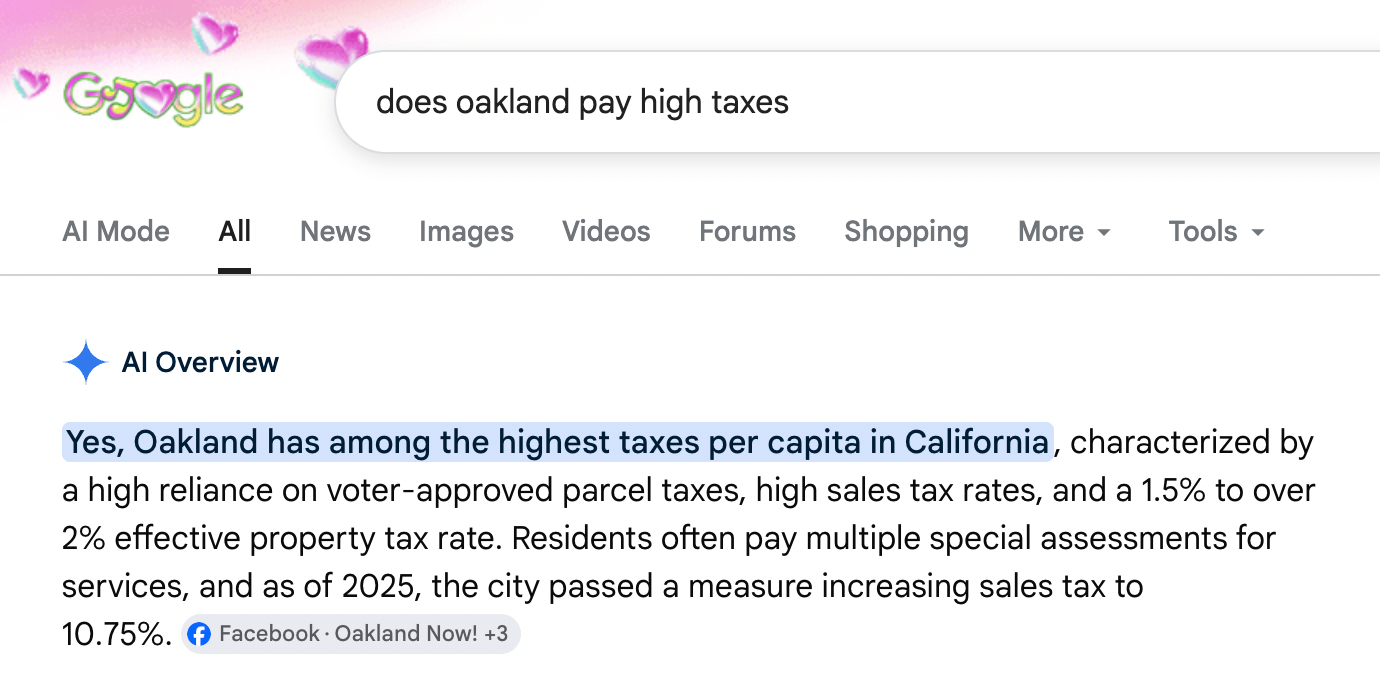
Google—the new Google, incidentally, not the old one that referred you to other authorities but the current, chatbotified version that has consumed the references for you and speaks in a horrible simulacrum of authority—phrases it that specific way because it has been reading Oakland Report. I asked it only about “high taxes” in a general way, without specifying any point of comparison (Florida? New York? Sweden?), but Google introduced the terms “per capita in California” (and “among”), and did so because those are the terms that Oakland Report uses. Oakland Report is not quite the only source Google will admit to using (if you click the links it provides), but it almost is, and most of the social media posts it cites also lead back to Oakland Report: people posting Oakland Report articles on Reddit, or some of the world’s most normal people lamenting on Nextdoor (with good grammar and spelling), that “Oaklanders are already taxed crazy amounts” and “This place is way over taxed” (while posting Oakland Report articles elsewhere).
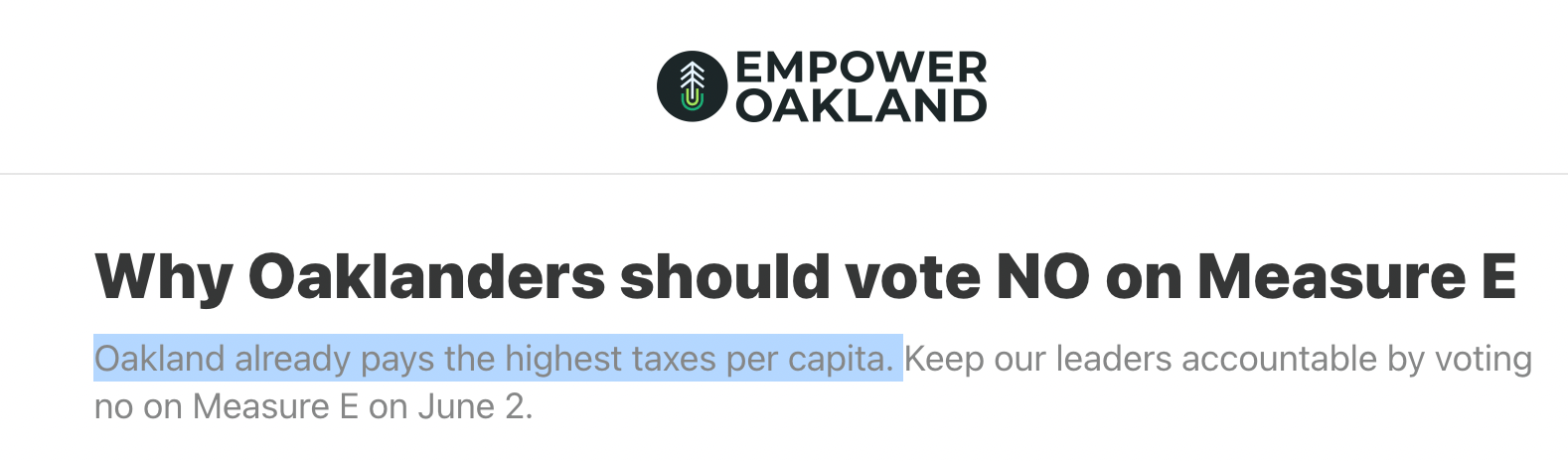
Oakland Report is a load-bearing foundation for this memetic landscape. When people are furious about their taxes on Facebook, they use AI to scrape summaries of Oakland Report to back up their position; on Twitter, friend-of-Oakland Garry Tan cites Oakland Report to the same effect (“Oakland has highest taxes per capita among similar cities”) while “Oakland’s merchant of bad vibes” Sam Singer cites Oakland Report to declare that “Oakland residents pay the highest taxes per capita compared to similar CA cities.” And by the time you get to the voting guide for Loren Taylor’s Empower Oakland declaring that “Oaklanders already pay the highest taxes per capita of any city in California,” the lack of citation is no impediment to knowing where it came from. As with Google’s result, the specificity of the phrasing is essentially a signature.
◎
All of this, literally everything I’ve linked to, is part of a campaign against Measure E, a proposed parcel tax for Oakland that would raise $34 million “for essential services.” You can ask Google a very general question about Oakland’s taxes and get caught in this very particular whirlpool: That specific phrasing, that signature (“highest taxes per capita in California”), is particular to the reaction against Measure E, and a framing that (for good reasons) almost no one else ever uses, as I’ll explain. It illustrates Oakland Report’s success in framing the discourse that you could ask Google such a broad question and get such a specifically motivated response.
It is also a mark of their success that so many of the chuds throwing that factoid onto social media feel no need (nor are they required) to explain where they got it from: One doesn’t need to cite sources, or offer proof, for facts that are taken for granted. Oakland Report has put in the work, writing articles, getting them posted and shared on social media, and has done it strategically enough that, at the end of the day, they’ve created a sense of certainty, clarity, and obviousness around what might otherwise be seen as a rather complicated question. For the people who have chosen to follow their lead, therefore, the notion that Oakland has “high taxes” is just true, a data point to be cited while making other arguments, and not, itself, a question they need to argue or resolve. (Even Google agrees!)
But whether Oakland’s taxes are “high” is actually such a complicated question that it might not really have an answer. There are important questions and qualifications about what those words actually mean that go unasked and unchecked, assumptions that get buried under the sheer repetition of this phrase, the familiarity it accrues, and the consensus it crystalizes. When a community—even an online one—comes to consensus about which questions no longer even need to be asked, that memetic consensus can make it hard to see how its claims are less true or false than not even wrong. In this case, a statement like “Oakland has high taxes” might have a core factuality to it—or at least a strong whiff of reality—but when it gets mixed with hyperbole and ambiguity, and also raw falsehood, the very recognizable object you get—which has become known, familiar, and polished with use—is also, at the same time, incoherent, unfalsifiable, unprovable, and fundamentally cursed.
For example, if you go back and carefully look at Oakland Report’s claims, you’ll find that sometimes Oakland’s taxes are described as “some of the highest” or “among the highest” in California, while sometimes they are called “the highest” (my italics). That last one is a distinctly more absolute claim. But if you are the tallest person in the world—if that’s a fact—then you wouldn’t describe yourself as “among the tallest people in the world,” even if that’s still technically true. You’d say that only if you were trying to downplay it (which none of these people are), or unless you weren’t really sure.
Yet whether Oakland’s taxes are singularly high, when compared with comparable cities—or whether our taxes are high just like comparable cities that we sit among—is actually an important question. And in that sense, it’s technically true, as Oakland Report will say, that after “Oakland’s sales tax was raised in April [2025] to 10.75...[o]nly one California city has a higher rate: Lancaster/Palmdale in Los Angeles County.” There are no actual lies in those sentences, and so, their raw factuality has been taken up, for example, by Google, who included Oakland’s “high sales tax rates” in its judgement that Oakland has generally high taxes.
That sentence is also a bullshit nonfact: the city of Oakland added that 0.5 percent to give us our total 10.75 percent sales tax, in 2025, but when Walnut Creek added the same 0.5 percent to its sales tax, in 2022, their number only went up to 9.75 percent.
Why? Because Alameda County collects a significantly higher sales tax than Contra Costa County does, such that every single city in Alameda County has a higher sales tax burden than every city in Contra Costa. So, yes, technically, Oaklanders pay a high sales tax, yes—the same high sales tax as other Alameda County cities like Union City, Alameda, San Leandro, and Emeryville—but it’s mostly because they pay the Alameda County sales taxes.
Yet, framed that way, doesn’t Oakland suddenly look a lot more similar to comparable cities rather than standing out from them as singularly highly taxed? My point is not that there are any clear-cut conclusions to be drawn from these numbers, but that the deeper you go into them, the less clear everything becomes, and the harder it gets to tell a simple and gratifying story, with clear villains and victims.
With that in mind, let’s go back to the basic Oakland Report claim that Oakland’s taxes are “high.” What does the “height” of the taxes being referenced actually mean? Ask yourself whether you think it means a high rate of taxation, or whether it means that the total amount of tax revenue collected is high. This is, after all, a very basic difference, but as you were reading that phrase a few paragraphs up, over and over, were you carried along by my mellifluous rhetoric, or did you stop and ask which it was? Did you simply assume you already knew?
Most readers of Oakland Report, I think, have simply assumed. And yet that very basic difference makes a big difference: A city full of very poor people could have a high rate of taxation while still collecting a relatively low amount of revenue. Conversely, a very wealthy city could pull in a bundle of money from a comparatively low rate of taxation. But if a 10 percent property tax on a very poor person’s home could produce less total revenue than a 1 percent tax on a millionaire’s—and Oakland has both kinds of homes—then isn’t it a problem that “total revenue” and “rate of taxation” might turn out to be very different things?
It’s a useful postmodern truism that “facts” gets slipperier as you drill into the ambiguities out of which certainty is made, that there’s an endless column of turtles and disappearing presuppositions, all the way down. It’s a no less useful, if less postmodern, truism that sometimes people are simply bullshitting you. Sometimes “facts” get framed the way they do in order to fool you. And by carefully phrasing it “highest taxes per capita” (and getting Google’s AI to repeat the framing), Oakland Report strongly suggests that they mean rate of taxation, even when—as turns out to be the case—the citation they’re relying on is very specifically and clearly talking about total revenues.
This is not hard to prove. Oakland Report only ever cites one source for the “highest taxes per capita” claim, always exactly the same footnote, and only one footnote, every single time, a publication on “Balancing Oakland’s Budget” put out last year by SPUR, an organization whose acronymic UR once stood for “Urban Renewal” but no longer does:





If you click the link on the report, and if you scroll down to page 17, you will indeed find this phrase: “Compared with other California cities of a similar size with comparable services, Oakland has the highest tax revenue per resident (Exhibit 10)” (my italics), along with a helpful bar chart:

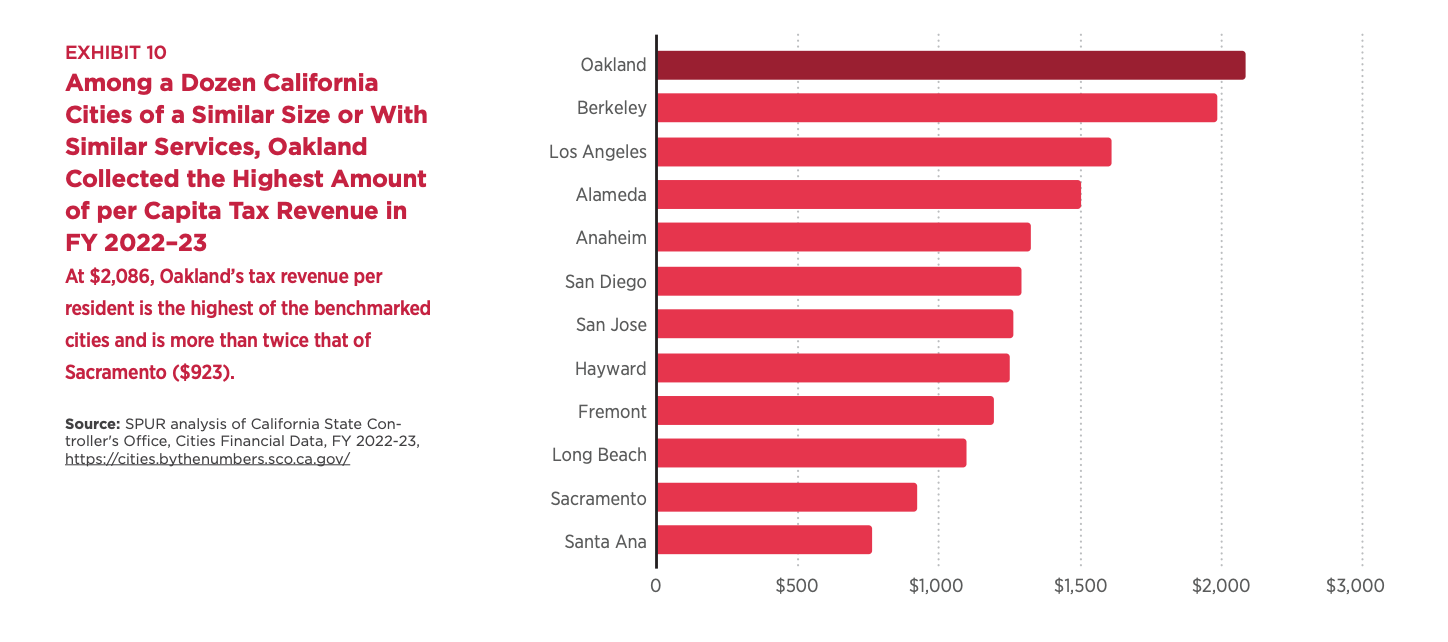
Oakland is at the top of this particular list of California cities, but that list does not include all California cities; in that sense, it turns out the difference between “high” or “highest” is a function of which cities you include in the comparison. San Francisco is absent from the comparison, for example, but were you to divide San Francisco’s total tax revenue by its population—since San Francisco has almost six times Oakland’s tax revenue and not quite twice the population—the red line you would produce would be more than three times as long as Oakland’s. Perhaps it’s not included, here, because “Oakland has the highest taxes per capita in the state compared to similar cities… except for San Francisco’s, which is three times higher” is not a story anyone wants to cook these numbers in order to tell?
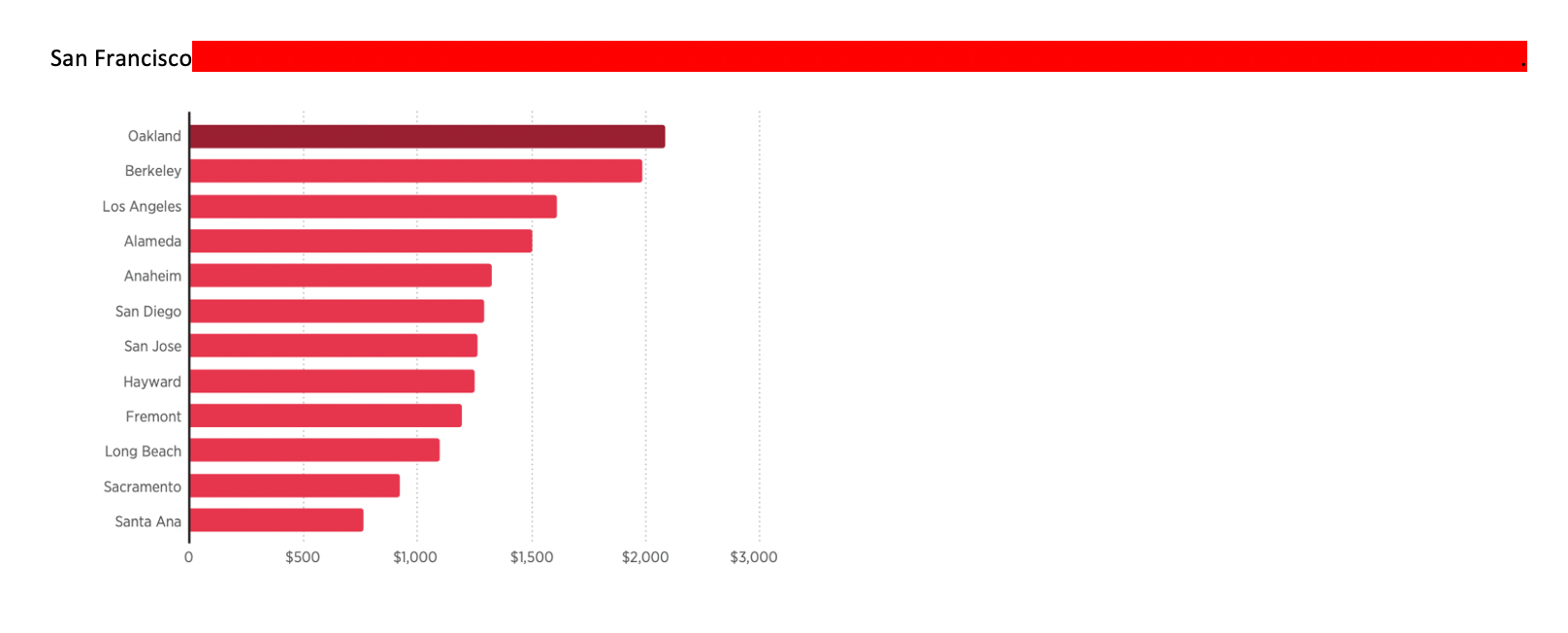
And perhaps for good reason. When I emailed Nicole Neditch, she explained that San Francisco was excluded “because it is both a city and county, and it is very difficult to do a side by side comparison as the services they provide and their revenue sources as a result are much different.” Which seems reasonable enough: Since Oakland is blessed to be a part of Alameda County, a one-to-one comparison with San Francisco might not be meaningful. “Alameda, Berkeley, Fremont, and Hayward were benchmarked because they are in Alameda County and so generally have the same services that they need to provide as Oakland, but have pretty different demographics / populations.”
I imagine Palo Alto and Pasadena were excluded for similarly reasonable considerations, and not only because their inclusion would have made a hash of the narrative that Oakland’s tax revenue per capita is unusually high. And yet, none of these cities is really all that much like Oakland, which has about four times the population of Alameda (a small city, which is actually an enclave within the Bay Area region, if not literally within Oakland itself), and about one tenth the population of Los Angeles (a very large city, and the core of a greater urban area itself). If we’re including Oakland in a list of “cities of a similar size” that ranges from the largest city in California to a city like Alameda that wouldn’t even technically be a city at all if it were just a little bit smaller, I am left pretty unsure what the comparison even shows.
Nicole did tell me that “Los Angeles was included honestly because people were asking as I was rolling out this report and comparing some of Oakland's challenges to those of big cities such as LA, others were included because they are of similar sizes.” But I don’t get the sense she was particularly aware or interested in how load-bearing an element her little chart had become for the reactionary anti–Measure E position (or at least she was not interested in commenting on it to me, in the immediate lead-up to the election). That’s probably because, in large part, that chart and data point don’t mean, in the SPUR report, what Oakland Report is harvesting it to mean; within the SPUR report itself, it’s mainly just illustrating that Oakland has done well in raising its tax base over the last few years
For me, it tells a story that SPUR’s very specific (and correct) phrasing, “Highest Amount of per Capita Tax Revenue,” seems to appear exactly nowhere in Oakland Report, or anywhere that cites them. The story is that this piece of data from SPUR is a seed which has grown across the discourse, but only by shifting in that very subtle but meaningful way: What was initially presented as a measure of the total amount of taxes collected (divided by the number of people it was collected from), has become “highest taxes per capita,” a phrase that might mean the same thing, if you squint at it, but more likely sounds to you like they’re describing a high tax rate.
If you wanted, I guess you could argue with a straight face that this isn’t a lie? That while probably misleading, in practice, it isn’t technically false? But “tax rate per capita” is a little like “doing the kessel run in 12 parsecs”: essentially meaningless because it combines two kinds of measurements that don’t really go together that way. It’s why, if you google “highest taxes per capita” (inverting my little test from before), you’ll probably find that most usages of that exact phrase only take you back to Oakland Report itself.
When I did this, for example, on May 9 (in an incognito browser), I got: Oakland Report, Oakland Report, Sam Singer citing Oakland Report, and Garry Tan tweeting Oakland Report:
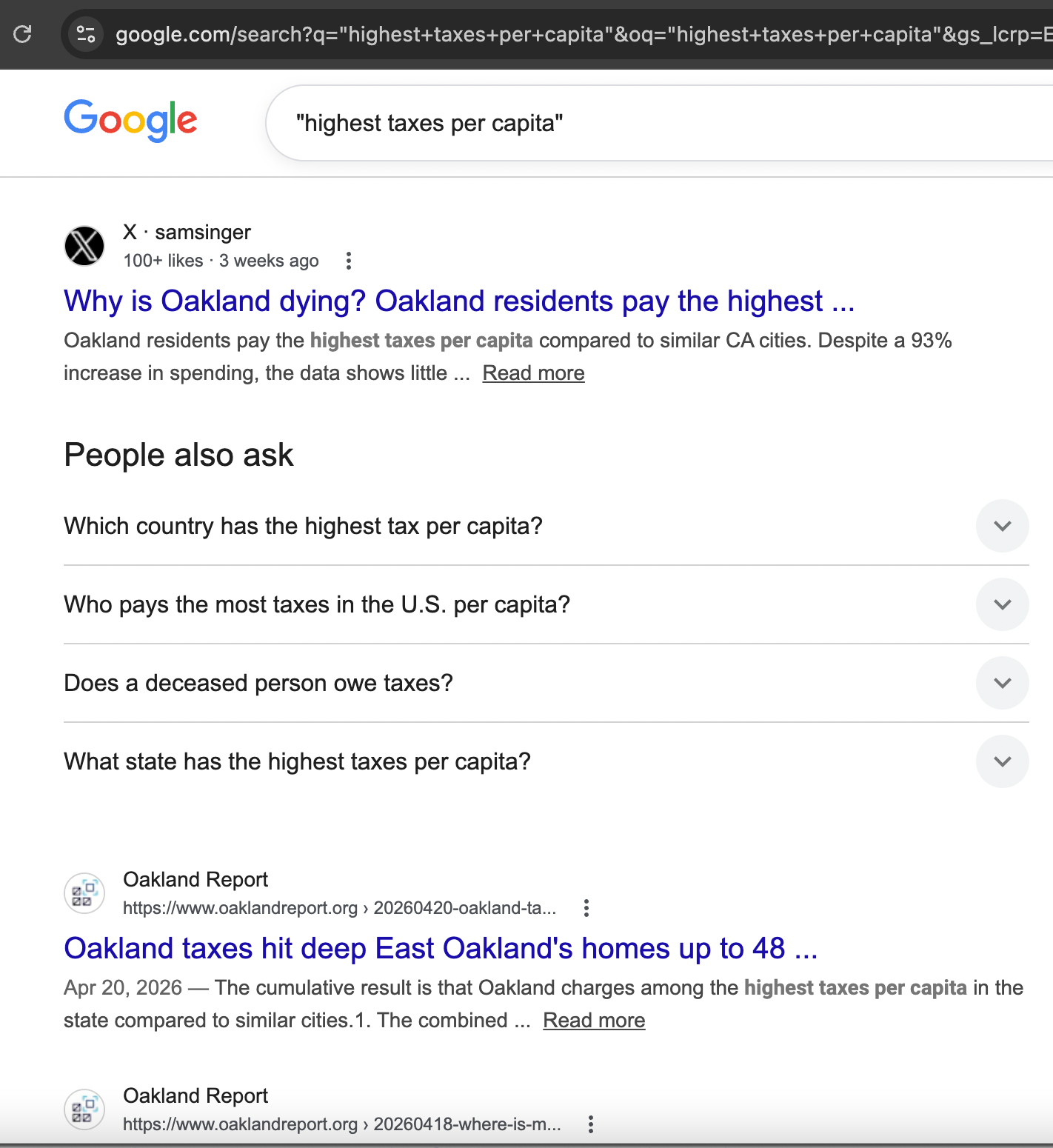
This is “probably” what you’ll get, too, because you probably live in California, even though what Google gives you is a moving target. (If you are in New York, for example, you’ll tend to get New York–oriented antitax rhetoric when you google it). In Oakland, the reason this specific phrase takes us back to Oakland Report agitprop against Measure E is that there simply isn’t, otherwise, a good reason to talk about “high taxes per capita.” Unless you’re trying to doctor the facts in this very specific way, it doesn’t really measure anything meaningful. Either you want to talk about high tax revenue per capita (as SPUR was) or you want to talk about a high tax rate, which will be one of two things: the same for everyone (making the “per capita” redundant) or not the same for everyone (making it misleading).
A reason you might want to use that phrase, however, would be if you want to take the fact of a high wealth city or state (which also collects a lot of that wealth as tax revenue), and make it into something where it sounds like individuals are being taxed at a high rate, compared with other individuals in other cities or states. This is why a publication like Oakland Report—which, almost literally every single day, publishes a different article about why Oaklanders pay too much in taxes and/or are misgoverned by corrupt, labor-aligned tax-and-spend progressives—was polishing that turd so vigorously throughout the entirety of April of 2026:. High tax revenues might sound like a good thing (“Oh, nice, the city has more money to spend on services!”), while high tax rate is more likely to seem like a bad thing (“Oh, shit, the city is taking a larger percentage of my money away from me!”). The number they have measures the former; the reaction they seem to want is the latter.
To see this small sleight of hand, you’d have to read the citation and note how it’s changed. But even though there’s only one, only ever one, my suspicion is that the median Oakland Report reader (or Nextdoor/Reddit citer) probably hasn’t read it. They’d have had to click a link, open the pdf, scroll seventeen pages down, maybe even read some of those pages, and engage with the complexity.
Communities formed around a “fact” like this don’t operate like that, do they? They don’t tend to question the shibboleth that opens the door. SPUR’s findings and recommendations are complicated and—if not exactly nonideological—far less useful for the simple story people on social media would like to enjoy telling, a story aimed at a much less taxing part of the brain, if you’ll pardon the pun: that you, an Oaklander, are being taxed a lot, and a lot more than people in other comparable cities, and it is not fair. Oakland Report is telling the kind of story that can give you a burst of pleasure, as you read it, of outrage, indignation, and righteous victimhood. And why, after all, are we on the internet, if not to enjoy ourselves? Surely we’re not here to comb through footnotes and pdfs and try to make sense of actually quite complicated stories about funding streams. Where’s the fun in that?
◎
But let’s have some not-fun with the question of Oakland’s taxes. Measure E is a proposed new parcel tax of $192 a year for homeowners, as well as $131 per unit for owners of multi-unit residential properties. It will—if passed—help Oakland to balance its budget, which one might imagine to be a good thing, framed that way. In one sense, the $34 million it will raise will go to “essential services”: police, new fire engines, shelter beds, garbage cleanup, etc. But money is fungible, in another sense; when a city budget isn’t balanced, police are almost never where the cuts happen. If Measure E doesn’t pass, we can assume that what will happen is mostly that working people will lose more services, while cops—sitting on a quarter of the budget—will keep getting paid whatever they ask for (even when it’s higher than what they were even budgeted for).
Public sector unions are fighting very hard for Measure E; realtors and property owners are fighting against it, if that helps you grasp the political arrangement here. (Oakland Report knows which side of that semi-colon they’re on.) But an irony of Measure E’s politics is that the public employees—and unions—who Oakland Report is mad about are, or you’d think should be, the police and their union, OPOA. They can avoid noticing this, in part, because the OPOA is largely sitting this thing out. Oakland Report diatribes target “public employees,” to allow you to picture some sleek bureaucrat in a suit and an office (and probably a Black woman), the way Ronald Reagan and 1970s tax revolt rhetoric has trained you to do.
But cops are the problem, if you even get close to looking at what the actual budget pays for. For all that Oakland Report blurs that distinction by talking about public employees’ “average total compensation,” police are paid so much more than other city employees, with so much more generous and consistent pay raises, that emphasizing the average allows us the congenial ideological position of blaming underpaid civilian public employees (whose compensation has often not kept up with inflation) for the way police overcompensation has risen so high that it skews even the average of both above inflation. But while you can add Lieutenant Timothy Dolan’s total compensation to that of an Oakland sewer maintenance worker, divide by two, and produce an average total compensation of $524k, producing that kind of “average compensation” only makes it sound like the sewer maintenance worker is getting paid a lot more than the $82k a year salary (plus benefits), that he’s actually getting. It’s the sort of average you might only produce if that was the misperception you wanted to pass along.
It’s worth really emphasizing, too, that OPD’s spiraling and unaccountable costs are why spending on “public employees” can be made to seem so high. Oakland Report wants you to picture the average SEIU union member as the problem, not the hundreds of literal millionaires we employ as police officers. But if you scroll down a list of Oakland’s highest-paid public employees, it’s hard to overstate how it’s just all fucking cops. You start to get a sprinkling of firefighters in the twenties and thirties, and a few paramedics, but you don’t even start to see titles like “director of” or “manager” or “city attorney” until you’re well into three figures; more than eight hundred “public employees” made more than the mayor, the majority of them police officers. People who do actual work turn out to be quite low on this list; it’s the millionaires who sit in their cars playing Candy Crush who are soaking up the money from the general fund. But Oakland Report wants to defund “public employees” because they know, as we should also have confidence in assuming, that a $34 million shortfall in the budget will not be made up by paying sworn officers less.
◎
Oakland Report is against Measure E for a lot of reasons, but the main one—and the reason Oakland’s highest taxes per capita in California compared to similar cities is their rod and staff—is that it’s a tax.
They insist that they are not antitax across the board, in principle, and they try to appeal to progressives, for example, by arguing that parcel taxes are regressive, that a fixed parcel tax will, for example, be a greater tax rise in parts of the cities where properties are relatively less valuable. In this vein, for example, they proclaim, “Oakland taxes hit deep East Oakland’s homes up to 48% harder than Rockridge’s,” a merely 0.012 percent property tax rise in Rockridge, but as much as 0.28 percent if you own a home in Deep East.
But a funny thing about Measure E, given all the sound and fury, is that it simply doesn’t represent that much money. For the homeowners who pay it, it would be roughly the cost of a Netflix subscription (or the $15/month membership in Oakland Review of Books, the proverbial “couple cups of coffee a month” that publications use to make their subscription fees seem low). Indeed, a $20 monthly supporter of Oakland Report will pay $240 dollars a year, a price Oakland Report presumably thinks is well worth paying. But as the tiny little percentages above indicate, those two third-wave coffees are just not a lot more money compared with the total amount that a homeowner already pays in property taxes. After all, are you really mad that Measure E might add a quarter to every $100 you (as the homeowner you surely are) already pay in property taxes? Even as artificially deflated by Proposition 13 as they are, the property taxes people are paying are already going to rise by more than that amount, just on account of inflation and the regional tendency of property values to rise.
It gets doubly weird when you factor in the expiring “Pension Override ad valorem tax,” which—as SPUR notes—“is expected to fall by as much as 94%, dropping the average single-family cost from $437 to roughly $27 annually [such that] the majority of single-family homeowners would pay less in combined property taxes [if E passes] than they do today.” This is, unsurprisingly, a SPUR fact that Oakland Report does not cite. The language they use instead (“a proposal to add yet another flat-rate parcel tax on top of the existing stack” and “layering another flat-rate parcel tax on an already heavy stack”) could be argued not to be a lie, but, you know, you could also argue that they are mendacious bullshitters, if you wanted.
◎
For the anti–Measure E people, ultimately, the amount of money raised by Measure E is simply not the issue. Because you are already taxed way too much, they say, you should say no to new taxes. It’s the principle, and the fact that you can afford Measure E would not be the point: You should decline to pay it because city government has lost the moral authority to tax and spend that extra quarter on top of the hundred dollars you pay in property taxes (as a homeowner, the only kind of person there is). They are, in this sense, classic “tax revolt” people.
My personal take is that we should probably vote for Measure E, less because it’s good, as such, but because its failure will only make things worse in a city which has been in a state of permanent austerity for almost half a century. Civilian public sector unions are pushing hard for it because the raises they bargained and fought for will only come into being if the budget is balanced; cops are ignoring it because they will get theirs no matter what; and commercial real estate is spending hard against it because $131 per unit will start to add up to actual money for large apartment buildings. But at the end of the day, Measure E crystallizes the kind of ideological tensions and contradictions it does because of the basic problem one does face when trying to understand why Oakland is the way it is: If Oakland collects such high tax revenues (“the highest taxes per capita in the state compared to similar cities,” if you haven’t heard) then why is the city so broke?
It’s worth reiterating that one reason Oakland collects the “Highest Amount of per Capita Tax Revenue” is that—while there are a lot of poor people in this city, of course, and a lot of need for social services to provide—there are also a lot of rich people here, and a lot of very expensive real estate. In the last twenty years, as the population has grown modestly, from about 400k to about 440k, the city’s tax revenues have more than doubled, almost tripled, which means the “Amount of per Capita Tax Revenue” (if that’s a data point we’re interested in) has also doubled, nearly tripled:
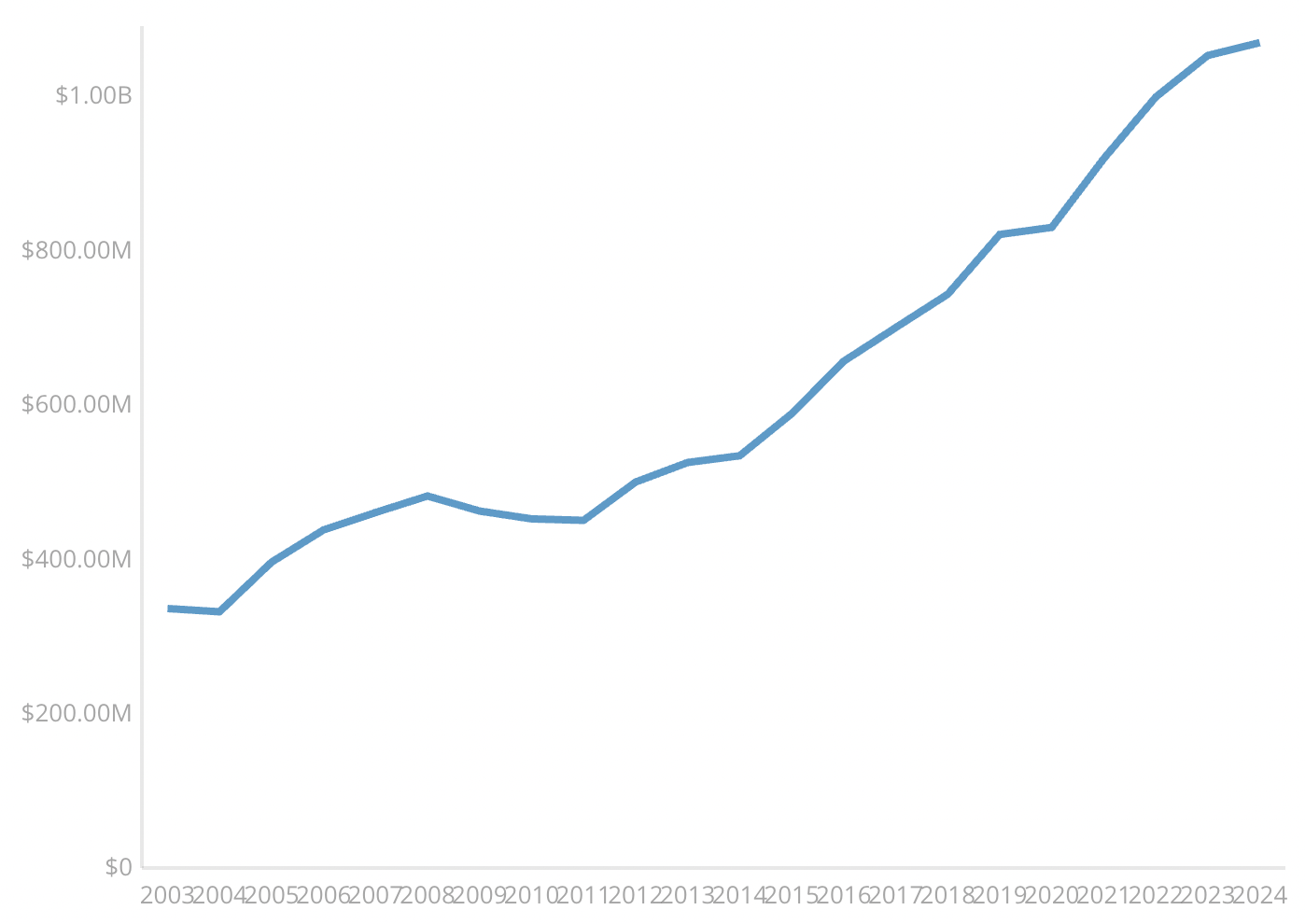
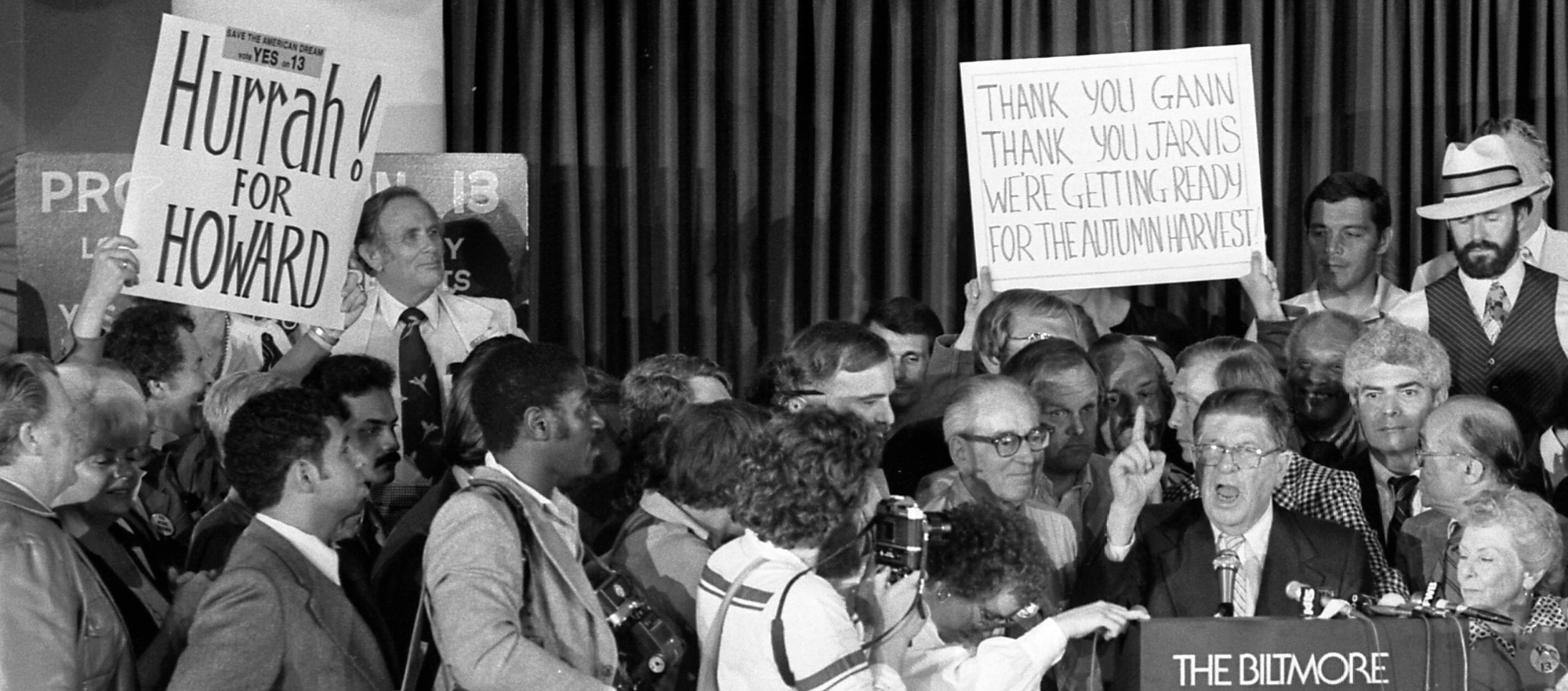
Some of that growth is inflation, but a lot of it is property values rising; in a time period in which a lot of people got priced out of the city, a lot of their homes were bought by highly paid tech workers, who consequently began paying much higher property taxes (having reset their Proposition 13 clocks). Seen in this context, that number, “total tax revenue,” might seem like a good thing. But if it doesn’t seem like a bad thing to you that a city with a lot of needs raises a lot of money—mostly by taxing owners of property, who are a minority of the city’s residents—then you might not be the grim specter of Howard Jarvis, risen from your final resting place in Forest Lawn Memorial Park to haunt and afflict anyone who might attempt to tax a property, anywhere, ever.
If you are, then yes, it is, literally, as such, a bad thing. Property should not be taxed at all, if you are Howard Jarvis’s ghastly wraith, shambling through the countryside feasting on the corpses of social services. People who aren’t the hideous phantasm of the architect of Proposition 13—and the broader tax revolt of the late seventies—might think to themselves: Actually, it’s kind of good that Oakland collects a lot of taxes from, for example, rich people who own multimillion dollar homes? They might even consider that taxing the owners of apartment buildings $131 per unit is a good way to raise the funds a cash-strapped city needs; they might think it’s good thing the city can spend the money they raise on, for example, a cost-of-living increase for public sector employees who live in one of the hottest and most expensive real estate markets in the country, after decades of wage stagnation. Since health care and retirement costs are rising very fast, being able to pay city employees might be a good thing?
If you are the unclean manifestation of Howard Jarvis grotesque remains, however, you will not think this; similarly, if you are the Oakland Report, the idea that the city would have money to pay workers to do work is a dour prospect. But if you take a step back and ask why Oakland is struggling so hard to raise enough money to fund basic services—and if you aren’t absolutely obsessed with the seventies-era specter of public sector layabouts, all those fat cats drawing public salaries and doing nothing for their pay, who you absolutely do not picture as noble sworn police officers (because you’re picturing Black women in offices)—you might start to notice that all of this, all of this, is the way it is because the first tax revolt was victorious, and got what it wanted: a starved public sector, shrunk down almost to a small enough size that you can drown it in a bathtub.
And so the irony of all this is that the ideological heirs of the tax revolt are now suggesting a tax revolt as a solution to the problems produced by…the tax revolt.
This becomes clear if you actually open the SPUR report that Oakland Report loves to cite, unread. Neditch’s report on balancing Oakland’s budget puts it very clearly and forthrightly: Oakland’s crisis stems not from what makes it stand out among California cities but from broad factors that it shares with other California cities, above all the lingering curse of Proposition 13. “Although Oakland’s budget crisis is severe, many U.S. cities are facing similar challenges, in part because of the lingering effects of the COVID-19 pandemic,” SPUR notes. “Sluggish real estate markets, the shift to hybrid work that has reduced foot traffic and increased office vacancies in downtown centers, and declines in business travel, tourism, and retail sales taxes, among other economic factors, have dragged down local tax revenues.”
Ever since Proposition 13 was passed, in 1978, every California city has struggled under a state of permanent tax crisis—Oakland more than many; if it weren't for Proposition 13, the city's tax revenues would be so much higher that the numbers almost stop being meaningful. “Oakland’s structural deficit was created decades ago,” as SPUR notes, when “Proposition 13 capped property taxes and reduced local government revenues by 60%.” But because we live in the world made by the tax revolt—in which properties are taxed not on their actual value, but on whatever amount you happened to have paid, depending on when you first bought it—it can be hard to even conceptualize what a radically different system we would have if not for Prop 13. Our baseline shifted so long ago that the post–Prop 13 fiscal system feels normal.
However, Proposition 13 isn’t only a social program shielding longtime homeowners from the downside of market shifts that otherwise benefit them. Seeing it in those terms is important; fundamentally, it’s a government program ensuring that property owners benefit from market speculation but do not pay the accompanying capital gains tax. But it also scrambles the kinds of statistics we use to make sense of reality: Because it benefits longtime homeowners the most—and because new buyers essentially reset the clock—Proposition 13 makes “per capita” statistics about Oakland tax burdens actively misleading.
Think about this way: If you bought your home more than a decade or two ago—a time period in which local property values have gone through the roof—then you are currently getting a great deal on your property, which has been the best investment you could ever have made, and on which you’ve paid quite minimal capital gains taxes. That’s because Proposition 13 keeps your property taxes down—lucky you, who purchased a home for peanuts in 1987 or whatever—in a way it doesn’t for someone who bought their home last year (or not nearly as much). The two of you might live in the same city, in one sense; in another, though, you do not live in the same tax regime.
For this reason, it’s misleading when Oakland Report asserts that Oakland homeowners pay an effective property tax rate of 1.5-2 percent (when you factor in parcel taxes). That’s because the tax regime created by Proposition 13 made where you buy less important—and when you bought a lot more important—such that an “average property tax” figure in a space like Oakland becomes a cursed antifact.
On a single block in North Oakland, as this nice little 2018 Prop 13 explainer explains:
Decades-long owners of a 1,300 square foot home on one end of the block paid $1,168 in property taxes last year. New homeowners with a smaller home on the other end of the block paid almost 10 times that amount. Two very similar homes, two incredibly different property tax bills.
It might be a slight overstatement to say that a new homeowner anywhere in Oakland is paying higher taxes than a longtime homeowner anywhere else in Oakland, but not by much. But what that fact means is that there really is no “average” tax rate in Oakland, or at least not in a useful sense; it means that per capita figures actually make you understand less about the city’s finances and about what share of them individual people carry. If the property tax bill of two houses, side by side and of compatible value, can vary by a factor of ten depending on purchase date, then what on earth could the “average” of them mean? And what difference could it mean that a parcel tax will add an extra quarter per hundred dollars of property tax payments, when the date you bought your house changes your tax bill (up or down) by a factor of ten? The more recently you bought your house, the more miniscule a fraction Measure E will add to your property tax bill.
Take just a minute with this tool, wander through a neighborhood you know, and notice how many million dollar houses there are that are paying significantly less than one percent of its valuation (side by side with houses paying substantially greater fractions of their worth). Those homeowners live in Oakland, but their taxes are not “high,” are they?
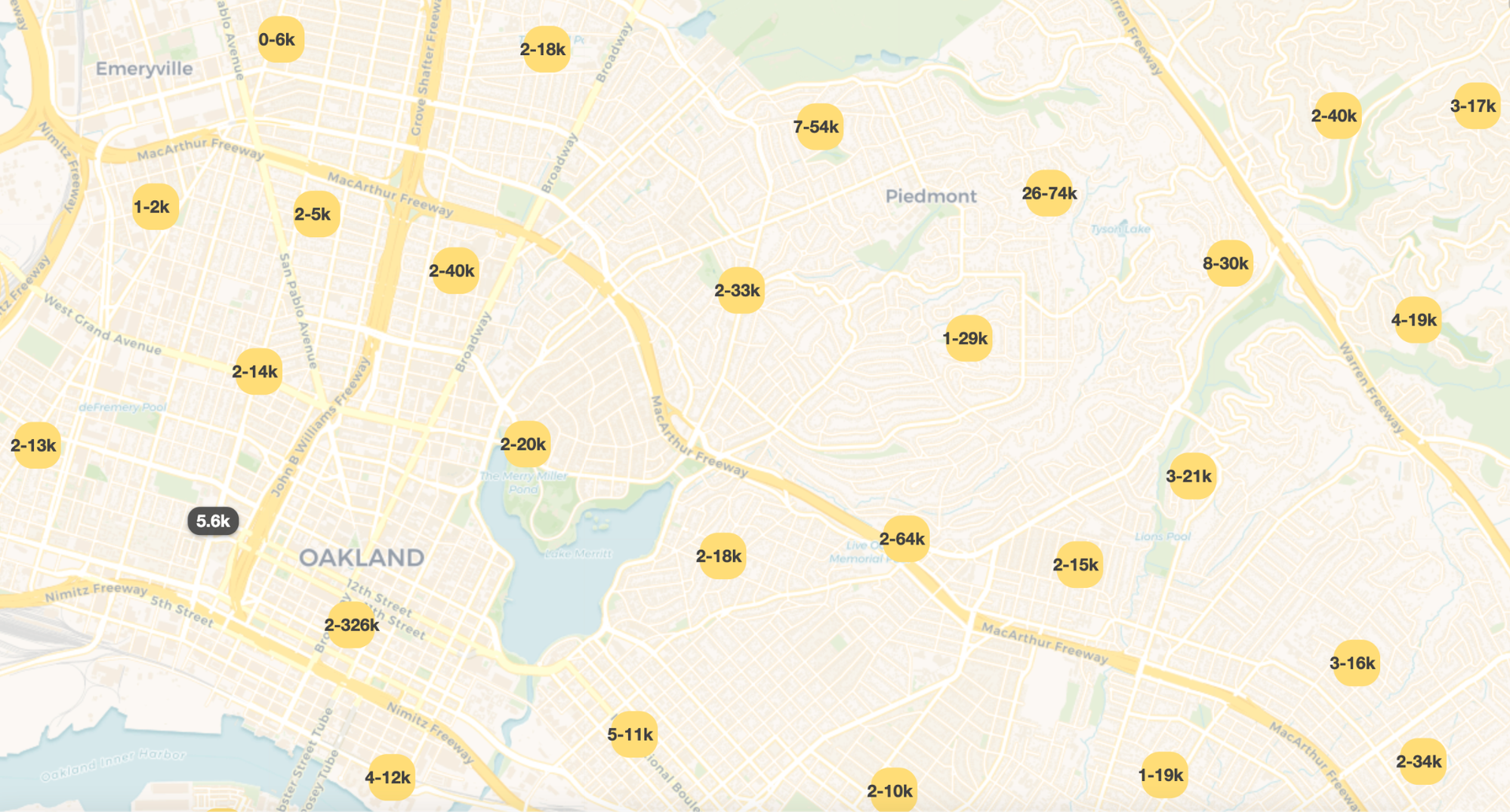
If you made everyone in the city actually pay 1.5 percent of their actual property values—and probably even a lower percentage than that—Oakland’s budget issues would utterly disappear. By the same token, if we raised the same revenues from property tax collections but evened out the percentage everyone paid, a lot of people who are paying a high rate, now, would find themselves paying quite a bit less. An effect of the way Oakland Report doctors the numbers is that it mutes this contradiction, which might otherwise obtain between high-tax-paying newcomers and low-tax–paying old-timers, people who might otherwise see themselves as being taxed very differently. If all Oaklanders decide, on the other hand, that they are very heavily taxed, then, for example, all the tech workers who moved to the city in the last decade or so—turning their high salaries into new home purchases—might be compelled to see their economic interests as aligning with longtime property owners.
◎
Oakland Report occasionally mentions our regressive sales tax, even if property tax is the thing that really pisses them off. But they never talk about how California doesn’t have a local personal income tax, the way cities like New York do. You have to go as far back as 1971 to find people arguing that maybe we should (another baseline that shifted so long ago no one remembers the before time). But if you want to measure Oakland’s “high taxes” by comparing, say, sales taxes to comparable cities, then one of the ways you make that meaningless is by not including the taxes we don’t have to pay. For example, the three percent that New York City takes from its residents’ paychecks is a tax that Oakland residents do not pay; the revenue that NYC raises through progressive taxation on incomes, Oakland is forced to raise through a more regressive sales tax (and through taxes on business receipts).
This kind of thing isn’t a fact that Oakland Report emphasizes, and it will never become a truth that an online community would find itself by organizing around. This will not happen because, unlike “Oakland has high taxes!” it can’t be used to cement an otherwise unsteady reactionary alliance between newcomer tech workers and the traditional tax revolt political base; it doesn’t paper over the contradiction between those who pay comparatively high property taxes because they moved here recently and the tax-sheltered older property-owning class that’s been feeding off Proposition 13 for generations. It can’t do what tax revolts do and reformulate a political space’s sense of itself to privilege capital-holders (which is what owners of as houses and other residential properties are) over the mere workers, who merely benefit from the social services provided by those taxes (or are in some cases directly employed by them).
What Oakland’s absence of a personal income tax doesn’t do is give those constituencies an enemy, with a conveniently racialized and gendered service-worker face; what it doesn’t do is allow them to overlook what divides them and unite in deploring the city, throwing money at its police and its real estate interests, kicking unions in the teeth, and demanding, of its government, that it do a lot more with less. It doesn’t become a fact, in the end, because it doesn’t crystalize a feeling: that they are fleecing me, but I am too smart, I have done my research (googled it and read one source), and now I can see the truth. Because it doesn’t make the people who read it feel good in that specific way, it can never become “true” in a way that matters.
Tax revolts are about this feeling, about the relief of knowing answers that finally solve the question. But if there’s one thing I want you to come away with from this, if you’ve read this far, it’s that this feeling has a cost, one you pay for when you let yourself be gratified by people who only know only one or two things, and know it over and over and over again. You get to feel smart, and know better than your enemies who are trying to fool you and cheat you; you get to blame the weak for the injuries inflicted on you by the strong. But what you won’t get are the things you might say you want, things like clean streets or thriving businesses or affordable rents or good schools; you won’t get a balanced budget, or even a lower tax bill, because the one thing you will get—more highly paid cops—will be the one thing that your city will never stop borrowing from everywhere to afford.