Measure EE doesn’t speak for me. Vote no.
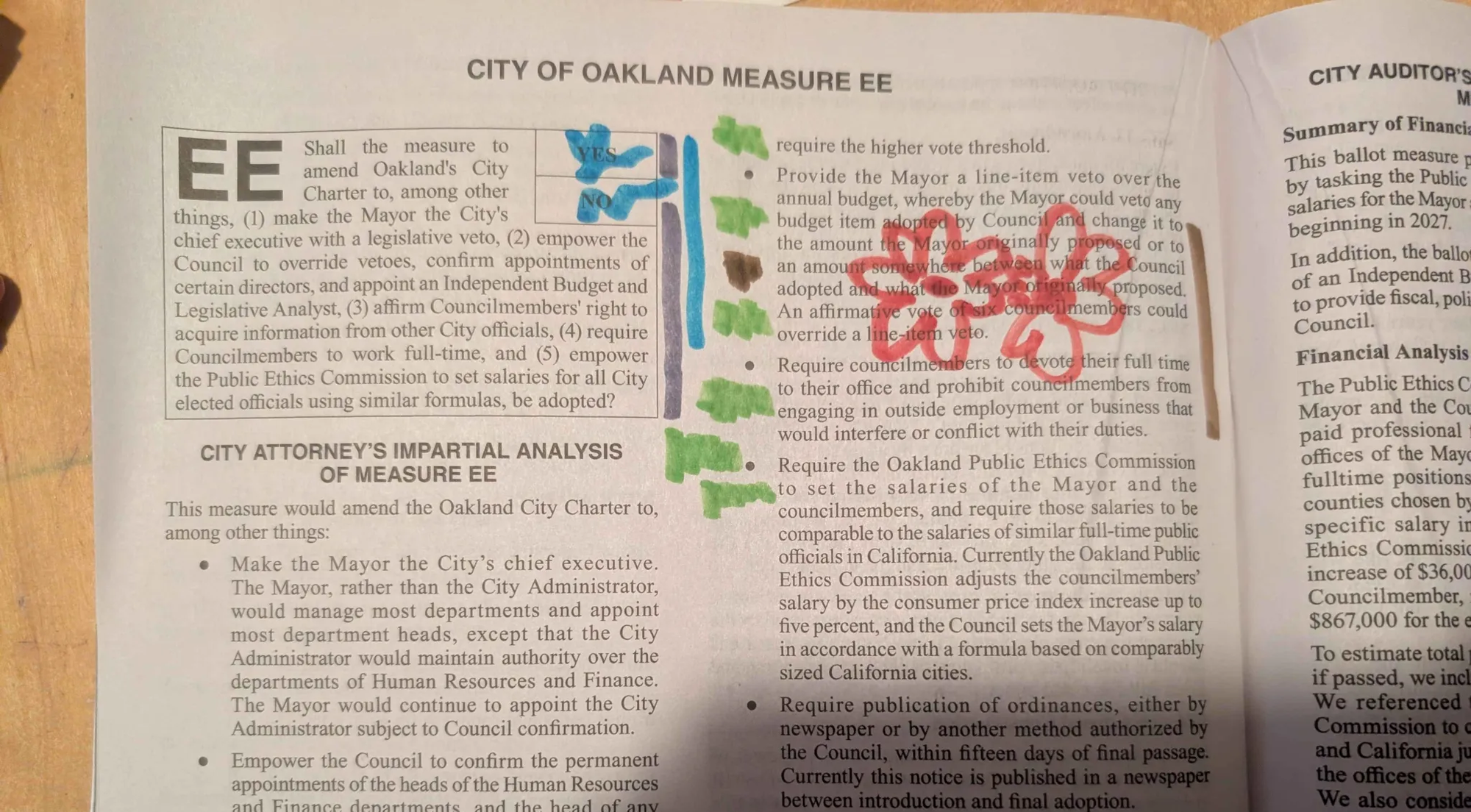
“Mayoral Powers, City Council Oversight, and Elected Officials Charter Amendment”
Our mayors have been complaining that they don’t have enough power for a long time. In the nineties—when the council-appointed city manager wouldn’t work with him—Mayor Elihu Harris reportedly put a sign on his desk saying “The buck doesn’t stop here. See the city manager.” He tried to change the charter to give himself more direct power over city administration, as Mayor Lionel Wilson had before him; both failed. It was Jerry Brown who got a charter reform passed in 1998, over the protests of many who felt it gave the mayor much too much direct personal power. Oakland mayors have been “strong” ever since. Instead of the much more common council–manager model, where the mayor is essentially part of the council (which is where real power lies), the “strong” mayor system allowed once and future Governor Brown to function as a separate executive, away from the council, and able to directly hire and fire the city manager (now called city administrator).
Measure EE proposes to give us an Even Stronger Mayor, with more direct personal power over hiring and firing and especially over the budget (including a line-item veto that would take a council supermajority to overrule). This particular charter reform was pushed forward by our current mayor—endorsed by former Mayor Libby Schaaf—over the objections of the council and others advocating a mayor-led council manager system; it will, perhaps, not shock you to learn that mayors seem to think mayors having more power is good. And because strong mayor systems tend to pass when those mayors are popular, Barbara Lee’s popularity and personal advocacy may help EE to pass. But the question of whether Oakland should have an Even Stronger Mayor system is a lot bigger than one mayor. You have to ask: Do you want Loren Taylor or Sheng Thao to be your Even Stronger Mayor? (Pick the one you don’t like.)
 Oakland Review of Books

While EE has been driven by Barbara Lee, it’s a version of a plan that SPUR has been pushing since at least 2021’s “Making Government Work,” a report that criticized how Oakland’s “hybrid structure makes it difficult to establish accountability for the effective functioning of government, since it leaves open the question of which branch of government is in charge,” and argued “for a more consolidated executive function within government,” more or less what EE would provide. It is not that surprising that Barbara Lee’s working group on charter reform came to the same conclusion as SPUR, since SPUR was a major part of the working group, and they essentially argue the same things:
Oakland’s current Charter assigns powers and responsibilities in ways that create confusion, undermine accountability, and impede the city from addressing its most pressing challenges effectively. Residents hold the Mayor accountable for citywide outcomes, yet the Mayor lacks sufficient authority to deliver results. Meanwhile, the City Council struggles to provide effective oversight without clear lines of responsibility or adequate analytical capacity.
The Chromicle’s editorial in favor of EE, “There’s no question something needs to change in Oakland. Is Measure EE the answer?”—whose Betteridge question mark answers the assertion that there is no question—gives us a lazy “it can sometimes feel like dysfunction is embedded in the city’s very DNA,” after which they declare that “the reforms Measure EE is pursuing are all normal and, yes, essential components of a strong mayor system,” and assert that “It’s bizarre that Oakland doesn’t already have them.”
Once we decide to not raise our eyebrows at the “city’s DNA” phrasing, this editorial helpfully frames the basic appeal: Oakland’s bizarre failures and dysfunction can all be solved if only Oakland just gets a NORMAL government. And the least kneejerk and Oakland-phobic version of this story is worth at least entertaining; SPUR’s argument that we have a neither-nor system, neither a real council–manager structure nor a truly strong mayor, is not wrong on its face. And if we already had the kind of Even Stronger Mayor system that San Francisco has, for example, we probably wouldn’t think about it much. It would simply be the rules of the game, by which we would play (though there, too, SPUR has been pushing for an Even Stronger-er Mayor)
But here is the thing: The grass sure does always seem to be greener, doesn’t it? If only things were different, we so often find ourselves thinking, then things would be DIFFERENT. And while actually existing government is so often measured against what we believe the ideal form of government should do and be—a thing we imagine out of all the stories we tell and are told about government, more than any direct experience of it—that thing, “the ideal form of government,” exists only in the imagination.
People of this country tend to hold two basic truths as self-evident: first, that ours is the perfect form of government, unique among the nations of the world—who look to us with admiration and envy, longing to breathe free as we do—and second, that the machine is broken, these people are crooks, and every single fucking thing about our actual government is a worthless goddamn piece of shit. Perhaps it is true that the test of a first-rate nation is the ability to hold those opposed ideas in the mind at the same time, as F. Scott Fitzgerald might have put it, if someone asked him about municipal governance reform. Or perhaps the ways we think about government are often extremely incoherent and disconnected from reality. Perhaps the very idea of “government” is more a story we tell about why things aren’t how they should be, a mythology not without elements of truth, but more than anything else, an alibi for and an evasion from the other true stories we might tell about why things aren’t the way we’d like them to be, which we’re less comfortable talking about.
For that reason, we put it to you, first, that Oakland’s problems are simply not meaningfully caused by the absence of an Even Stronger Mayor, and, two, there are excellent reasons not to have an Even Stronger Mayor.
1. The structure of city government is not actually the problem.
If your keys should happen to be under the lamppost, you’d be a fool not to at least check there. But just because you have a hammer, doesn’t mean the problem is a nail. And on some level, we already know that so many—most, even all—of Oakland’s problems are caused by systems and structures and forces far larger and bigger than the city. All of the appeals for charter reform at least implicitly argue the reverse. If we think honestly about why [X bad thing] is the way it is, in Oakland, the answer is going to be something like: extractive capitalism, the generational inheritance of racial disenfranchisement and subordination, and also being embedded in a larger system of governance that consistently sets the city—and cities like us—up to fail. We might quibble on the details, the ordering, and the phrasing, but that scale is what we probably won’t disagree too much about. The problems Oakland faces—because they are problems every city like Oakland faces—simply cannot be solved by futzing with governance structure.
For example, we at ORB think that “what Oakland needs” is for Prop 13 to be repealed, billionaires to be taxed, and for that money to be spent on things that help human beings thrive, like schools, hospitals, and social services, instead of war machines, cops, and the increasing wealth of billionaires. We might even replace laissez-faire capitalism with social democracy, as a treat. But while you might not exactly share our politics, we would suggest that if you were given absolute power to do one big thing, to solve all Oakland’s problems, what you wouldn’t do, first and foremost, is adjust the delicate balance of Oakland governance’s dispersal of power, authority, and accountability between the council and mayor.
Adjusting the delicate balance of Oakland governance is what you do because you don’t have any real power, and when you only think about government as a problem (and one that only the government can curb). This is incoherent, but it’s a kind of learned helplessness that decades of being disempowered will teach you to have; if all the stuff that actually matters is outside of our control, then, well, let’s look for the keys under the lamppost and fix the thing we have the power to fix. We have a hammer, let’s hope the problem is a nail.
What’s strange about the story told by the EE proponents, however, is that they not only think the problem is a nail; they talk as if we don’t already have a hammer. We already have a strong mayor system. It’s true that the mayor could be stronger. But the idea that the mayor is powerless and limited is, well, it’s a bit much. Libby Schaaf had no trouble getting Ed Reiskin to do what she wanted him to do, because she hired him and could fire him; mayors ever since Jerry Brown have not had the problems Elihu Harris had, precisely because once and future Governor Brown wanted to be a stronger executive, and made that happen.
It’s even stranger that the debate over EE rarely notices how few California cities have strong mayors, how relatively recent the innovation is, or the reasons a city might not want to have one (and the reasons most don’t), which would also be arguments against an Even Stronger Mayor system. We’ll get to that in a moment, but first: 97 percent of California cities have a council–manager form of government, in which the council appoints and supervises the city manager (and the mayor gets their power from being part of the council). Oakland is one of the five that don’t, along with Los Angeles, San Diego, San Francisco, and Fresno. Having a “strong mayor” is, in other words, both a huge outlier in city governments in this state and something that only the very largest cities have.
Sacramento keeps voting down more or less what we already have, in which the mayor appoints (and can fire) the city administrator, and thus has the kind of direct personal power over them that Elihu Harris didn’t; San José considered it and then weakened its mayor instead. And perhaps you think Oakland is much more like Los Angeles, San Diego, and San Francisco, and should have the same form of city government (and that Oakland is not like Sacramento, San José, Long Beach, or all the other California cities of less than half a million people that all have council–manager systems, other than Fresno). But it’s having a strong mayor at all that makes Oakland a little unusual.
2. There are good reasons not to want an Even Stronger Mayor.
When a strong mayor becomes stronger, that power comes from somewhere else. A lot of it will come from city council. Ken Houston, elected under the current charter, almost made us rethink our opposition to EE when he said he was “not running again if my power gets lessened.” But weakening the council is the point, or at least the effect of EE; there are other models that wouldn’t sideline city council in the way this one does. This one does. As District 1’s councilmember, Zac Unger, observed, “Council members under a strong mayor would continue to be the face of futility, even greater futility than we already are and will essentially become shields for all of the failures of the administration. If council members lose primacy on budgeting, lose primacy on legislation, lose even more juice on constituent services, then what is a council member even for?”
It’s worth remembering, in that vein, what a councilmember is for, and why we have districts instead of at-large seats: to provide representation for parts of the city and communities which are otherwise politically weak and easy to ignore, particularly by a mayor whose structure of accountability is going to point toward big donors, wealthier residents, parts of the city with higher voting rates, and their political prospects outside of city government. Centralizing power in the mayor will, in short, take power away from the people whom district-elected council members are meant to represent.
The Even Stronger Mayor would particularly gain power, at the council’s expense, over the budget. Currently, the mayor proposes a budget—with some nominal “input” from the council—but a simple majority on the council can amend it more or less however they want. Sometimes they have big fights over it, depending on the composition of the council, and politics plays into that; a politically strong mayor can get her way on a lot of things (as the example of Lee getting clearly unenthusiastic councilmembers to vote for EE demonstrates). But, at the end of the day, a simple council majority can put whatever they want in the budget, mayor be damned. That is actually a pretty good and democratic way to do it: Budget decisions are mostly made by people whose political careers will begin and end in Oakland and who tend to be much more directly accountable to their constituents. Power of the purse is not concentrated in a single politician, whose post-mayoral eye will almost always be on higher office; Lee is an exception to the otherwise consistent trend of the Oakland mayoralty being a way station to state-level politics.
Most dramatically, Measure EE would shift this balance completely by giving the mayor a line-item veto. The council could still amend the mayor’s budget, but since the mayor can just veto those amendments—putting a lot of councilmembers in a position of deciding whether to piss off the mayor and probably get nothing out of it—the EE-amended charter would mean the mayor and three members of the council can do whatever they want with the budget. This is the kind of city governance you want if what you want is austerity budgets; that it will be easier to “balance the budget”—which is where SPUR is coming from on all of this—is also a nice way of saying the mayor will be empowered to cut spending that more locally accountable councilmembers would have been able to save. Councilmembers already have no means of compelling the city administrator to actually act on their legislation, when, as sometimes happens, the city administrator chooses to go slow or not at all; stripping them of real control over the budget will complete that, rather than fix it.
The Even Stronger Mayor will also get more power at the expense of the city administrator. If people like the idea of a popular mayor getting more power, it’s because they know Barbara Lee’s name and like her; city administrators are people it’s harder to advocate for because, if you know a lot about them, it’s probably because they’re not doing a great job.
But there are good reasons to want authority over government function to be distributed among electeds and invested in someone whose name you don’t know, rather than in an individual politician. While it’s a complete fluke that the Sheng Thao corruption trial happens to be happening right now, while we’re voting in this, it certainly is a striking illustration of the problem that a too-strong executive can create. Of course, innocent until proven guilty, etc; we have our own thoughts about Thao, specifically, and the merits of this case. But the kind of thing that Sheng Thao is alleged to have done—and what is, if proven, the kind of corruption that a mayor can be put in prison for—is also exactly the kind of thing that EE would make more normal and routine, the kind of shady stuff that proliferates the more a city’s affairs turn on the prerogative of a single politician.
In a nutshell, that’s exactly the reason 97 percent of Californian cities don’t have a strong mayor, and why people argued against letting Jerry Brown change our system then. Concentrated political power makes corruption more likely. The rise of the council–manager system impeded the patronage and graft that were once synonymous with municipal politics, especially the old cities on the East Coast; it was for that reason that the much younger cities on the West Coast, when they were setting up their charters in the late 19th and 20th centuries, overwhelmingly chose to invest executive power in an appointed, professional city manager. (“It took years to diffuse the power entrenched in turn-of-the-century city political machines and special interests [but] citizens throughout the U.S. have resumed control by adopting or retaining council-manager government”). There is actual data strongly suggesting that council–manager systems are less corrupt, if vibes aren’t enough for you.
It’s easy to understand why: Vesting executive power in a professional city manager prevents elected officials from making patronage appointments only to advance their own political careers. We wonder a little about the too-neatness of categories of political sin like “patronage” and even “corruption”—is Barbara Lee pacifying a prominent recaller with a deal for a downtown development corporation categorically different from Sheng Thao extending a recycling contract for the Duongs in return for campaign help?—but still there’s a lot to recommend insulating day-to-day city management from electoral politics.
The future prospects for civil servants depend on their cities being well run, rather than on rich people giving them money for future campaigns. And someone who has been working in city government for decades, who is trained and experienced and knows where all the bodies are buried—who is the kind of nerd who unwinds by watching traffic patterns and scrolling through budget pdfs—might know a few things about how government works that someone on their way up to or down from federal government might not know, or care about. Electeds never stop running for office, and never stop thinking about who has and will donate to their past and future campaigns; do you want that person directly appointing department heads? Or do you want to put hiring decisions in the hands of someone whose entire job is to keep the machinery of government running smoothly and who answers to the more democratic of our local governing institutions?
A lot of it comes back, in the end, to stories. The desire for a stronger executive is not necessarily bad, just as a division of powers is not necessarily good. But what else must be true for a Stronger Executive to seem like the solution to what ails you? It should give you pause that the people arguing that what we need is a Strong Leader get to that argument by rehearsing a lot of lightly refreshed reactionary talking points about governmental dysfunction, and implicitly—but categorically—dismissing the importance of district-level representation and accountability, as well as the value of buffering city management from electoral politics.
Fascism relies on the idea that the bureaucrats, the technocrats, and the experts who spend your tax dollars are inefficient and corrupt, and that what we need is a strong leader who can be trusted to do the right thing. That’s not exactly what’s happening here. But it’s not exactly not what’s happening here either: The more dysfunctional the professional civil servants can be made to seem, the more sense it will make that we need to just Let Barbara Lee Speak for Me. And although we have a few less-than-sanguine thoughts about how she’s actually governed, ultimately Barbara Lee is not who they’ve been building this chair for. The model of an Even Stronger Mayor is Daniel Lurie, across the bridge, whose entire purpose and function is to use government power to make the economy go brrr and to steamroll opposition from people who don’t matter. We probably haven’t learned the name of the Even Stronger Mayor to come, but let’s hope we never do. Vote no.
Find more of our voting guide here.