Prop 2: Yes
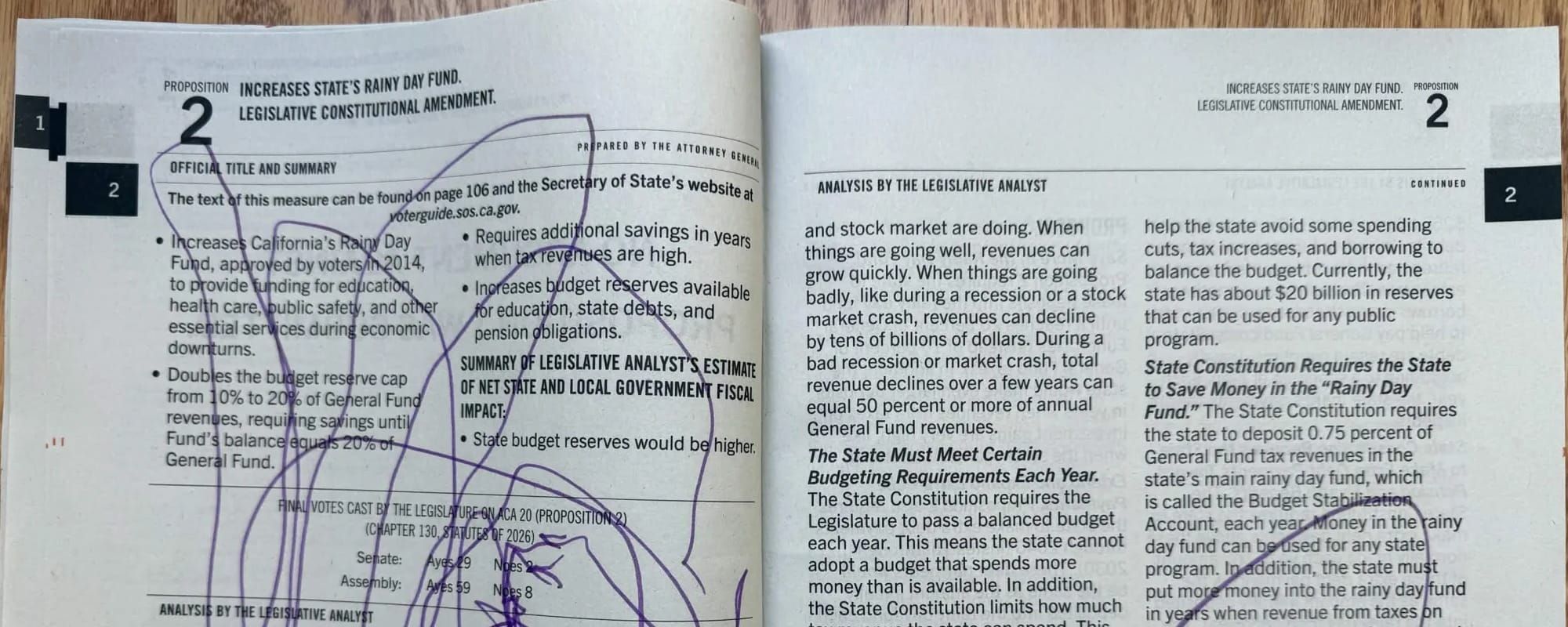
“Budget Stabilization Account Cap Increase and Gann Limit Changes Amendment”
It’s easy to take your cues on this one from who wants you to vote “no,” and vote “yes, fuck those guys.” A yes vote is with Democrats rearranging deck chairs on a budgetary shipwreck—in this metaphor, the iceberg is the permanent tax revolt—while Republicans and the Howard Jarvis Taxpayers Association wax pompous about the sovereign importance of “the Gann limit” and try to bail water back into the ship.
(Paul Gann was the other of “those guys” driving the iceberg in Grover Norquist’s bathtub, along with Howard Jarvis; Gann’s name is on Proposition 13, the original sin of this state’s great self-inflicted budgetary injury. And in this metaphor, we’re sort of picturing a ship being made small enough that we can drown it in a bathtub; while you might argue that, A., ships don’t drown and, B., icebergs don’t shrink the boat they hit, and yes, you might have a point, but our point would be that rhetorical figures are not an exact science, it’s called poetic license, and we’d be in danger of missing the point, here, which is, again, say it with us: “fuck those guys.”)
 Oakland Review of Books
This year’s Prop 2 allows the state a new, slight wiggle around the Gann limit, which is why “fiscal discipline” masochists are mad about it. After Proposition 13 limited how much the state could tax in 1978, the 1979 followup—the less well-known Proposition 4—created the “Gann limit” as a cap on how much the state could spend each year. But the irony is that there actually wasn’t much to limit for a while. Because the Gann limit was arbitrarily pegged to what the state spent in 1979–80—a year of relatively high spending—after which the state went into a recession, the limit didn’t come into play for a while.
When it eventually did, enough of the antitax fury had subsided that the state was able to piece together little changes to what counts as “spending,” or build in other exceptions to the rule, when it needed. In 1988, for example, after the Gann limit had forced the state to rebate between a few tens and a few hundreds of dollars back to Californians who’d paid taxes, some of the excess was allowed to go to schools; since then, there have been more rounds of “actually X or Y doesn’t really count as spending,” which has kept the Gann limit from being more of a problem than Democrats want it to be. Sometimes it’s a good problem for them. For example, in 2021, when tax revenues were climbing, Newsom turned his Gann Limit–mandated tax rebate into an “inflation-fighting” “Golden State Stimulus,” rebating some money to under-$75k annual earners, and probably helping himself avoid recall, in the bargain. While turning on their spits in hell, Jarvis and Gann were probably mildly annoyed that Newsom’s stimulus went to poor and middle-class people—rather than capitalist “job creators”—but they still basically won, since Newsom gave money “back” to “taxpayers.”
In a rational system, we’d have sent Prop 13 and the Gann limit to join their creators by now. Instead, this year’s Proposition 2 is just the latest kludge, exempting specific deposits to the state’s rainy-day fund from the Gann limit, a similar accounting trick as when some of your income goes into a retirement fund, and you don’t pay taxes on it until you spend it later. Austerity still basically wins; while this kludge lets the state “keep” the money it’s taxed, there are Jerry Brown–shaped forms of “fiscal discipline” embedded in how the rainy-day fund was constructed in 2014. The state gets to save revenue and use it to pay down debts (instead of doing tax rebates), but it doesn’t get to spend that revenue in any way it pleases; in fact, it’s required to save more of it than it was before, which I guess will be nice if the state runs out of money—and it does, in fact, sometimes “rain”—but idk, sometimes the best way to survive a downpour is to have spent the money to build a good roof back when the sun was still shining? (See Proposition 1.)
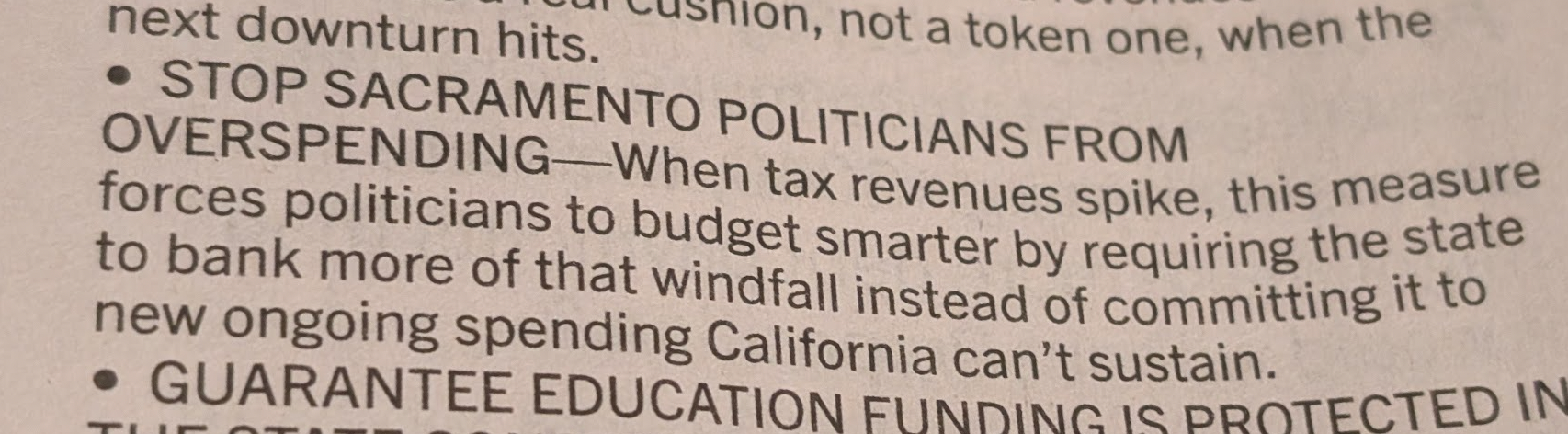
But this is budgetary politics in a state where Jerry Brown and Gavin Newsom can pass as progressives. Jerry responded to Prop 13 by declaring himself a “born-again tax cutter” (and once called Prop 13 “sacred doctrine that should never be questioned”). In this vein, most of these kludges rationalize and work within—and thus, render all the more permanent—an underlying self-imposed limitation on spending whose Jarvis-y philosophical basis goes unchallenged. That’s why even the “vote yes on Prop 2” argument in your coffee table book of a voter information guide can’t help but throw in bullshit about “Stop Sacramento Politicians from Overspending”:
Whatever. Voting yes solves nothing, but it solves even less to vote no.
Find more of our voting guide here.