Prop 4: Yes
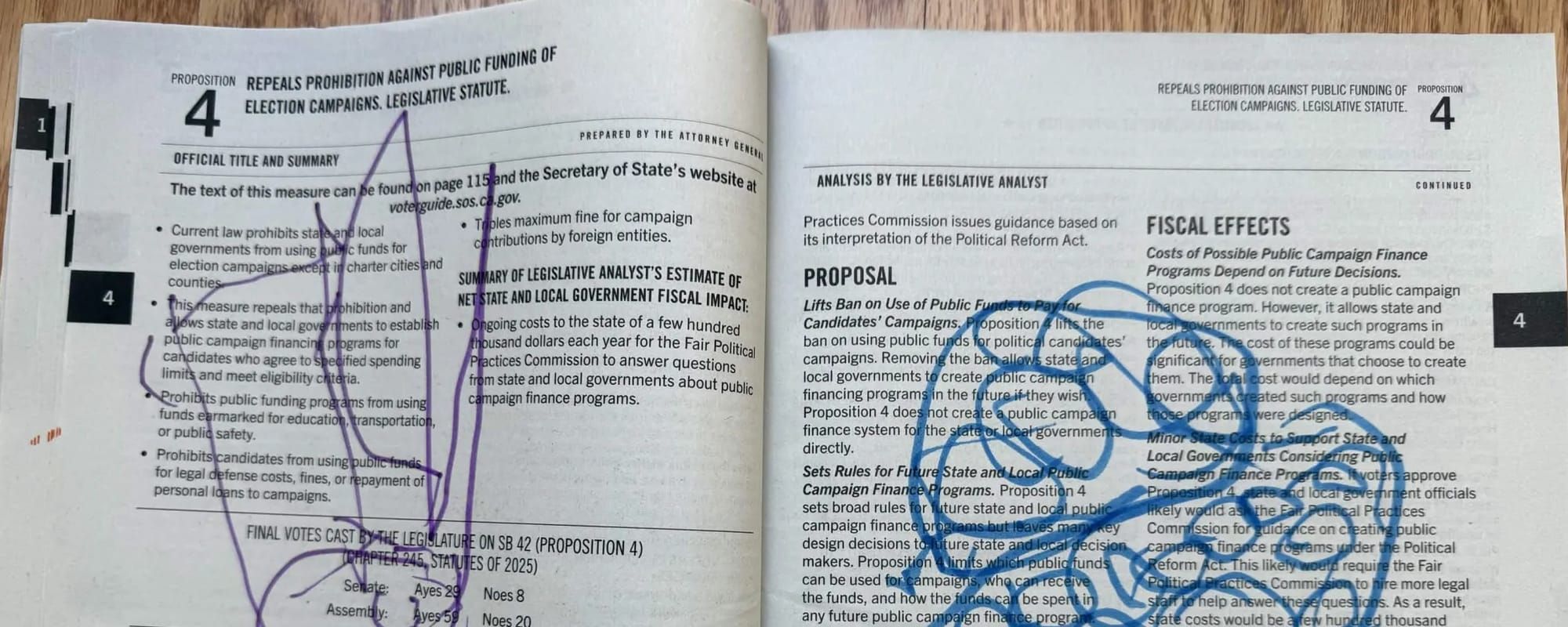
“Allow Public Financing of Election Campaigns Measure”
Readers in Oakland or Berkeley might be confused by this measure, because we already have public financing of elections; 73 percent of Oakland voters in 2022 might remember passing Measure W, aka “Democracy Dollars,” giving individual residents money to spend on candidates of their choosing. (Alas, Oakland invoked fiscal emergency provisions to delay the implementation of Democracy Dollars until 2028 at the earliest, and then cut the remaining direct-to-candidates public funding that had already existed.)
We have (or had) public funding because these cities are all charter cities. There’s a default set of municipal laws that govern California cities, but if a particular city wants its own, bespoke set of laws, they can adopt their own charter, a sort of municipal constitution, which allows them to have different powers from non-charter cities. Only 26 percent of California cities have charters, but they tend to be the largest cities, which means that 58 percent of Californians actually do live in one. (And Oakland is currently voting on a new charter, Measure EE).
 Oakland Review of Books
This proposition would change the default municipal law, to allow regular old, basic-ass California cities to decide for themselves how they want to structure public financing. Democracy! And the reason they need to be given that democratic choice is that, in 1988, 58 percent of Californians voted for Proposition 73—whose name was “Campaign Funding. Contribution Limits. Prohibition Of Public Funding”—except a funny thing happened after the masses democratically chose to both limit campaign contributions and also prohibit public funding: A district judge rolled up and told the voters to get fucked on the first part of that, such that a proposition which mainly seemed to be a limitation on campaign contributions (with a public funding ban sort of bundled in at the end) was turned into only a ban on public funding. (Another very funny thing is that, in 1988, a majority of voters also chose a second campaign financing proposition, which courts told to get fucked right off the bat). It’s all very amusing that all those voters who thought they were expressing their preference for limiting campaign contributions turned out to be taking away their city’s ability to (democratically!) choose to have public financing. Ha. Ha.
Anyway, left-leaning groups paying attention to elections and corruption think public financing’s good—Berkeley, Long Beach, Los Angeles, Oakland, Richmond, and San Francisco have chosen to have it—and if a city doesn’t want to enact such a program, Proposition 4 won’t make them. Oakland’s “Democracy Dollars” is an interesting new model, wherein adult residents get $100 to donate to eligible candidates; in Berkeley, candidates collect small-dollar donations and then get public funding as a multiplier on those donations (and must limit their overall spending, with large-dollar donations outright banned). The idea is to make campaigns less about dialing for big dollars and more about door-knocking, switching the indicator of a candidate’s viability away from “size of war chest” to “number of donors,” a Good Thing particularly when candidates accepting public funds are limited to donations of $60 per supporter. Vote yes, and then let’s figure out how to, for example, pay the cops a little less so as to afford to have the public funding system we already supposedly have, which voters chose, and which the legislators that we elected then chose for us to not have as an available choice.
Find more of our voting guide here.