Prop 40: Hell fuck yes
“One-Time Wealth Tax for State-Funded Health Care Programs Initiative”
Your opinion on Proposition 40 will probably depend on whether it matters to you that there will be a very Big—with a “B,” as in Billions—health care–shaped hole in California’s budget, next year and for the foreseeable future. Trump cut a trillion dollars from federal health care spending in last year’s One Big Beautiful Bill—along with dramatically cutting taxes for the rich—and the pain is now starting, with big cuts to programs like Covered California and Medi-Cal, along with millions of Californians losing eligibility. You can get into the details, but the gist is simple: Unless something big changes, California spends tens of billions of dollars less each year on health care, the state’s uninsured rate doubles (with certain categories of immigrants specifically targeted), people go hungry, and health care facilities close.
The budget shortfall is actually worse than the numbers make it seem, since it lowers the cost to California when people are made ineligible for state-administered programs. But whether Trump’s cuts will “cost the state $28.4 billion” over the next ten years, or “between $2.3 billion and $5.1 billion annually,” or “up to $19 billion in annual federal funding,” you get the scale of the event.
And so it’s worth asking, simply, whether it matters to you that this is happening. Because if you are individually quite comfortable and secure—or if you think you are—you might find yourself saying something like: well, at some point in the next several years, Trump will die, or something, and Democrats will be back in power, or something, and we’ll have a normal budget and things will be back to normal. Sure, in the meantime, tens of billions of dollars will have not been spent on health care—or on the other programs that got axed—but if you’re wealthy enough, and selfish enough, you might say, well, it will have just been a temporary period of belt tightening. Indeed, you might even be glad to see the progressive largesse of an overly progressive state pruned back, if you’re that kind of fiscal “moderate” (why, after all, should undocumented immigrants get health care?). If you’re a true right-wing ghoul, you might question why things like Medicaid should even exist at all.
 Oakland Review of Books

We suspect you are not a right-wing ghoul, nor rich enough to be truly secure from what’s coming. We suspect you might, instead, be saying something like: Shouldn’t someone do something, now? If a fuck-ton of money is suddenly not given to people for health care, will not many people die and get sick? Will not many of the health care facilities which rely on medical dollars to stay afloat go under? Will this not be quite exceedingly bad? Should not, instead, something be done about it?
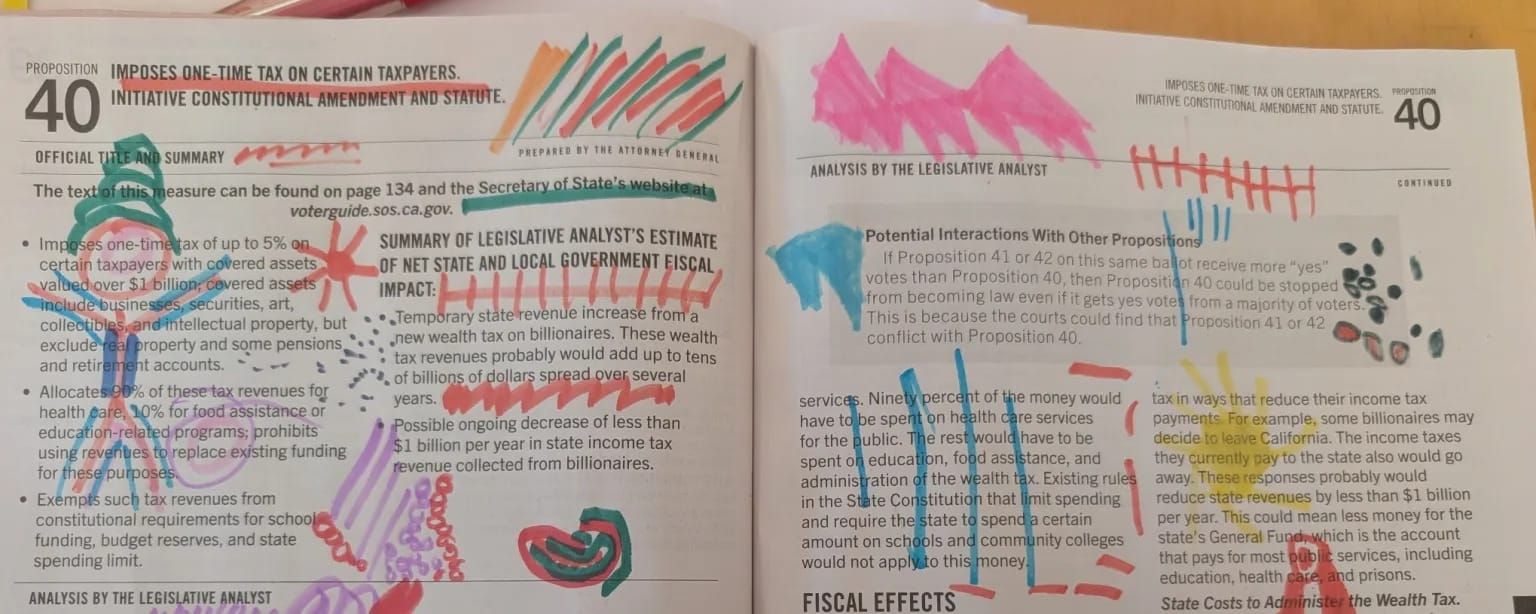
If so, you might be pleased to learn that there is a plan to do something at the scale of the problem, that there is precisely one way that “something big changes” which could mitigate a lot of that suffering. It is Proposition 40, brought by SEIU-UHW, but largely authored by Berkeley professor Emmanuel Saez and colleagues, who call it a “test of whether modern governments can reassert fiscal power over massive private fortunes.” It will make up for the tens of billions of dollars that the California budget is losing over the next several years by raising, according to the LAO, “tens of billions of dollars spread over several years” from a tax on billionaire wealth. As Saez and his colleagues explained in a working paper, while the wealth of California billionaires has reached $2.3 trillion (“as large as all the annual income reported on income tax returns of all Californians”), those California billionaires only “pay about 0.2 percent of their wealth each year in California income tax ($3.2 billion/year), representing 2.4 percent of total California income tax revenue on average.” There are many reasons to specifically target billionaire wealth. One of them is that other avenues for taxation have been choked off by Prop 13 and other antitax initiatives. The main one, however, is simply that billionaires have truly vast amounts of wealth which is essentially untaxed: Between 2019 and 2025, California billionaires paid income tax of about “1.6 percent of their wealth gains over the period.” As the authors note, on average, “the top four richest (Page, Brin, Zuckerberg, Huang) pay 0.07 percent of their wealth or $0.27 billion total each year in California individual income tax” on their company wealth; in many years, they paid nothing at all.
Though the proposed tax would be collected at one time, the revenue would be spread over the next five years. It is, therefore, the kind of money, at the right scale, that would be able to prevent the number of uninsured Californians from doubling by 2030. And in the absence of that money, at that scale, that is what it will do.
The scale is important. While a million seconds is about twelve days, a billion seconds is around 32 years. And in budgetary terms, billions are very different from the million dollars, here and there, that budget wonks call “budget dust.” If a few million dollars are cut from a budget, you can usually make up some or all of the difference from somewhere else, without fundamentally restructuring the budget. But a billion dollars is qualitatively different in scale. If you cut tens of billions of dollars from the budget, the numbers themselves stop mattering so much; all the other numbers are far too small to make up for it.
We’ve belabored this point because some people want to act as if the big health care–shaped hole in the budget is not such a big deal and won’t crater our state’s health care system, that throwing millions of Californians off their health care plans won’t fundamentally alter the fabric of the state. It is the same kind of mass delusion—or sociopathy—as the idea that letting the Bay Area’s transit system crash and burn—if the Regional Transit Measure doesn’t pass—is something endurable. It’s the same mass delusion—or sociopathy—as thinking climate change is just one bad thing among many. It is a misunderstanding of scale, conscious or unconscious, a fantasy that there won’t be consequences that matter.
This crowd of people wants you to misunderstand the scale of the thing, and not to think about the absence of any other prospect of fixing the problem at the scale at which it will occur. This is made a little easier by the way it hits poor and immigrant communities. And they particularly want you not to think about how, for the tens of billions of dollars needed to plug the hole Trump made—on behalf of the billionaire class—a tax on the wealth of billionaires is literally the only option there is. What they don’t want you to understand is that there is nowhere else in the budget that money could come from, because then you might notice that, if we choose not to take it from that location, then there simply is no fixing the problem.
If you do think about these things, we would argue, it becomes a very simple choice.
If Californians vote yes on Prop 40 (and vote no on Props 41 and 42), then we can raise tens of billions of dollars, spread it over the next five years, prevent some or all of the bad shit from happening, while we wait for Trump to relax his grip on government (and perhaps corporal existence).
On the other hand, if we vote down Prop 40, or if we vote up Props 41 or 42, then we will not have those tens of billions of dollars spread over several years to plug the hole. All that bad shit will happen. People will suffer and many will literally, actually, nonmetaphorically die because of it.
That is the choice. And of course, even if Prop 40 passes, and Props 41 and 42 don’t, it’s not necessarily over. The billionaires will push back—they already are and have been—and the courts might get involved, because huge swathes of the courts are simply an arm of the Republican Party now. Deciding to do something doesn’t mean the doing will necessarily be easy or instantly successful; only “not doing anything” offers certainty of result. But while “certainty” can sound better than “uncertainty” in the abstract, we don’t live in the abstract. In the world we live in, the literal worst-case scenario of passing Prop 40 (having it struck down) is the same as not passing it.
\O/
We’ve tried to keep this simple because it is, actually, pretty simple, and because particular kinds of complexity and nuance can be and are being and will be very instrumentally used—ideologically and misleadingly—to obscure that simplicity. You can easily get bogged down in names, partisan identification and reverse polarization; you can find yourself fixating on whatever opinions you have about taxes, unions, personalities, or any of the variety of grievances or grudges that might enable you to miss the basic fact that Props 40, 41, and 42 are essentially about whether billionaire wealth accumulation is more precious than a lot of Californians having basic food and health care. We are not being sentimental or manipulative when we say that while Prop 40 targets literal billionaires, Trump’s cuts—being racist and xenophobic—literally and specifically target California’s immigrant communities. Only a few years after Medi-Cal was made available to all Californians, it’s being clawed back, even from the undocumented workers who do the literally back-breaking labor of growing the food you eat.
In short, we don’t so much get to choose as we have to choose between those two communities, broadly conceived. To the extent that one of them is going to pay, the other will not. Once you see it this way, this ballot measure stops being a complicated debate and becomes an intellectual and moral test, in which you get to decide whether you want to vote for people to die or not. You can choose whether you want to talk about what is actually happening, rather than just shit billionaire propaganda out of your mouth-hole. That simplicity also allows us to look at the different groups of people who are absolutely declining to acknowledge it—who are inventing different kinds of subtlety and nuance and complexity and also outright lies and bullshit to obscure it—and makes it possible to their statements as useful revelatory documentary evidence about who, exactly, those people are, whom they see as their power base, source of funding, and constituency, and whom it is they serve.
You get to see how, in so many cases, it simply isn’t us, the working and voting people of California. “Review” is in our name. Let us review them.
1. Billionaires
In general, the richest one percent of the country—whose taxes were cut, and whose wealth has grown tremendously as a result of Trump’s policies—are going to be fine with what’s happening. But billionaires form a tiny subset even of that one percent, and it’s they who are most fine with it, especially the coterie of billionaires who bankroll Trump (and who, as such, effectively authored the budget themselves). Sergey Brin, for example, is very visibly at the center of a web of anti-Prop 40 billionaire activism, not only because he stands to lose $13 billion of his $273 billion, but also because he is, himself, a huge supporter of Donald Trump.
Billionaires do not really pay taxes on their wealth. This has been comprehensively reported—along with ProPublica’s work, see the book Emmanuel Saez wrote with Gabriel Zucman, Zucman’s more recent (and excellent) manifesto, and the recent working paper I cited above—but it’s still not widely understood how categorically untaxed they are. Take Jeff Bezos between 2006 to 2018, for example: As ProPublica demonstrated, his “wealth increased by $127 billion…but he reported a total of $6.5 billion in income. The $1.4 billion he paid in personal federal taxes is a massive number—yet it amounts to a 1.1 percent true tax rate on the rise in his fortune.”
Imagine if you paid only a 1 percent tax on your income. You don’t because increases in billionaire wealth are taxed differently from the kind of income you make. In this way, Elon Musk could report no income at all in 2018, a ludicrous and obscene sentence, and the general rate at which billionaires are taxed never really rises above the very low single figures. You might think we have an income tax in this country, but what we really have is better understood as a wage tax: Waged and salaried workers pay a sizable share of what they make to the government, while billionaires increase their wealth in a kind of default, on-shore Cayman Island, sheltering it from taxes. (“If all France’s billionaires were to flee to the Cayman Islands tomorrow,” Zucman noted, “the loss of tax revenue to the country would be insignificant: around 0.0 per cent.”)
Billionaires like Sergey Brin are fighting tooth and nail, therefore, against a really mild tax increase. Prop 40 would “require them to part with one-eighth of the wealth they’ve gained since January 1, 2025,” as Inequality notes, twenty months of Donald Trump, during which the combined wealth of the twenty-two billionaires fighting Prop 40 “increased $282.6 billion, a gain of over 64 percent.” If you think one-eighth of the wealth you’ve accumulated in the last two years of being atrociously coddled by a billionaire president (and not even income, but wealth) is a high amount of tax to pay—one time!—then you might be a billionaire. But if you are a worker and you pay taxes on your income, paying only that tax would be, for you, a very large tax cut. You pay a much higher tax rate than Sergey Brin does. To be asked to pay only what they are going to war to avoid would be a great deal for you, which is why you are not being offered it.
(Note: NVIDIA billionaire CEO Jensen Huang is officially chill and cool about being taxed.)
2. Billionaire mouthpieces
As you scroll down through this list, you are trickling down through the channels made by money, as it encourages and rewards people and institutions for their brave stands on behalf of billionaires.
Top of that list is the Hoover Institute. Because their whole thing is helping rich people keep their money out of the hands of poor people, it’s no surprise that they’ve been issuing statements and agitprop about how taxing property (and billionaires) is a bad thing that we should not do. The overwhelmingly billionaire-owned media is, of course, always glad to refer to Hoover’s product, simply, as the output of Stanford professors, which is not untrue, but is mainly just a much nicer brand than the “cancel the New Deal” think tank that Hoover is (and despite Berkeley’s also very nice brand, the Berkeley economics professors who authored the proposition are rarely cited in that way, or allowed to retort). In any case, Hoover’s scholars have put a lot of fingers on a variety of scales and make a lot of assumptions that allow them to come to their desired conclusions. First, they very generously estimate how much income tax billionaires will pay into the state in the future, such that it can then be calculated as lost revenue if those billionaires decide to leave. After that, they assume that many more billionaires will choose to and successfully manage to leave, to evade the law, joining the six who have publicly claimed to have left the state (in this assumption, they also posit that they win in court to overturn the plain language of the law).
If you accept all of these assumptions, then the numbers do look worse. But plutocrat flight is one of these good times we’re always threatened with and rarely receive. Witness the non-exodus of capital from Mamdani’s New York City, for example, after all that sturm und drang leading up to the election; look at places like Massachusetts, where a tax on high-wealth earners didn’t lead to a wealthy exodus (or Norway, where same). But a Hoover-brain never notices all the reasons why moving to Florida or Nevada is something rich people like to threaten more than actually do. Why would they completely uproot their lives just to save what actually is, for them, a strikingly small piece of an essentially uncountable wealth, one time? Ideological freaks like Brin or Musk might be willing to cut off their nose to spite their face—and Trump will reward them for their loyalty—but how many billionaires hate paying such a tiny fraction of their wealth in taxes so much that they would give up all the reasons they are located in California in the first place? (Hoover does not factor into their analysis any of the reasons why leaving California would represent, for this crowd, a real loss of access to economic power).
While Hoover takes the six who have reported that they have left at their word, without question—as well as assuming that more will follow—Saez and company note that changing residency in the terms required doesn’t just mean buying a house in Nevada, hopping on a plane, and issuing a press release; it would mean “uprooting most of the individual’s personal and business ties to California, not just the reincorporation or relocation of a few business assets or the purchase of real estate out of state.” (They even cite a law firm explaining how it can be done—perhaps trolling for billionaire business—as a demonstration of how complicated and difficult it would be to do it so quickly.) For this reason, Saez and company estimate that “only billionaires who had already started the process of leaving California well before could possibly complete the process in such a tight time frame.” They also calculate the prospect of billionaire flight very, very differently: “In the extreme case where all billionaires left, it would take 25 years for the income tax loss to match the revenue from the tax.” As far as I know, this counterargument has not featured in any of the news reports which breathlessly take Hoover at their word as they breathlessly take Sergey Brin at his.
And who knows, it may be that the six billionaires that Hoover counts have managed to pull it off on short notice. But it seems a lot more likely to me that they are just saying they did, to dissuade passage of the proposition, because they know billionaire-owned entities like Hoover and the newspapers that quote them will never check. I suspect that a proposition very specifically crafted to make it impossible for billionaires to move their assets to escape the tax—by experts in tax shelters and billionaire wealth—will, as a consequence of being designed to do so, do so.
Even after torturing the numbers pretty relentlessly, Hoover can’t come up with a scenario worse than Proposition 40 costing almost as much as it would bring in. Put another way, the result of passing Prop 40 is, at worst, roughly the same as the best-case scenario of not trying at all. And just as massaging the figures in the way that Hoover does is an overt effort to discourage the proposition’s passage, which they ideologically object to, it’s exactly the point that this is all a part of a fight, one that does not end with passing Proposition 40. Billionaires will fight like hell to avoid paying even a fraction of the percentage of your tax rate, and given all the Federalist Society brainrot in the American judiciary, the courts will be sympathetic to the argument that taxing billionaires is wrong, because of the legal principle that it is wrong to tax the people that bribe them. But while Hoover’s arguments that Proposition 40 is doomed to failure presume an entire, unified political system working to defeat it—and that isn’t completely implausible—doing so simply presumes the outcome, rather than arguing it. Any fight will be won by one side, if you posit that the other side didn’t show up. (This scenario also cuts against their scary warning that passing a wealth tax once means people could pass another one, again; they can’t decide if our future wealth tax is comprehensively defeated and consigned to the dustbin of history or if it, also, presages the coming of a comprehensive economic collapse in which we tax every billionaire out of existence. It can’t really be both.)
Along with Hoover, let us also list in this heading institutions like the Howard Jarvis Taxpayers Association or Reform California, which have a similar message—taxes are bad—but whose argument specifically relies on eliding the difference between you and billionaires. That a tax on billionaires opens the door to wealth taxes for you, a nonbillionaire, is, on the one hand, a classic “Oh, so you like this thing? What if it was a completely different thing? Not so great now, is it!” tactic. But on the other hand, they rely on you not realizing that you already pay wealth taxes on your car and home (if you own those things, which, if you listen to these folks, you surely do). They try to make you identify with billionaires—an injury to Elon Musk being an injury to all—by helping you forget what you should otherwise know about how radically and fundamentally different your life (and economic station) is from theirs.
Finally, let us also hand out some special raspberries for billionaire-funded GrowSF—whose billionaire backers include Chris Larsen, one of the main anti-40 funders—for having the stones to say in their voting guide, with a straight face, that “[t]his same ballot carries a durable alternative we endorse: Prop 3, which keeps the existing tax rates on high earners.” The word “alternative” is offensively ludicrous. Prop 3 keeps an existing marginal tax rate on the highest earners, the current status quo: Obviously we should pass it, but marvel at the intellectual dishonesty required to present “let’s not cut taxes on high earners” as an “alternative” to the only new source of revenue on offer.
(I was curious if Empower Oakland would find a way to come out against it; alas, their voter guide did not include California propositions, so we are left to navigate these stormy waters without their wisdom.)
3. The “it’s complicated” brigade
While it is not exactly surprising that organizations like SPUR and the League of Women Voters are officially neutral on Prop 40, it still sucks and is disappointing. But organizations like these come up with their recommendations through a process, and in the absence of consensus among their board and backers, that process can produce this kind of result, and often does in the more controversial propositions. Since a lot of people with a lot of money are saying, very strongly, that we should do nothing about the hole in the budget (alongside those who think we should do something), there is a lack of clear consensus, which the “neutral” stance in these organizations reflects.
That said, something interesting happens when these voter guides have to retroactively justify what their board or selecting committees have chosen (or failed to chose), and one can read something in the pretzels they have to contort themselves into to make “do nothing” sound reasonable, judicious, and defensible.
SPUR says “the proposal fails on some good government principles” and the “state will need a permanent solution to the gaps H.R. 1 creates, not just a one-time fix”; the League of Women Voters says “the tax mechanism limits legislative flexibility for allocating money where it is most crucial and raises the risk of taxpayer flight.” But in balancing their sense of what an ideal solution would look like, they find themselves falsely implying that one is on offer, which it is not. More interestingly, they implicitly establish a principle of equivalency which is worth rendering explicit, balancing “good government principles” and “legislative flexibility” against all those not-sick and not-uninsured and not-dead Californians. This is a very institutional sociopathy that comes out when people responsible for writing actual sentences and paragraphs have to justify their “Neutral on Prop 40” mandate, because they find themselves arguing that the “short-term” nature of the solution—weighed against the need for a “permanent solution”—means the actual effects of this short-term solution are somehow worse than doing nothing.
SPUR and the League of Women Voters will not and cannot say that, of course; they cannot argue that “limiting legislative flexibility” is a worse outcome than millions of Californians losing health insurance, or to make the actual case that X number of hungry children or sick and dead Californians is a price we must pay for “good government principles.” But that is what they are saying. To be officially “neutral” on this issue, to be unable to know—or say—which side to choose, is not an institutionally surprising outcome, but it does reflect the value of an advocacy organization that cannot advocate.
4. Fake progressives
Knock us over with a feather that Gavin Newsom is against Prop 40 (as is Becerra); Newsom was already trying to pull undocumented workers off Medi-Cal before Trump’s budget did it for him. And a lot of Civic Joy Fund–affiliated SF politicians, like Scott Wiener, oppose the billionaire tax because they are dependent on the billionaires who support them; Daniel Lurie is of course against it, because he is a billionaire (or billionaire to be) and serves billionaires, and the San Francisco Democratic Party also broke with the state Democratic Party on this issue.
However, because they are California politicians, they are occasionally forced by their electoral constituents to pretend to be progressives. When this happens, they will do two things: tell Hoover scare-stories about the prospect of billionaire flight and then pretend to be in favor of a national ultramillionaire wealth tax, like the one Elizabeth Warren has proposed. And of course, Warren’s proposal would be a good thing: Her webpage cites Zucman and Saez as well, the same as the people who brought Proposition 40 do, because the arguments, rationale, and facts are all the same. But at the meeting where SF Democrats voted 17-4 to oppose Proposition 40, two of the “no” votes also put forward a resolution for a national wealth tax. This is also Newsom’s position, and it’s a lot of people’s position who would like to shift responsibility to where the problem was intentionally created, and to the people who created it, thereby excusing Californian politicians from any responsibility for mitigating what is happening. And sure, it certainly would be good if the federal government, instead of intentionally hurting immigrant communities and enriching billionaires, would do the opposite of that. Perhaps we should ask them? Perhaps we should try calling him “Drumpf” and see if that works? Or perhaps a pointed tweet, addressing him as “sir” and appealing to his inner dignity?
Or we could be adults. Calling for a national wealth tax—while doing nothing in California now—is not a plan. It’s an alibi for sitting on your hands while the cuts take effect. Nothing would do more to make a national wealth tax possible and plausible than passing Proposition 40 now. These people are against both. It’s insulting to see them pretend otherwise.
5. Sellouts
Does former representative and world’s best boss Katie Porter still matter? Is she only a book influencer, now? If she does still matter, it’s because she has enough of a reputation and name as a resistance liberal and clipboard wonk that she can write an oped arguing that Prop 40 is “a seemingly progressive-sounding policy solution that ultimately just perpetuates the status quo” (in the billionaire-owned SF Chronicle). Perhaps because she no longer has to appeal to her one-time constituents in Orange County—a district very split between fans of billionaires and working-class immigrants—she has, like Obama in his Richard Branson’s–yacht era, decided to cash in on her name. Maybe she’s just paying back donors to her gubernatorial campaign (among them Chris Larsen). But because we’ve seen and heard from more than a few people who value her opinion, specifically, it’s worth taking a look at her claim that being against the billionaire tax is the progressive position that breaks with the status quo.
For Porter, Proposition 40 is bad because it “does nothing to reform our healthcare system and would send billions in tax dollars to private health insurance companies and corporations that dominate our healthcare system.” This is delicately and carefully phrased to align the proposition with a for-profit status quo, which is not exactly a lie, but is very misleading. Prop 40 “perpetuates the status quo” in that it will pay for the programs Trump is gutting, which pay for care in the system that actually exists in the world. Porter is lecturing someone having a heart attack about how short-term a solution a bypass would be, advising diet, exercise, and addressing the underlying problem instead of a stent. Since people will die because they can’t afford the “private health insurance companies and corporations” that provide so much of our health care, this is barely even an analogy.
Porter also claims that “Prop. 40 delivers only a limited, one-time transfer, not the sustainable, predictable funding required to keep hospitals, community clinics and reproductive health providers afloat,” concretely misrepresenting what Proposition 40 would do—provide FIVE YEARS of funding—as well as misrepresenting what other options are out there. Because of course it would be better if we got a permanent wealth tax. But rhetorical sleights-of-hand like “Despite what its supporters say, Prop 40 is not a solution to our health care crisis” is a way of bullshitting you away from what its supporters actually say, which is that it’s a short-term triage response to an immediate problem. “Let us instead pretend that we’re about to pass universal health care” is not a counterargument.
6. Philanthropic health care
As thirty-one angry Planned Parenthood workers in Southern California wrote an open letter to observe, Jodi Hicks—the president and CEO of Planned Parenthood Affiliates of California—has come out against Proposition 40, by (in their words) “falsely claiming that the Billionaire Tax is not the right solution to the crisis facing our state and our organization—all without proposing any other viable fix.”
And it took many by surprise that the head of a health care provider would do this. Since the Planned Parenthood voter guide offers no explanation, you have to go to the official “No on 40” website to find her full statement: Prop 40’s “uncertain impacts on the state budget and lack of specificity on health care allocations will do more harm than good in the long term”—a statement, by the way, displayed at the very top of their page, because Planned Parenthood is a real get for them. You can also dig out press releases that quote her elsewhere on the “No on 40” website.
Do “uncertainty” and “lack of specificity” equal concrete harm? Does that harm outweigh the good of literally millions of people not losing health care? If you dig into Hicks’s public statements to figure out how she gets there, what you find is a very specifically Planned Parenthood perspective: Because Planned Parenthood lost a lot of funding from Trump’s bill, she is angry that the funding from Prop 40 will not specifically and necessarily replace it (as well as being left out of the coalition that put it together).
This may be as petty and shortsighted as her colleagues at Planned Parenthood say it is. And when she begins and ends with recognizing “the need to address the devastating impacts of H.R. 1 and ongoing attacks on health care” and urges their partners “to work towards a real long term solution,” it makes her sound kind of crazy for implying that there are any other significant efforts to address the impacts of HR 1, or that there is some other “long-term solution” on the horizon. Is she pathologically self-centered? Is she crazy?
Probably not! I suspect she simply thinks that billionaires will be a more reliable source of funding for Planned Parenthood than the government will. After all, it was only a few years ago that billionaire MacKenzie Scott gave $275 million to Planned Parenthood. If Proposition 40 will not give Planned Parenthood the $300 million that Trump cut, maybe a few billionaires like Scott will? But might Planned Parenthood advocating for Prop 40 make those billionaires less likely to do so? Advocating against it, as Hicks has, might be what she judges to be their best route toward institutional stability in this prisoner’s dilemma.
I suspect this might be the basic calculation for a lot of people like her: not to wait Trump out, and not to oppose him, but to adapt to a world in which his backers are, and remain, the only power and source of funding available. People like Francisco Silva, for example, whose California Primary Care Association “represents more than 2,300 not-for-profit Community Health Centers” (my emphasis): Perhaps he is simply judging that since nonprofits can raise money from billionaires or from the government, billionaires are going to be the best way to get that money, going forward. (When pressed on the point, in this interview, Silva hems and haws a little about exactly how, in the absence of Prop 40, those billions of dollars will show up, and offers the opposite of substance, mostly a lot of futzing around on the margins of already existing taxes, none of which is at the right scale.)
Whatever else it is, big philanthropy is also an expression of power; it’s not “just giving,” per Rob Reich. When Oakland rejected a parcel tax that would, among other things, have funded trash cleanup efforts, a billionaire immediately popped up to reward us with $9 million for drones and enforcement. In moments like these, billionaires are teaching the state to rely on them, instead of citizens, degrading the fabric of democracy. They can spend what are very small (to them) amounts of money to get what is actually a lot of power and influence over the government, and that’s why they do it, reshaping the state to reflect their policy preferences (and incentivizing it to rely on them). Billionaires would like to run the country, even more than they do, and they’ll spend money to buy that power. Sergey Brin is not spending $100 million dollars to stop Prop 40 just to save $13 billion; that hundred million is the price tag he and his crew will pay for control over state tax policy.
7. Unions behaving badly
Like Planned Parenthood, the California Teachers Association is sufficiently ashamed of their stance against Proposition 40 that it’s a lot easier to find it on the No on 40 website than on their own actual site, and you’ll need to read media accounts even to piece together their supposed rationale, beyond “will not provide the sustainable and long-lasting funding that our schools and communities deserve.” That 40 aims to provide $2.5 billion a year for schools would seem to be relevant, but perhaps CTA did not deem it so?
In any case, CTA gets us to the whole labor-unions-thing of it all, since the reason CTA is against this is that it doesn’t benefit them, specifically, enough. Does this seem shortsighted and bad to you? It does to me! After all, if it’s true that “CTA opposes Prop. 40 because TK-12 and community colleges would receive only 10 percent of the take from Prop. 40, a smaller ratio than the 40 percent that they already get annually as their share of the state’s general fund,” then, well, that’s a bad argument, unless you are the worst kind of narrowly construing self-interested professional advocacy organization, which is precisely what real labor unions should not be (but often, alas, are). If CTA’s position is that it’s bad to receive billions of dollars in new funding if health care providers are getting proportionally more than they are getting, then this is a monstrously antisolidaristic argument and the ghost of Tom Joad should have a word with them.
That, to me, is a bad union: an organization which serves the interests of its own members at the expense of class solidarity with workers more generally. (It’s why cop unions are bad unions, too.)
Anyway, that brings us to the broad argument, brought by a lot of billionaire-friendly media, that SEIU-UHW is, itself, a bad union, particularly its leader. There was a story in the billionaire-owned Los Angeles Times, for example, about SEIU-UHW president Dave Regan allegedly “extorting” support for Proposition 40 and generally being a bully, even possibly physically aggressive. And who knows, there might be something there, even if the political usefulness of these stories is why they’re being dredged up (from seventeen years ago?!) in the way they are.
But sure, follow up on any and all allegations of actual misbehavior by him! Let’s just have a sense of proportion here. Manny Yekutiel was opposed to Proposition 40, and the fact that he has had to flee politics after being unveiled as a sex creep isn’t what makes his Pro 40 position wrong, or that of his friends in the SF Democratic Party who voted with him and tried to brazen out his accusations. And just generally, please miss us with the idea that this is about Regan, specifically, or even about his union. SEIU-UHW is also, allegedly, a bit messy, in the sense that they engage in a lot of really combative legislative actions, like this one, and they don’t always seem to be good coalition partners with other unions. This is something you hear a lot of people say (even people who aren’t like CTA, taking stances that testify to the kind of bad labor coalition partner they are).
But even if you grant it, so what? The other side is filled with some of the most reactionary political ghouls in California politics; if you find SEIU-UHW to be bad company, compared to that lot, we’re not sure what to say, but it probably isn’t to your ears that our arguments are aimed. Whether or not we should take billions of dollars from billionaires and use it to fund the not-dying-of-Californians is an important question; whether Dave Regan is a bad person—or whether SEIU-UHW should get to have a “win”—is not an important part of answering it.
Find more of our voting guide here.