Prop 44: No
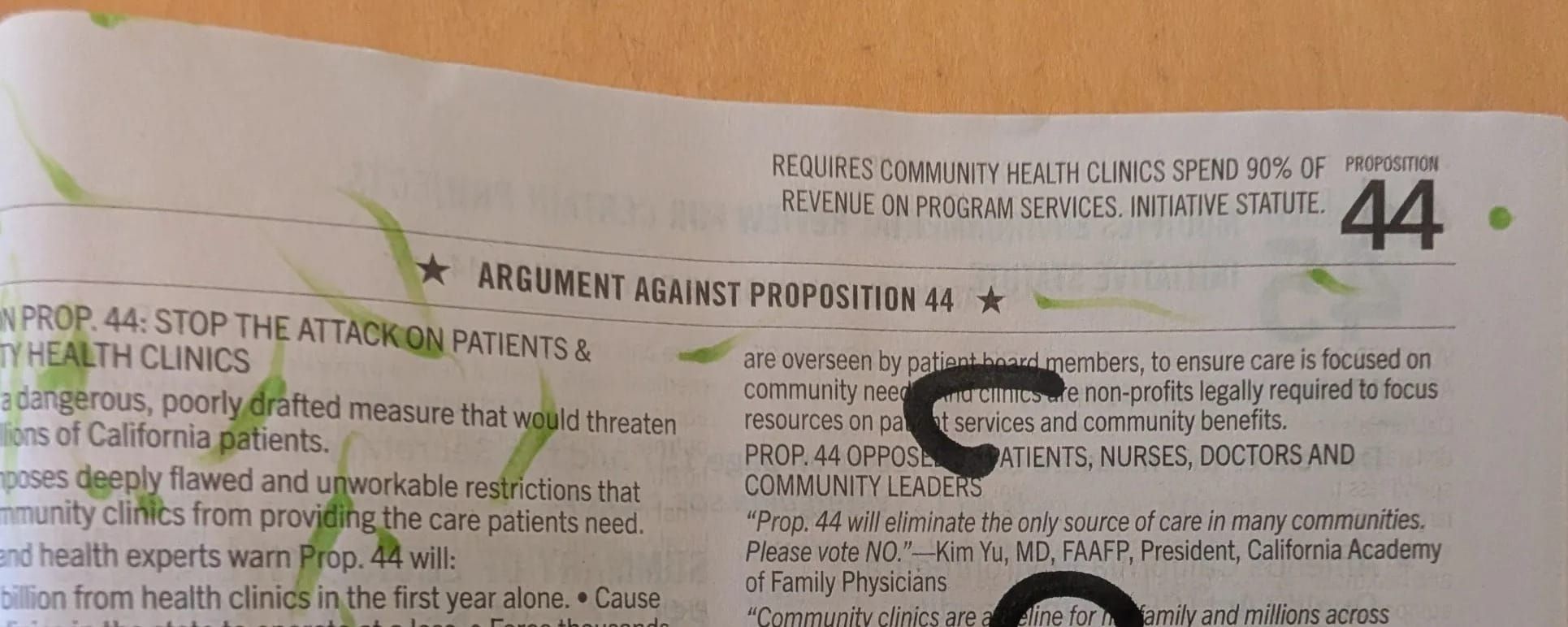
“Spending Requirements for Federally Qualified Health Centers Initiative”
Proposition 44, like Proposition 40, is sponsored by SEIU-UHW, and like Proposition 40, has been attacked as “heart in the right place but bad policy.” But whereas Proposition 40 could protect health care for thousands of people and literally save lives from the murderous Trump administration (and at worst, if the haters are right, leave us stuck in the catastrophic status quo, albeit with some sad billionaires), Proposition 44 carries considerably greater risks, and those risks fall on vulnerable patients and rural communities. Most progressive voter guides are recommending a no vote—DSA is an exception—and ORB will, with a sigh, join them in urging a no on this one. Proposition 44 has noble intentions—make clinics spend more on patient care and less on executive salaries and overhead—but is probably a bad law, in practice, and in this case, that matters.
Fundamentally, it’s an attempt to use the proposition system as a too-blunt instrument to win a labor fight. This use of propositions and more local ballot measures is a longstanding SEIU-UHW strategy, and a source of much internecine skepticism (or outright hostility) from other labor unions. Actually, SEIU-UHW, or United Healthcare Workers West, has been the source of a lot of intra-union conflict, for close to twenty years. In 2009, the 120,000-member union was taken over by SEIU National, resulting in a knock-down fight and litigation and SEIU-UHW’s previously nationally prominent leader, Sal Rosselli, founding a competing union, NUHW, and beginning a series of union turf wars among medical workers in the Bay and beyond.
 Oakland Review of Books
Meanwhile, SEIU-UHW’s new, post-takeover leader, Dave Regan, pivoted to the use of propositions as a signature strategy. You may remember a series of ballot measures involving dialysis clinics in 2018, 2020, and 2022. The 2018 proposition would have required clinics to issue refunds if revenue exceeded 115 percent of the amount spent on patient care and health care improvements, while the 2020 and 2022 iterations required that clinics be staffed with licensed physicians and certain disclosures to the state and/or patients. A lot of people need dialysis each month to stay alive, and the two largest corporate providers, Fresenius and Davita, own more than 80 percent of US dialysis centers, and are awful: Fresenius has had to pay a cool couple hundred million in penalties for violations of the Foreign Corrupt Practices Act—to the Trump DOJ, so you know it was really bad—and the CEO of Davita was indicted for antitrust labor market violations.
But the policies SEIU-UHW pushed via proposition were ultimately at an angle to the union’s real goal, which was gaining representation for the underpaid people who staffed these clinics. Voters who were sympathetic to both workers and patients were put in something of a bind. And whether conflicted voters ultimately went with patients or were simply overwhelmed by the clinics’ propaganda (SEIU-UHW was outspent ten to one on each of these campaigns), the ballot measures failed.
At least at the voting booth. There have been (temporary) trustbusting victories against the dialysis duopoly: The California legislature took up the cause and in 2020 enacted legislation capping the reimbursement rate for dialysis for patients with private insurance (thereby thwarting an ongoing alleged scheme by which Fresenius and Davita donated to the American Kidney Fund in exchange for the latter directing patients to private insurance). That legislation has since been struck down by two far-right-wing Trump-appointed judges, because of fucking course. In their ongoing effort to unionize exploited dialysis workers, SEIU-UHW has managed some victories as well; by February 2023, workers at eleven dialysis clinics in California had voted to organize.
Proposition 44 is another iteration of this type of fight, and so if you’re a voter and feel like you’ve been thrust into an ongoing war and asked to make a choice without really being told who the sides are and why they’re fighting, well, fair enough. Again, although the measure is about spending, it’s also about labor power. One of the largest of the targeted clinics is currently engaged in light union-busting. (The fact that it’s the Trump NLRB filing charges means you know it’s really bad.) Some of the clinics are also guilty of overpaying executives at the expense of workers and patients alike: The CEO of one of health care providers of last resort (Altamed) made $2 million per year in 2024, the “Senior Strategy Executive” makes another million, and the CEO of Innercare (the clinic accused of union-busting) made close to $700K in 2024. Proposition 44 would require that these clinics spend at least 90 percent of their revenue on “activities that accomplish each clinic’s exempt purposes,” which would be all to the good. These clinics are overwhelmingly funded by public dollars, so it is particularly egregious that their executives compensate themselves so generously (and that a big chunk of their revenue goes to something other than patient care).
But examples of CEO salaries aside, the clinics being targeted are a diverse group of health care providers, termed “federally qualified health centers,” defined as any nonprofits that receive federal grants because they serve patients in places with a “shortage of personal health services.” Applying a blanket spending threshold to these nonprofits is thus a high-risk enterprise for their patients. Anyone who has spent a lot of time in and around nonprofits can tell you that strict restrictions on funding to programmatic activities are generally counterproductive. Organizations do need infrastructure, accountants, an HR department, and copiers; overhead is the stuff that holds the services together, and executives do need to be paid. An estimated eighty percent of the nonprofits subject to the measure are currently out of compliance, which could indicate either widespread malfeasance or an unrealistic standard, but in either case, could mean driving a nonzero number of health clinics right out of operation if Proposition 44 passes. Given that, at this exact moment, a lot of “federally qualified” nonprofits are suddenly very short of actual federal funding (for more on why and our moral obligation to fix that, see our 6,000-plus words on why you should vote YES on SEIU-UHW-sponsored Proposition 40); it might be exactly the wrong time to pass a stringent limit on how much can be spent on what are sometimes very fixed costs.
This is not to say that we agree with all those supercilious and pearl-clutching editorials about how scandalous it is that unions would risk patient care for their own selfish benefit and how outrageous it is that SEIU-UHW has adopted ballot measures as a strategy, editorials written by publications who held their noses and endorsed Proposition 22, in which Uber and Lyft bought their way out of state labor law. Others have been written by “nonprofit” trade association spokespeople paid upward of $560,000 per year to have opinions about how much medical executives should make. But even if the Chromicle editorial is full of shit, as are health care lobbyists, is this specific kind of categorical rule about funding and spending a good idea? We feel pretty confident saying no.
And here’s where we can’t resist shoehorning this ballot measure into our voter guide’s theme: Proposition 44 is also asking voters to apply a bandaid to a gaping wound caused by massive public divestment. It’s a little harder to see in this case, since the nonprofits that would be affected by this measure are overwhelmingly funded by Medicaid, Medicare, and federal and state grants (only 14 percent of revenue came from private insurers in 2024). But the reason Altamed’s and Innercare’s executives can reward themselves so handsomely while unions have to fight for representation is that rather than directly pay for the work of providing health care in rural areas, through either state or federal governments, we funnel money through complex systems of grants and means-tested insurance to nonprofits that have their own interests and their own executives, and which do not offer the kind of worker protections that public employment generally entails. We could have a rural system akin to the VA; instead we have Altamed and Innercare.
At the end of the day, a spending requirement won’t fix that. And more to the point of how you should vote, it could do real harm. So we’ll hold our nose, vote no on Prop 44, and then call our state reps and ask about capping state-funded nonprofit leadership salaries (and whether it’s time to start funding some government-run clinics, with union staff, instead).
Find more of our voting guide here.