Prop 5: Yes
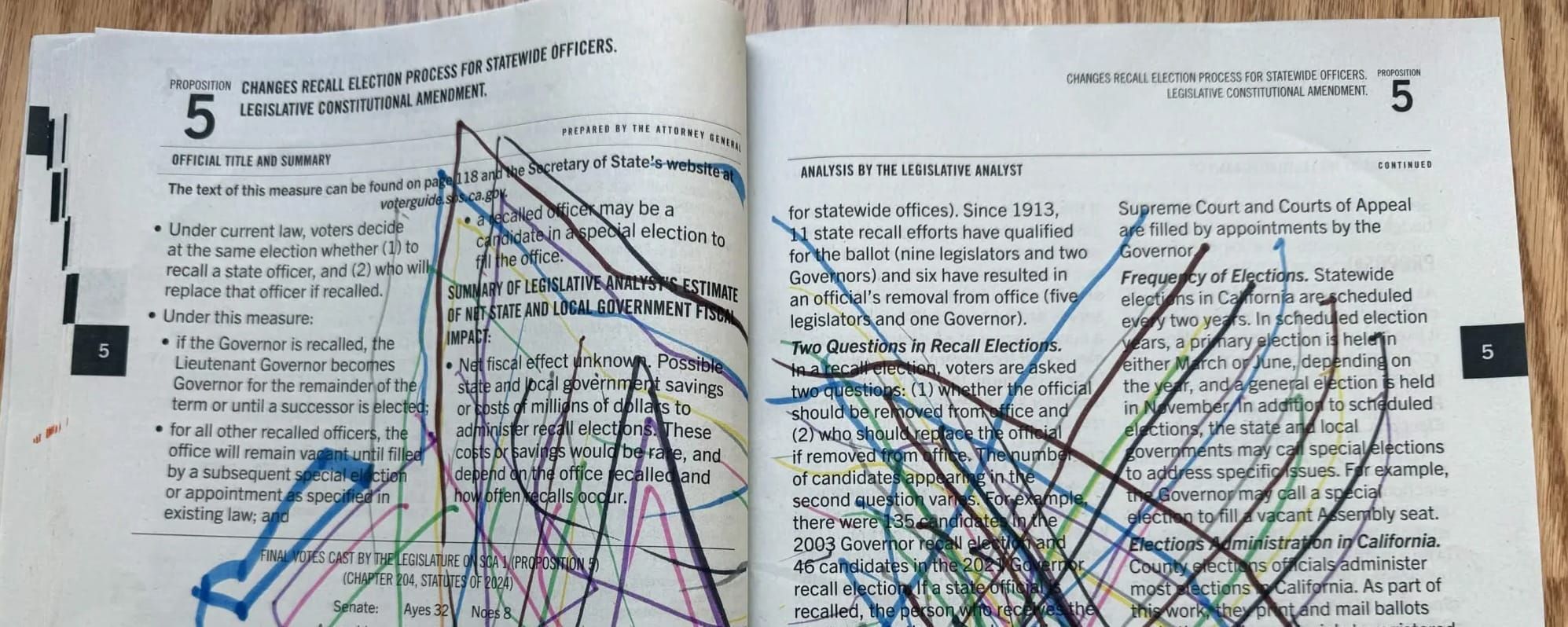
“Eliminate State Officer Recall Successor Elections Amendment”
California has a lot of recalls! This is because we have a lot of Democratic voters and a lot of rich people. The Democratic voters like to vote for Democrats and our rich people like to spend money to overturn those electoral outcomes. It’s the circle of life.
At the local level, this means—as we in Oakland know—millionaires in Piedmont get to call a redo on elections if they don’t like an elected official. Recalls cost money, and only happen when someone has gobs of money to burn on political spite. Whatever one thinks about Pamela Price or Sheng Thao—or whatever you’ve been conditioned to think about them, by media funded by the same people who funded their recalls—this creates an asymmetry whereby candidates on the left need to gear up for a potential recall campaign as soon as they are elected, while candidates on the right get to simply serve out their term, as elected. (And people may have voted to recall Thao because of the FBI stuff, after all, but the recall campaign began when the ink on her inauguration was barely dry.) The left doesn’t have a monopoly on deeply unpopular elected officials; if the left could gin up recalls on reactionary candidates, we’d get as many of theirs as they get of ours. We just don’t have the money to burn on political spite.
 Oakland Review of Books
But that’s just Oakland. This proposition isn’t exactly about that, even if it’s a partial reform of this very Californian general recall thing. This one takes aim only at a quirk in the state-level recall process: Because the state-level recall votes bundle together the question of who the replacement candidate is to be with the question of whether to recall the governor (or whoever it is, but it’s usually the governor), it tilts the scale in favor of recall. For example, when Gray Davis was recalled and replaced by Arnold Schwarzenegger, Schwarzenegger did narrowly get more “Yes to Arnold” votes on the second question than Gray Davis got “No to recall” votes on the first (though it wouldn’t have mattered if he hadn’t). But a lot of the “Yes to Arnold” voters were also “Yes to Gray Davis” voters; in other words, because you could vote to keep Gray Davis but also vote for Schwarzenegger as his replacement—and you could also vote to recall Davis but to replace him with someone other than Schwarzenegger—the number of people who actually voted for the outcome we got (no to Davis, yes to Schwarzenegger) not only could have been quite a bit lower than the number who voted to keep Gray Davis, but almost certainly was.
You could argue that this is fine, I guess. A majority still voted to recall Davis and a majority also voted for Schwarzenegger. You could also observe that the only reason this proposition happened is that Democrats want to take this weapon away from the Republicans, which is obviously true. Newsom managed to fight off the last recall, in 2021, by keeping any big name Democrats off the ballot (while Davis may have lost because his lieutenant governor, Cruz Bustamante, was on the ballot to give Gray-hating Democrats a Democrat to vote for). What this proposition does is establish that if you vote to recall a governor, you get the lieutenant governor as replacement, which probably eliminates the possibility of the GOP pulling off what they did in 2003. Why recall Becerra if you’re just going to get Fiona Ma?
And that’s a good thing. Deep-pocketed Republicans shouldn’t have a get-out-of-being-outvoted card to play to redo elections if they feel like it. This takes it away from them.
Find more of our voting guide here.