Regional Transit Measure: God yes
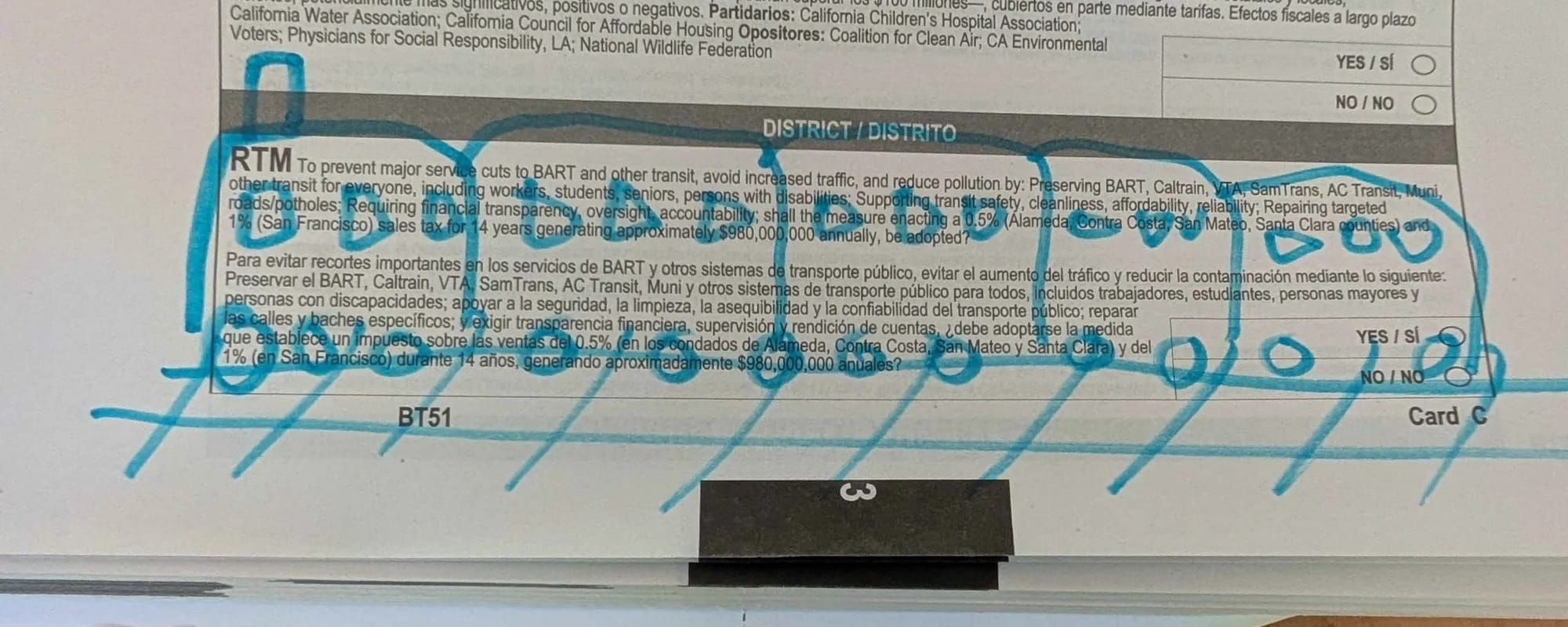
Public Transit Revenue Measure District, California, Proposition RTM, Create Sales Tax to Fund Regional Transportation Systems Initiative
If you vote “no” on this one, you’re probably deeply misinformed or an asshole. If you vote “no” on this, you are probably telling yourself ideologically congenial lies, rather than living in reality. And if you Work From Home (or even part-time WFH), and you vote no on this measure, you are engaged in an intra-class war against the workers who make your life comfortable.
Whoa, you say, ORB coming in hot, not sure I like being lectured like that. Well, you’re gonna get lectured because we feel strongly about this one.
 Oakland Review of Books
Let’s start with a clarification. While this is colloquially known as the “BART measure,” it is necessary for the continued solvency of pretty much every Bay Area transit system. Only 31 percent of the funds raised by the RTM will go to BART; Muni will get 16 percent, AC Transit will get 5 percent, and the Valley Transit Authority (which has 100,000 riders each weekday) will get 25.1 percent. This is, in other words, not just about East Bay–West Bay commuters. The mobility of a whole region is at stake.
If you ride any of these systems with any regularity at all, voting no is pure masochism. If the measure does not pass, BART will cut two of its five lines, close fifteen stations, run trains only every 30 minutes, and close at 9 p.m. The AC Transit cuts are more complicated but still pretty dire. If you have a Clipper card in your wallet or phone that you refill with any regularity, pure unadulterated self-interest should have you checking the “yes” box and telling your friends to, as well. Unless you truly do not value your time at all, the amount you will lose waiting for less frequent and reliable trains and buses—as the system as a whole degrades—vastly outweighs the additional sales tax you will pay (to say nothing of all the times you’ll say “fuck it” and take a more expensive alternative anyway).
What about those not fortunate enough to live in proximity to BART, you say? With higher housing prices near transit hubs, is it really fair to impose a sales tax on everyone to subsidize those fortunate enough to make use of these systems? Or, for the less high-minded, who declare, simply: I drive, why should I have to pay for trains I don’t take?
This is where the regional nature of the measure is important. First of all, the RTM is crucial to preserving bus service, which disproportionately serves low-income households. Two-thirds of AC Transit riders come from low-income households, but voting no on this measure will take bus service away from poor people. Even if you only look at BART riders—who, incidentally, have incomes roughly on par with the Bay Area as a whole—you’re not helping the folks who are driving (because they can’t afford to ride BART) by taking away BART from those who can. If we take away the transit, more people will drive, which means anyone who drives will face considerably longer drive times. How much would you pay to avoid spending an extra 76 minutes commuting via the Bay Bridge every day? Put that way, an extra 0.5 percent sales tax to buy more than an hour of your life back five days a week seems like a steal. Mass transit takes drivers off the roads, and the death of mass transit will put them back on:
With Caltrain gone or unusable, 36,000 cars would flood highway 101 alone. If BART dies or dramatically reduces service once money runs out, we’re looking at Bay Bridge congestion increasing by 73 percent conservatively. That trickles down to double and triple the travel time even for non-transbay travel on highways 24, 80, 580 and 880 alone.
But perhaps you aren’t commuting five days a week. Perhaps you aren’t commuting at all. And here’s where the rub—and the name-calling—comes in. The reason we need this tax measure in the first place, the reason BART is teetering on the edge of collapse—and it is, because when a transit system moves to twice-hourly trains, it will become unusable and will collapse when people don’t use it—is because people who work from home don’t take transit.
It’s not especially complicated. Here’s a graph of BART ridership, courtesy of ENO:
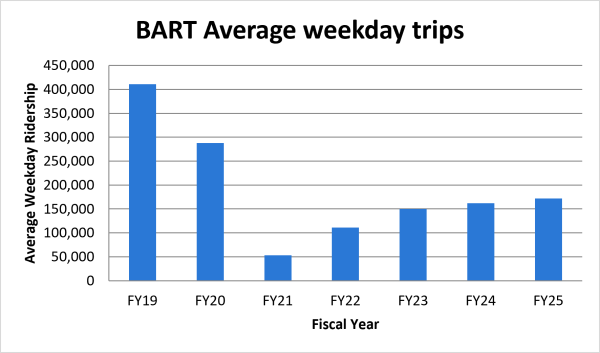
We don’t need this tax increase due to mismanagement or fiscal profligacy. People will say that, because it makes them feel good to blame Government Mismanagement or Those Union Contracts, or whatever; people like excusing themselves from doing anything by declaring that They Brought It On Themselves. But the reason BART is in such financial straits is that we have never funded it the way other cities fund their subways and commuter trains; it is BART’s self-sufficiency that made the post-pandemic rise of WFH such a fatal blow to its fiscal structure:
Before the pandemic, paying riders made up 60 to 70 percent of Bart’s operating revenue, with just 5 percent coming from the state. By contrast, New York City’s transit agency gets 28 percent of its funding from the state, Boston’s gets 44 percent and Philadelphia gets a full 50 percent.
We need this tax because the alternative is bad. We risk permanently losing an essential service, with high fixed costs, because that service lost more than half its users abruptly and without fault, six years ago, due to a global pandemic and the subsequent reordering of the local labor economy. That’s it.
However, the benefits of this reordering—if you consider WFH to be a benefit, which I think most people would—were not felt equally across jobs or incomes. Nationally, WFH employees make 12 percent more than people who commute, in large part because the people with jobs who can work remotely are in higher-wage professions and/or are in more senior roles. The “essential workers” who masked up and risked their lives during the pandemic to keep the physical economy moving and the low-wage service workers (who stream into San Francisco to make lunches for the tech workers who show up two days a week and clean the hotel rooms of tourists and pick up trash) are still commuting, even if you aren’t.
If you are WFH (or even part-time WFH) and you vote no on this measure, you are engaged in an intra-class war against the workers who make your life comfortable.
And look, we’ll be honest, this is not a perfect measure. It’s a sales tax, the most regressive form of taxation, because the less money you have, the higher percentage of your money you end up spending on consumer goods. Sales taxes take a higher percentage of poorer folks’ income than richer folks’. That sucks. But the alternative to a marginal increase on an already-regressive tax on consumption is to deprive everyone in the Bay Area who cannot drive or cannot afford to of what has been a decent, timely, and reliable means of moving from place to place, and creating havoc and materially harming the quality of life for those people who are able to drive instead. (And we haven’t even mentioned the climate impacts!) Given everyone and everything Covid already took from us, we really hope we will not add BART and buses to that list.
You want us to make a positive case?
OK, here goes: Public transit is the physical infrastructure that makes human movement possible in our cities without the oppressive intervention of a multiton, multi-thousand-dollar personal vehicle. Public transit is the material precondition of whatever approximation of physical freedom we enjoy under capitalism. It is the thing that makes us, throughout Greater Oakland and the West Bay, into a single metropolis, enabling the formation of something like a community across geographic and economic distance. It has restored lifetimes of hours to our collective days, allowing us to use precious moments of our too-brief time on this planet in a book or song or thought or goddamn TikTok video rather than consumed with the mental load of navigating traffic. It is one of the few places in our stratified society where people encounter other people much richer or poorer than them, where everyone is compelled to share space and be with strangers. (This is, in fact, why so many people hate it so much and why “safety on BART” is such an obsession among certain media outlets.) It is a miracle of collective commitment and of engineering.
If you vote to kill that then, yeah, you’re an asshole. Don’t be. Vote yes.
Find more of our voting guide here.