Retain the judges
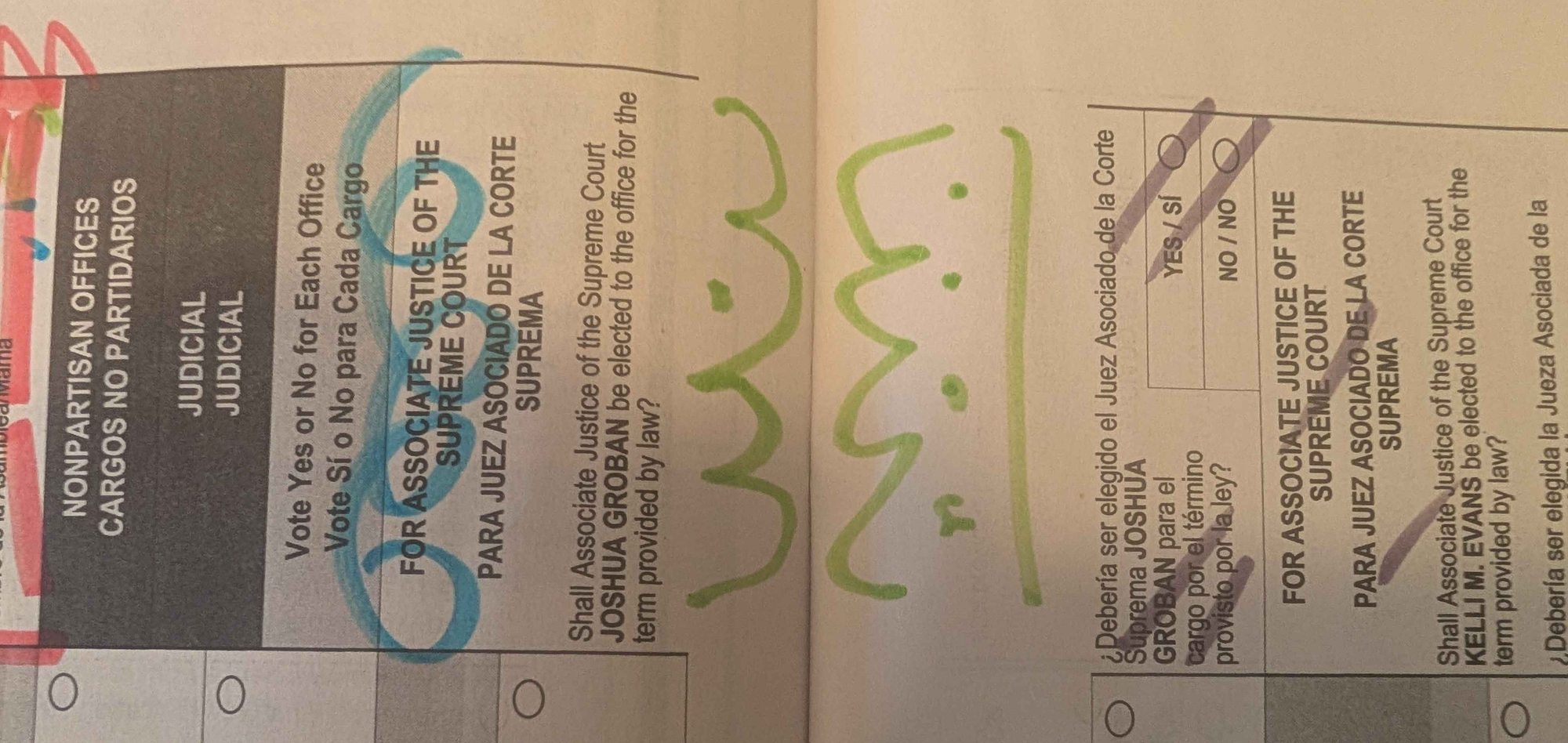
Judicial
We did the bare minimum on this one and googled the California judges coming up for retention. They seem fine. The decisions we found were basically pro-worker, and in some cases pro-defendant, none of them have any newsworthy scandals, and a few appear to be pretty progressive and/or the first of their minority or minoritized group to reach a particular office. Are we promising they are all clean as a whistle and haven’t written a legal decision that would piss you off? No. But fuck it. There needs to be a high bar for not voting to retain these judges.
Here’s why our pen starts out hovering over the “yes” on these retention votes. While California has had judicial retention elections since 1934, Supreme Court justices have actually only been removed once, in 1986 (which gives California the honor of being the first state to vote a state Supreme Court justice out of office). And not just one was removed, but three: Chief Justice Rose Bird, Joseph R. Grodin, and Cruz Reynoso. These three justices were not kicked to the curb for misconduct. It was because they refused to kill people.
 Oakland Review of Books

In 1972, the California Supreme Court found the death penalty unconstitutional under the state constitution, the same year that two-thirds of voters enacted a constitutional amendment to restore the state’s death penalty. This set a fight in motion. Five years later, after the first iteration of Governor Jerry Brown appointed Rose Bird as chief justice of the California Supreme Court, this former public defender voted to overturn every one of the sixty-one death penalty cases that came before her. (A California legal peculiarity is that all death penalty decisions are appealed directly to the California Supreme Court and because—unlike other cases—the court must hear them, death penalty review takes up a significant portion of the court’s overall caseload.)
People got mad. Groups committed to the state murder of individuals—including the Republican Party—came after Bird, in a bruising retention election campaign in 1986; Bird’s opponents ran ads featuring the children of victims of murderers whose death sentences Bird voted against. And the people of California voted Bird out of office two to one and sent another two justices (who regularly voted with Bird to overturn death sentences) packing as well. The voters were not shy in explaining themselves, according to Grodin’s postmortem (pun intended) on the experience. Two-thirds of those voting no on her retention cited her leniency on crime and another overlapping two-thirds mentioned her position on the death penalty. An actual LA Times headline: “Rose Bird Opponents Elated by Death Ruling.”
This has had an impact on California judges. Grodin himself admitted that being booted from office affects how he thinks about cases and reported that at least one colleague said it did, too. Of course it does! And the jurisprudence of California Supreme Court justices on the criminal legal system, since 1986, reflects it, especially if you compare it to their pretty progressive record on civil issues. The California Supreme Court went thirty years without finding a single strike of a Black juror racially discriminatory, a track record so bad the state legislature eventually intervened and changed the relevant law. Judges, it turns out, are not a special species of law gods; they like their jobs and want to keep them, and find ways to convince themselves that the decision that avoids negative attention from right-wingers is also the correct decision, under the law. I might even go further and suggest that judges especially have spent much of their lives climbing various ladders and are perhaps less inclined than the average person to invite unemployment by appearing too soft on crime, or rather, criminals. The election of 1986 threw a long, heavy shadow.
With the receding of Californians’ criminal justice bloodlust since the mid-2000s or so (let’s not speak too soon; two years ago we saw a worrying resurgence), the ghost of Rose Bird, who died in 1999 at age 63, probably sends a little less of a chill through the occupants of the various appellate judicial seats in the California. But that’s the legacy of judicial retention elections in California!
Democracy is a good thing. And watching the unelected U.S. Supreme Court make use of its lifetime tenure to shred anything good they can think of sure does makes us long for a little more democratic oversight of the judiciary. But just as recall elections feel like democratic oversight but aren’t—if only the moneyed side of the aisle gets to call them—the same is true for judicial retention. Only a reactionary moral panic is ever likely to take out some judge whose name you wouldn’t otherwise even know. The available evidence suggests that when judicial elections get close, money starts to pour in, and that money is going to come from entities that want bad outcomes for defendants and working people.
As a result, our well-informed principles ultimately align with the electorate’s laziness. In practice, voters overwhelmingly vote to retain California judges—when they bother to vote on that line at all—and maybe this pattern, itself, tells a story about What Voters Want? Does the fact that so many voters default to retention reflect a general if inchoate sense that judges should mostly be outside of partisan politics? Does the fact that so many voters can’t be bothered to vote on judges at all only underscore that fact? Maybe!
Either way, the easy, lazy choice is also the right one. As satisfying as it would be to smash the “no” button on retaining Sam Alito—and regardless of how exposed you think the judiciary should be to democratic will, as a matter of constitutional principle—at the end of the day, this is a bunch of reasonable-enough judges asking to stay in their seats (and who will). And nonretention’s ugly history is worth remembering, for the next time a judge sticks their neck out, on principle, and incurs the wrath of bad people with money to burn. Vote retain this time, tell Becerra to put more Rose Birds on the bench, and if he does, vote to retain them, too.
Find more of our voting guide here.