Where everybody knows your father’s name
The big show began when former Governor Jerry Brown—that’s the two-time mayor of Oakland to you—began his ascent onto the slightly-above-knee-height stage. The deputy state librarian tried to suggest, in tones typically reserved for children, that he ascend at the intended location, on either end of the stage, where railings and stairs had been installed for this purpose. He made it up without them, of course. (Jerry has always been a little off the rails).
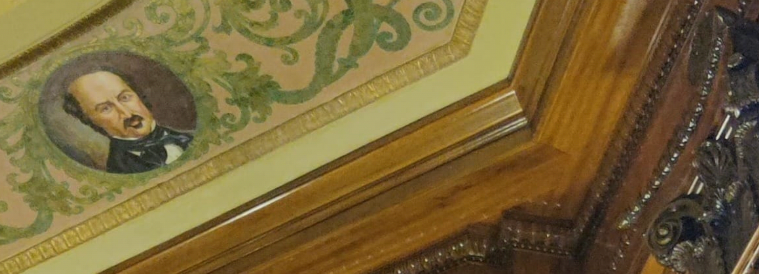
Nominally, this was a promotional event for Miriam Pawel’s California Dreams, a new book that traces the history of the University of California system through the lives of five of its “pioneering” graduates. But the real draw was Jerry. Perhaps this is why the event was held in a building with metal detectors, security guards, and a room featuring men with a diverse assortment of beard styles painted on the ceiling. (I recognized none of the men and I also lack the capacity to describe the exact configurations of their facial hair, so I was grateful when a fellow attendee later positively identified two of them as Adolph Sutro and John Sutter.)
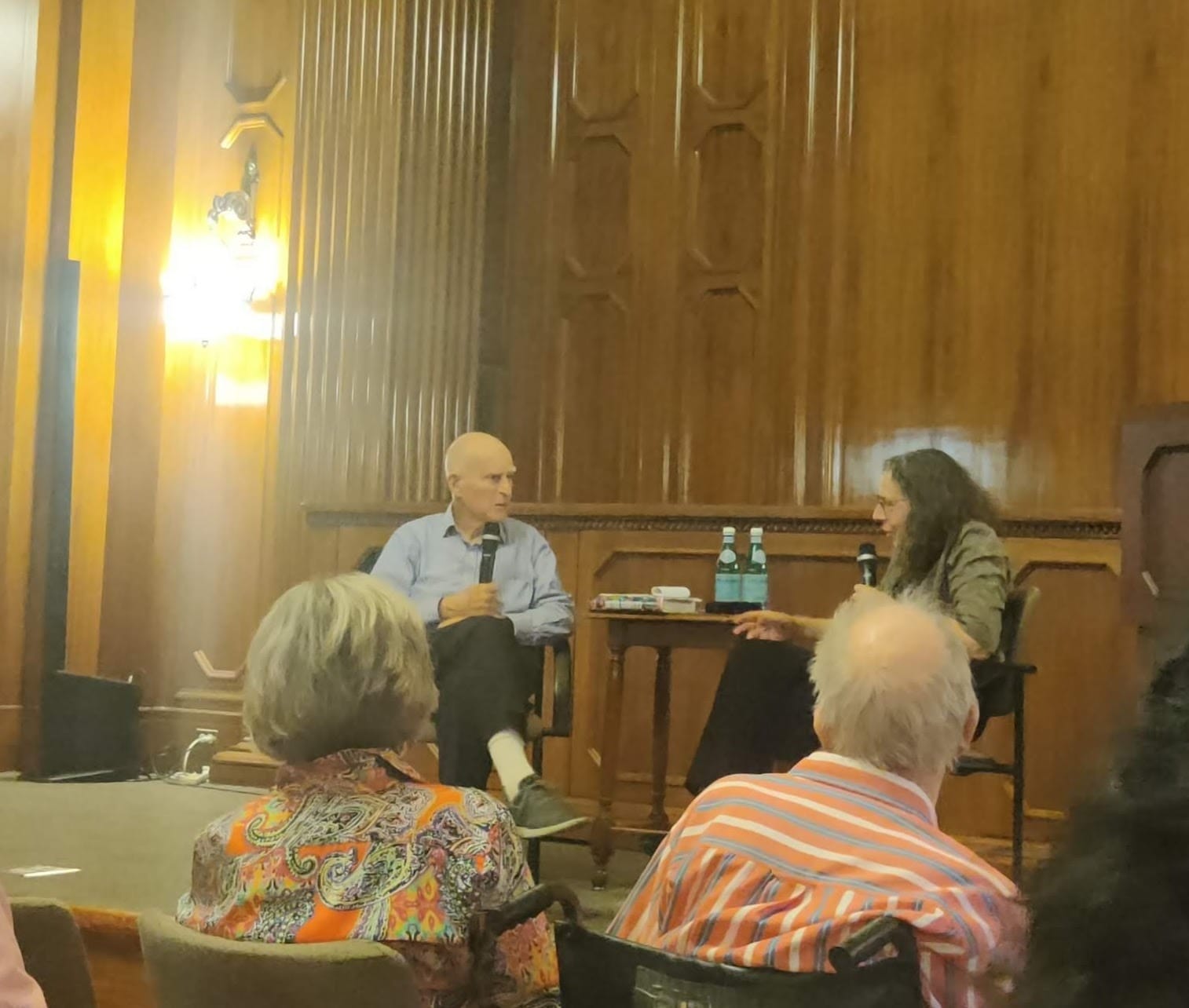
According to Jerry’s blurb, which he read in full from the back of the book to begin his comments, the book offers hope in a time of “terminal cynicism.” And in the beginning, Jerry stayed on topic, asking easy questions like how Pawel chose to write a book about the UCs. Pawel explained that when she moved to California, the UCs seemed like “such a pervasive force,” especially among those people who only referred to UC Berkeley as “Cal.” “Berkeley was the university,” Pawel said, reminding me of my high school guidance counselor who happily announced which graduating seniors would soon be attending The Ohio State University.
This is the mythical Berkeley, the one that “likes to compare itself to…the Ivy Leagues,” as Jerry would put it. But the book itself is much more provincial, one where narrating the lives of five alumni can stand in for the evolution of the university system as a whole. At the event itself, we didn’t hear much about these students, or really about anyone who attends or works at the university in a non-administrative position. In fact, one audience member asked who the other three other figures in the book were; she came to hear more about Millicent Washburn Shinn, one of the first women to graduate from Berkeley (and perhaps left disappointed), and had already heard more than enough about administrators like Clark Kerr.
Clark Kerr, of course, has not only lent his name to student housing and to a dirt track above it, but was the first chancellor of Berkeley and later president of the UC system. His presidency neatly coincided with the tenure of Pat Brown (known at this event nearly exclusively as “your father”) as California governor, a fact that had not escaped the attention of the California State Library employees who planned the event. Nor, I suspect, did they overlook the fact that Pawel’s previous book had been a multigenerational biography of the Brown family.
As the event slowly devolved into Pawel talking with Jerry about his father, a different—albeit still provincial—story of the UCs began to emerge. Rather than students or professors, these stories are about those who rule the UC system and their many quibbles. Jerry and Pawel collaborated to retell the widely-recounted legend of Jerry’s father’s expansion of the UC system, in which three new campuses were strategically built in Republican strongholds as either an educational mission to convert voters or an effort to change the demography of these areas. In these stories, of course, these power players appear as the audience’s close friends: Sacramento is a bar where everybody knows your father’s name. (For more than an hour of the event, I had convinced myself that I had indeed forgotten Pat Brown’s name and subsequently lost whatever credibility I have in this town.)
Still sharp and spry, the 88-year-old deployed volleys of the signature terms and phrases that minted headlines during his time in office. He still believes in the concept of “psychic income,” that perhaps people in intrinsically rewarding professions don’t need to be remunerated as much as people holding down unpleasant gigs. He also believes that the UCs—and any university, really—are bottomless money pits, and that “it’s hard to measure what you get for it.” If Governor Moonbeam had returned, with all his hope and optimism in government, he brought cynical, penny-pinching Jerry back too, with the question of how to value a university in the state budget.
The specter of noted English professor-who-turns-service-into-research Christopher Newfield loomed over the conversation all evening, if only because I was using a copy of Unmaking the Public University as a writing surface. Much of the transformation within the University of California documented by Newfield occurred between Jerry’s two governorships: the shift away from funding higher education precisely at the moment when more Black and brown students are attending public institutions (p91); the rise of the user-fee model of higher education to replace these lost public funds (p173-194); and the hollowing-out of opportunities for the middle class. Under the new university paradigm, students are trained to see themselves as entrepreneurs on an almost spiritual level, as born-again computer science majors who would never make the career-killing decision of earning a classics degree like Jerry did.
But there was no time for questions about how the University is changing now; here in Sacramento, one invites Jerry to a book talk simply to ask questions about his father, because the multigenerational Brown family represents a better, simpler time that we all miss. One audience member asks whether Jerry or his father did more for the UC system. Jerry responds that the world of Pat Brown didn’t exist when he was in office, so it’s impossible to compare them; that’s simply how history works. “There’s the dialectic,” he assures us. “It all works until it blows up.”
 Oakland Review of Books