The Little Hill has eyes
No one leaves Oakland for just one reason. For me, the most practical reason was the sewage leaking from the unit above ours for the second time. The reason you might write about on Nextdoor was the woman who was pistol-whipped outside our house by someone in a passing car but (hauntingly) not mugged. The vulgar economic reason was that we could rent a three-bedroom house across from a park in El Cerrito for the same price as our one-bedroom apartment near the Liquor Video in Rockridge, respect on its name.
But the real reason was the city meetings, although to be honest, the meetings were manageable. Really it was all the calls I made about the meetings, except actually it was not even the calls. Actually, the relationships those calls represented were the consolation prizes you get after you lose, the community that remains even when a campaign hits the wall. There is no winning in Oakland politics, not really. You can make as many calls as you want; your tax dollars will still pay for the five cops who murdered Joshua Pawlik to get years of back pay on a technicality. The real reason I left Oakland is the feeling that you can make as many calls as you want, and Pawlik will still be dead.
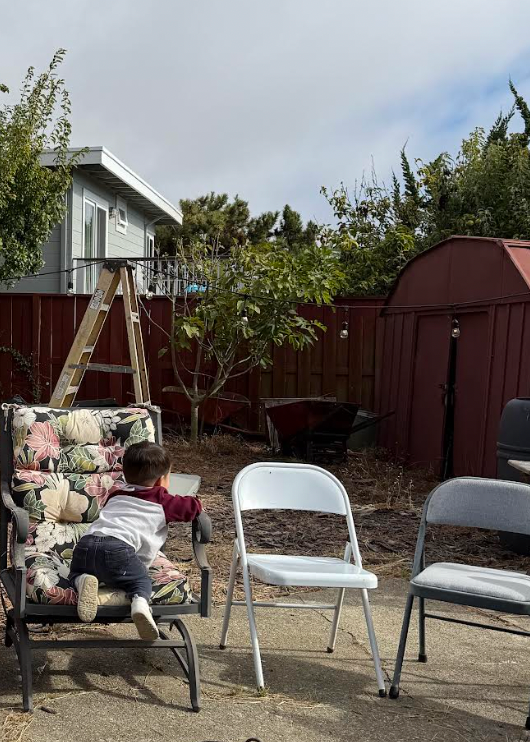
I’m thinking about those calls as I watch my two-year-old try to fall over the back of a wobbling wicker chair, in the very non-toddler-proofed backyard of another member of Flock Out of El Cerrito, a grassroots group of citizens against warrantless mass surveillance. I’m thinking about those calls because this is actually our second party. We had the first one three months ago, after we successfully convinced the El Cerrito City Council not to renew their contract with Flock, something Oakland and many other cities in the East Bay still have not been able to do. It’s a win that took us by surprise, but we don’t take it for granted (just like we don’t take for granted Flock’s claims that the non-contracted cameras aren’t recording). Three days after the party, the city will threaten to fine Flock for missing their deadline to remove the cameras, and all of El Cerrito’s Flock cameras will come down. The calls we will be making will be to celebrate.
In Oakland, five years ago, my supportive husband started asking me questions about all the calls I was making, when those calls started regularly going past 11pm. A few months later, we moved. Tonight, at the Flock Out party, I’m talking about it to a woman I know from Yes on C—the campaign for an El Cerrito library tax—as I take a rusty nail from my two-year-old’s outstretched hand. She nods in recognition. Her similarly supportive husband has also been asking her questions about her involvement in local politics. Questions like: What is this doing for you? What do you get from it, really? What’s the point?
These questions are a lot easier to answer on a beautiful afternoon when I’m surrounded by people I love, even though I only know some of them by their Signal handles, and because they stayed with me in El Cerrito City Hall until 1am one night to get the Flock contract canceled. Someone from another city’s Flock Out group asks us why we’re keeping the group going. There’s never just one reason, but what we say is that it’s because with Flock gone, other companies like Axon are bound to follow. And that’s true. But it’s also fun to hang out with people you already know you agree with, the community that remains (especially after you win).
The party is long by design, meandering from group business to crafts to a DJ set by a council member to live music. When another candidate for council points out, by text, that it’s pretty big tent to have a council member DJing the party who voted to keep Flock, I remember how she supported us procedurally and made sure our voices were heard. We invited every candidate for city council and every current council member, regardless of their previous position. The theory was that our parties are so good they will inspire politicians to oppose warrantless surveillance on principle.
At 3pm, the person who ran the ground game against the library tax is supposed to pitch us on canvassing for a truly vetted anti-Flock candidate, but we’re running late and as far as we can tell, no such candidate exists. This is my fault, I suppose. I pulled papers, started running, and then immediately found myself inundated with vitriol and even threatening messages. While the former was unpleasant, the latter made my supportive husband buy $200 worth of security cameras at Costco, which, okay, felt like a bit much given I was running as the anti-surveillance candidate. The night before the deadline, as my toddlers slept peacefully in the other room, I decided not to file.
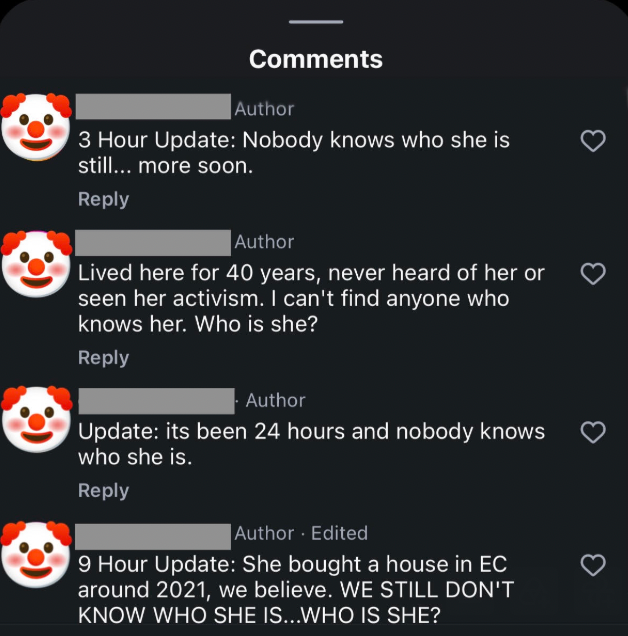
Of course there’s never just one reason anyone decides to drop out of a city council race. This, however, is the one we need to talk about without inflating its influence or rewarding intimidation: the threats and the subsequent hours my supportive husband spent fiddling with the positioning of the private security system that had become a condition of his continued support. Because if Oakland is a town, then El Cerrito is a village, by which I mean that within hours of my meeting the city clerk, a local blogger had declared both that I was running and that she knew where I lived. Within a day, an anonymous Instagram account previously devoted to campaigning against the library tax began posting frantic hour-by-hour updates of their attempts to figure out who I was. “9 Hour Update: She bought a house in EC around 2021, we believe. WE STILL DON’T KNOW WHO SHE IS…WHO IS SHE?” one comment by the poster on their own post read. (I rented in 2021 and bought in 2022, for the record.) These quickly escalated into a few vague threats that hovered above the line between law and crime, like someone waiting for the right moment to cross, when no one was looking.
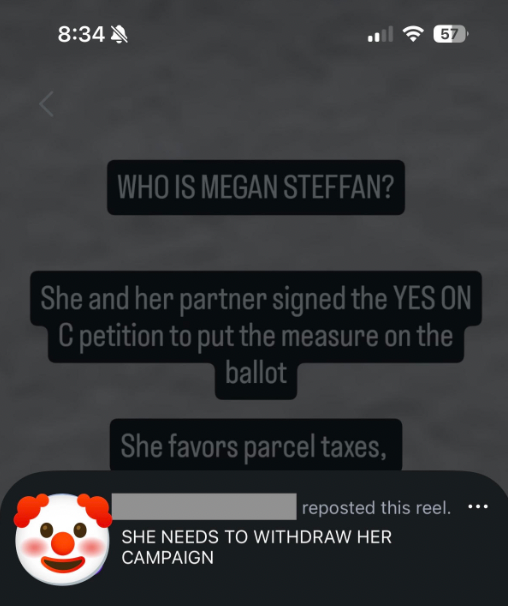
Like many women, I failed to make it to my thirties without being sexually assaulted and then stalked by a powerful man and his associates, and so I am intimately aware of the fact that threats do not necessarily correlate with or turn into violence. This kind of harassment is unpleasant and destabilizing in its own way, of course. But violence so often comes with no warning at all. And while I did find it a little alarming, it was also absurd, to have someone commenting within seconds on every post I made and making multiple videos per day about me. And all because I had helped campaign for a library tax? Even though it was active on Instagram, I mentally filed the account away with the handful of my neighbors on Nextdoor who seemed determined to make it feel terrible to live in El Cerrito for no reason. I told myself that it was like the time someone sent us an anonymous letter telling us we were bad people for not trimming our hedges. I was upset less by what they were saying than by the way their anonymity allowed them to say it in the least generous way.
That was how, in general, I tried to not think about it. I even developed a bit where I would respond by pretending the account had said something reasonable and supportive, which wasn’t quite feeding the troll but also wasn’t exactly keeping it out of the kitchen either. And because I tried to ignore it, I didn’t screenshot as much as I probably should have. It means that now, when I try to put together the paper trail, so I can show a reader (and my editor) what it was like—what it felt like, was made to feel like—it’s all a little foggy. I can’t even remember if the full version of a now-deleted Instagram comment actually was threatening or if it carefully stayed on the right side of the line. Something about the way it made me feel made me want to file it away, ignore it, and now I don’t remember what it said at all.
!["sit this one out. You'll only get [...]"](https://storage.ghost.io/c/e9/74/e974aa4e-486e-454e-a8c5-2af4d8741ff1/content/images/2026/08/data-src-image-5fcc6017-4dbf-4f9b-96e8-d2866cd33426.png)
I wanted to be a leader and I wanted to make it feel good to live in El Cerrito again. That meant I needed to focus. When a friend of mine texted me a screenshot of a comment that read, “MEGAN NEEDS TO PACK HER FAMILY AND MOVE. WE DON’T ACCEPT HER ENERGY IN EL CERRITO” a week after I pulled papers, my first reaction was to get angry—at her. Like: Yes! I get it! A freaky guy is constantly sending me freaky things! But freaking out instead of sleeping was not going to change anything. I wanted to change things.
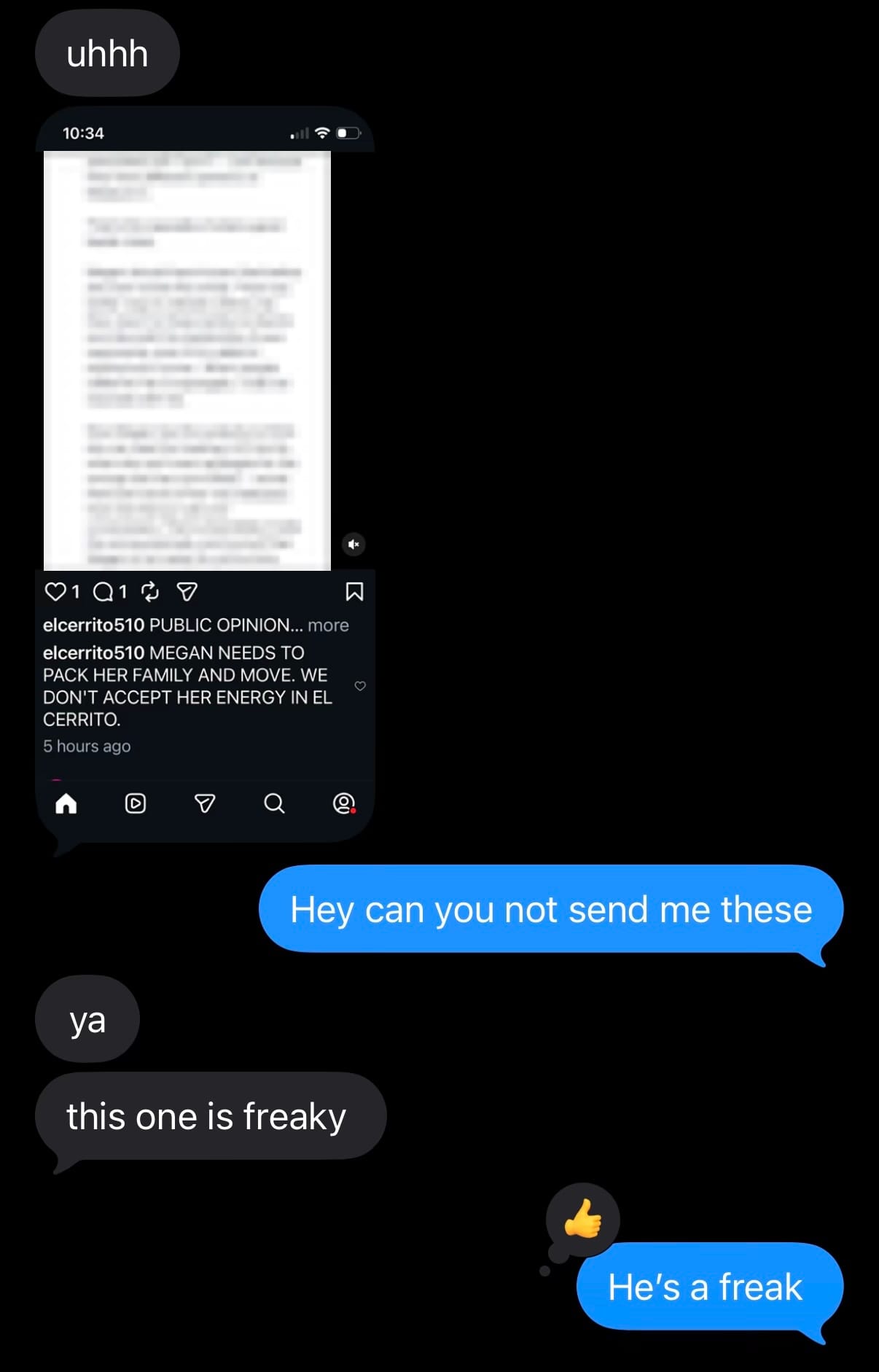
As my kids crawled into my bed the next morning, I started to feel differently about the calls I was making, the negative energy I was inviting into our lives, and the risks I might be exposing us to. The issue wasn’t just one unhinged person with extremely idiosyncratic and identifiable spelling mistakes. It was the overwhelming deluge of anger and personal attacks from many people that had been normalized during the campaign against the library tax, which went on for over a year. I wanted to run a campaign that would help us see El Cerrito as I saw it: a shining city on a little hill. Instead I realized that what I had taken for a shining light, in fact, might have been coming from people carrying torches and pitchforks.
It was the inevitability of the losses that had made Oakland politics “safe.” Never winning means you can never truly be a threat.
I didn’t capitulate right away. I did what I always do; I made calls. On one call, a friend of a friend who’s been professionally harassed online said to ignore the threats. Anyone posting online about me that frequently, she said, will be a coward in real life. What they want is for you to shut up, she said. So don’t. On other calls, longtime Contra Costa County politicians clicked their tongues; some said, “I can’t believe this is happening,” and others said, “Oh yeah, we all get threats.” And then something occurred to me. It was the inevitability of the losses that had made Oakland politics “safe.” Never winning means you can never truly be a threat. The same was not true in El Cerrito, where I was suddenly seen as a candidate who could cause someone else to lose.
You can spend the rest of your life wondering if the person who sends ominous, but somehow mostly legal, comments on Instagram is brave enough not just to wear their Kangol hat backward like a pale imitation of Samuel L. Jackson but also to ride their scooter up the little hill to where you live. You can spend the rest of your life wondering if there’s another person, a quieter, more brazen person you don’t even know about, watching your neighbors make you a villain and your family an acceptable target for violence. Or you can choose to hit a metaphorical ctrl+z, return to your wonderful life as an active, interested citizen, and let every supporter’s disappointed text pierce you like a (thankfully metaphorical) knife to the heart.
\O/
Back at the party, people are being very gentle with their disappointment. I’m wearing my sleeping two-year-old in a carrier on my back and the anti-Flock faithful are sitting patiently at a crafts table waiting for the No on C ground game person to begin her pitch for canvassing. She describes coming up through the Philadelphia ward system, which she tells us is a political machine “so corrupt it puts Tammany Hall to shame.” The number of votes an issue represents is the root of political power, she explains. Even when a single-issue candidate fails to win an election, the number of votes they receive flashes across their head, like a ticker tape, every time they talk to an elected official.
The metaphor is compelling, and I can see the party shifting. People start tossing out the names of candidates we might canvass for. And there is plenty left for everyone to do, even me, and even if we don’t do it right here. There are always calls to make, no matter where you are.
Here is who is here. There is one activist who always brings the same chocolate chip cookies for my children every time we have a meeting. When my two-year-old wakes up wailing, it’s the promise of those cookies that calms him and motivates him to plod happily up the stairs and into the kitchen where the host’s father is making homemade pizza and another activist is putting together a tomato salad made from organic produce she gets from a direct buyer’s club with tenant farmers. My toddler is thrilled to be in a kitchen free of baby-proofing paraphernalia, opening and closing every drawer he can reach (which is every drawer). I move to stop him, but one of the activists tells me it’s okay, that there’s nothing dangerous in any of those drawers.
“No” is the easiest thing to say. When we moved here five years ago, we were saying “no” to Oakland, and maybe that’s why I should be less surprised to have ended up somewhere that’s so good at saying “no” to things. The library tax. Flock. Smoking literally anywhere. But refusal is not really a means of escape. There’s never a clean ctrl+z. You might try to say “no” to Oakland politics, but then you will bring the person who is driven to make calls with you. You can try to outrun the random, impersonal violence of a big city and still end up with a targeted, personalized threat in a small one. And maybe, I tell myself, you cannot undo the effect that you have on the electorate. Neither if you told voters that saying “no” meant they had permission to tear apart their neighbors, nor if you asked them to say “yes” to healing their community.
By the time the microphone opens for “anti-Flock and anti-surveillance propaganda only,” my two-year-old is munching his cookie happily, paying rapt attention to people announcing other political causes we might support, actions we might take, or events we might want to attend. They are asking us to say “yes,” and we do. Together my two-year-old and I spend some time making a sign to hold in front of a Flock camera for the upcoming week of action, but by the time the politicians start showing up, my toddler has discovered a loose pile of ladders and attempted to climb it, which keeps me from giving the politicos the attention they deserve. By the time other activists start asking our council members to sign the pledge against warrantless surveillance, my two-year-old has found several more loose screws and a rusty saw blade. Everyone laughs and no one calls me a bad mother for letting my child play in a place like this (a place he knows and loves).
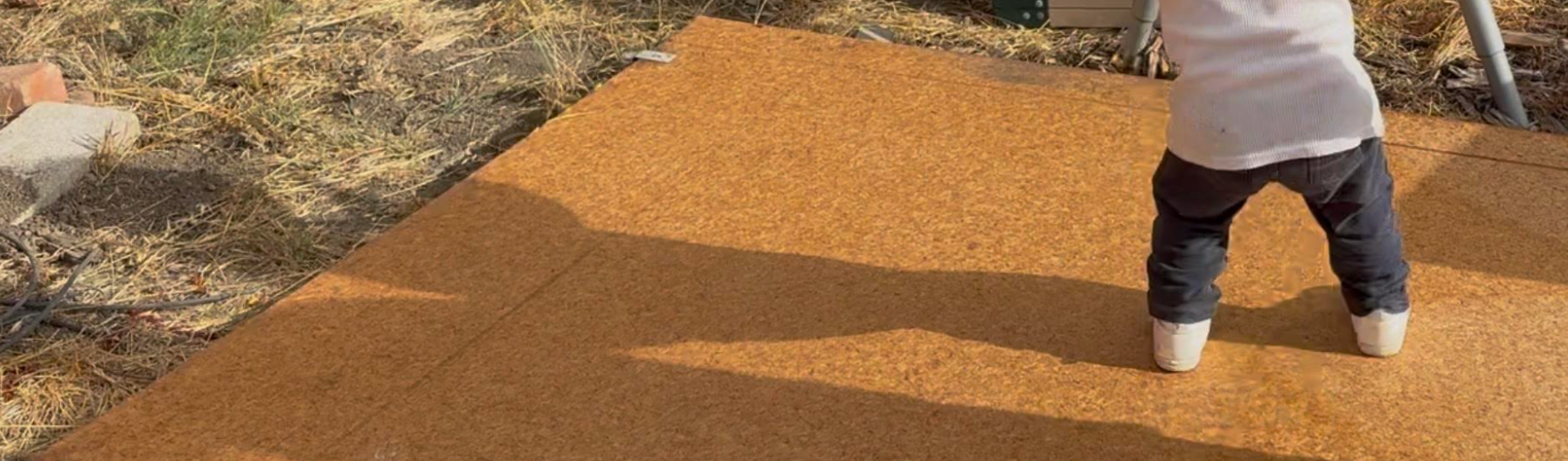
There’s never just one reason to say “yes” to where you are. One of them is being in a place where your voice matters enough for people to work to silence it. Finding good people who will speak and work alongside you for a better city and a better world—that’s something I will always say “yes” to. My two-year-old is dancing on a piece of loose plywood with the other toddler at the party. As the sounds of the Isley Brothers’ “Fight the Power” floats down, another activist drifts over to me, incredulous at who is DJing in the house above us.
“That’s our council member,” she laughs, “‘Fight the Power’? She is the power!”
Soon my two-year-old will start throwing chunks of loose concrete into the sky, and I will have to make the decision about how much risk to allow him to take. The next day, I’ll wake up early to watch the El Cerrito City Council joint candidate forum interviews, hosted by the Democratic Party of Contra Costa County and El Cerrito Democratic Club. The performances will be mixed at best, but what will be crystal clear is how ready all the candidates were to be asked about their position on Flock. Across the board, the Flock questions will generate their best prepared answers, and I’ll think to myself that maybe the activist was wrong. Maybe in El Cerrito, at this moment, we are the power. The candidates are responding to us—to our voices. It’s the type of win I can say “yes” to, even if it isn’t like winning an election. Even if it doesn’t really feel like winning yet.