Open the schools!
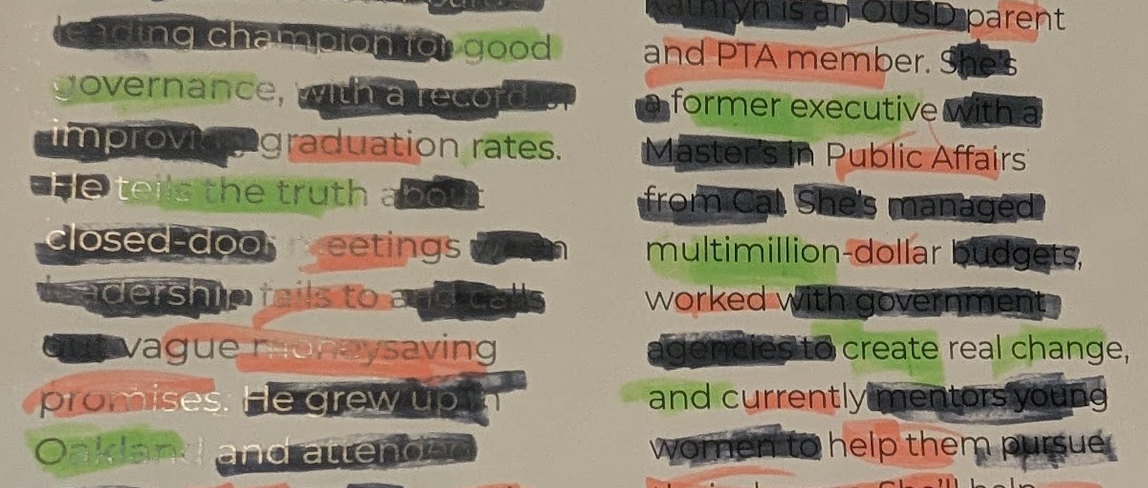
Oakland Unified Board of Education: Jennifer Brouhard (District 2), Sylvia Williams (District 4), Valarie Bachelor (District 6)
On the one hand, it can be hard to parse what exactly Mike Hutchinson’s whole deal is. He’s a school board member repping District 4, and he’s made a name for himself on TikTok posting clips from meetings in which he expresses dismay or disappointment or some combination of the two with his colleagues or the superintendent. Dismay and disappointment are the basic grammar of his politics. He votes no or abstains on just about any matter that comes before the board, as a kind of ongoing “no confidence” vote in the body. His approach to board politics might be factional, but it’s not outwardly ideological. He was once backed by the teachers—Hutchinson used to call himself an “OEA baby,” the child of an Oakland teacher—but he’s fallen out with them in recent years. At the same time, he’s still stridently opposed to school closures, as he’s always been, a litmus test for the teachers’ union. The only constant in his political behavior seems to be an adherence to the philosophy of fuck all y’all.
On the other hand, you know exactly what Mike Hutchinson is. Just look at the comments on his TikTok. One recent video shows a long speech in which Hutchinson expresses dismay and disappointment with the superintendent for somewhat obscure reasons having to do with, it seems, mismanagement of the budget and a lack of transparency. “Do I live in Oakland? No. Am I a CA tax payer? Yes. This man is who we need in leadership,” went one comment. “I live on the other side of the country and have no idea why this is in my feed,” went another, “but I desperately wish Mike Hutchinson worked for my school district- you rock, sir.” What do you suppose these commenters are responding to, despite their not having a clue what Hutchinson is talking about? What’s this last person picking up on, way over on the other side of the country? Are they moved by Hutchinson’s stirring allegiance to the letter of the Brown Act? Or is it just the spectacle of it, the little civic dumbshow he’s giving them—the guy at the dais with his sleeves rolled up, giving hell to those corrupt officials cheating the kids and wasting the taxpayers’ money?
 Oakland Review of Books

Hutchinson is being hammy where a lot of his colleagues choose to be prim, but Oakland school board politics are austerity politics, and all austerity politics, “left” or right, are this performance of seriousness, a whole smarmy theater of Making the Tough Calls and Facing the Cold, Hard Facts. It's an act designed to hide that scarcity is a choice and that who suffers the brunt of it is a choice as well. And while Hutchinson might be an outlier in temperament—the Bay Area News Group allowed that he is “abrasive and difficult to work with” in what was otherwise an endorsement—the truth is that just about everyone in OUSD politics seems to be making music in the same modality. Everyone in this election, whether it’s the candidates backed by the teachers’ union (Jennifer Brouhard in District 2, Sylvia Williams in District 4, and Valarie Bachelor in District 6) or the slate being bankrolled by the recallers-in-exile at Empower Oakland (Arielle Fleisher in District 2, Hutchinson and Kathryn Camp in District 4, and Alexandra Williams and LeAna Powell in District 6), is practicing austerity politics in one form or another.
Read through the interviews with this year’s candidates conducted by Ashley McBride, the Oaklandside’s exceptional education reporter. Here are some words and phrases you’ll find: “a platform of ending the financial mismanagement,” “a paycheck-to-paycheck kind of mentality,” “a fiscal stabilization strategy,” “budgeting more from our priorities,” “shift our resources,” “drawing away from the resources that we need,” “overspending,” “tying each line item in the budget to student outcomes,” “resolved these budget problems,” “rein in our contract spending,” “very hard to make those cuts and layoffs,” “an evaluation of all the different things we offer and all of the programs we’re paying for,” “data-driven decision-making,” “What are the biggest drivers of our costs? Where can we try to increase revenues?” They are all talking about the rolling crisis of the district’s budget, everyone in agreement—albeit with emphases in different places—that the district must figure out a way to make do with less, everyone using the language of inputs and outputs.
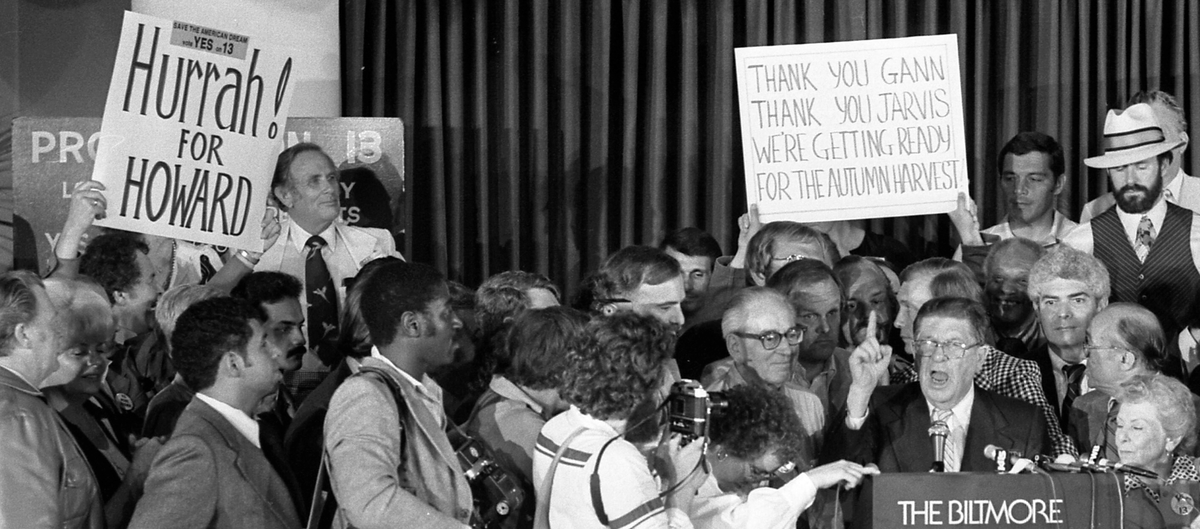
Here’s what you won’t find in any of the interviews: “Prop 13.” The underlying cause of everything they’re talking about in those quotes, the coldest, hardest fact of all in California public education, is—well, it’s worse than that it’s ignored. It’s…accepted. A given. As natural, inevitable, irrepressible, and unremarkable a force as gravity. Because Californians in 1978, in a fit of revanchist pique that really should be understood as a counterpart to the Massive Resistance movement against school desegregation in the South, choked off what could be collected in property taxes, our public schools exist in a condition of permanent austerity, subject to state formulas and the ups and downs of personal income tax collection.
After the passage of Prop 13, California schools lost a third or so of their funding overnight. Per-pupil spending in the state, a thousand dollars higher than the national average the year before Prop 13, soon dropped below the national average. The quality of education suffered as a result of the retrenchment in spending. Years and years and years of ed-reformer hooey has worked to obscure this point. We have been encouraged to believe that the matter of educating young people is more complicated than the simple question of funding—it’s about family background; no, school size; no, class size; no, the quality of teachers and the greed of their unaccountable unions—but the simple truth is that schooling is labor-intensive and schools with more resources to recruit and maintain that labor wind up providing better educations. Bruce Baker has shown as much; Kirabo Jackson and Claire Mackevicius, working in a wonkier vein, have reached a similar conclusion. Every year that Prop 13 is still on the books is a year that Californians have chosen to provide worse educations instead, for the sake of their property values.
The education scholar David Backer (author of the immensely clarifying book, As Public As Possible: Radical Finance for American Public Schools) has a useful phrase: “the accountability imperative.” He’s referring to a habit of reading the problems of public schooling through the lens of individual failures—the board members blowing a hole in the budget in their innumeracy, the superintendent rolling over for the teachers’ union, etc.—which orients the politics of public schooling around holding those individuals accountable. The imperative can be expressed in basically paranoid terms à la Hutchinson; it can be expressed in the bloodless technocrat-ese of budget priorities; it can be expressed in the phony neutrality of “accountability journalism,” or the tattletale puling of reactionary narc outfits like the Oakland Report. But whatever its idiom, the accountability imperative reduces all school politics to the question of who gets to be the sin-eater for the unconfessed crimes of Prop 13. (Think the religious connotation there is a bit much? During his second stint at governor, Jerry Brown, the old seminarian, referred to Prop 13 as a “sacred doctrine that should never be questioned.” Jesuits look for God in all things, even the unclean spirit of Howard Jarvis.)
It’s no accident that people have come to gloss the politics of schooling in this way. The structure of post–Prop 13 education policy has put school districts, now blocked from levying local property taxes, in a sort of vassalage before the state. Oakland in the 21st century has been a case study in how austerity remakes politics on the ground, and in how all the while it creates a structural ignorance—to use another of Backer’s terms—around its own operations. “It individualizes structural problems,” as René Espinoza Kissell, now an assistant professor of education policy at UC Santa Cruz, succinctly described the process.
Kissell watched it all up close, studying Oakland schools not long after OUSD went into state receivership, in 2003. Under the terms of that “emergency” state takeover, Oakland got a $100 million interest-bearing loan; this was overseen by a little-known agency called the Fiscal Crisis & Management Assistance Team. Talk to Kissell long enough and you start to question every piece of the deal. What is FCMAT, and why does it seem like, to use the technical term, so much IMF bullshit? What’s with that interest rate? Why did OUSD have to pay $20 million to bondholders for the privilege of handing over the keys to the state? If political pressure can bring that interest down—as happened with West Contra Costa Unified and its 5.7 percent rate, lowered after protesters staged a hunger strike in Sacramento—could more pressure take it all the way to zero? Why a loan anyway? Why is a district being made to borrow money from the state, at interest, to address a crisis that was generated in the first instance at the state level? And why does it feel as if the punitive structure of state education funding is all about enacting a racist melodrama in which Black or Blacker districts get punished for their supposed profligacy?
(Trick question. It feels that way because it is that way. Tax revolts are racist counterrevolutions—pass it on.)
 Aaron Bady
The questions point up the contingency of the whole arrangement. These are political decisions made for political reasons, favoring certain political actors over others, not some careful reckoning of inputs and outputs according to the hard, impersonal logic of a mythical market. That’s why the work of reactionary education politics in the post–Prop 13 environment has been to get people seeing with the eyes of that mythical market, to adopt what Backer describes as a “blame-the-victim sort of dynamic.” He characterizes it thus: “You have to cut, you have to close, you have to fire, you have to be able to make your expenditures match your revenues, you have to do whatever you have to do. It’s all on you, right?” This isn’t just a project of elites, either. In Oakland, in the late 2010s, Kissell watched the community get enlisted in its own impoverishment by way of the Blueprint for Quality Schools program. This involved a sort of participatory budgeting initiative to help the district arrive at decisions about school closures. In that the Blueprint was a very Oakland sort of thing: austerity done up in the guise of community empowerment. “They’re giving us the knife to cut our own necks,” Kissell recalls one community member saying.
Strictly speaking, Oakland exited state control in 2009, eventually paying off the loan last year. But to hear Kissell describe it, no district ever really exits receivership. “The fear of returning to receivership [is] always looming,” she says. “It was humiliating to lose your district, to lose power as a school board member. It was a humiliating process. And they talk about it almost in tears. There’s a shame, there’s a stigma about not balancing your budget. And so there still is this kind of legacy of—I don’t want to throw around the word ‘trauma,’ but there’s this kind of legacy of what happened.”
What’s more, under a law passed in 1991, the state requires that districts build three-year projections into their budget to ensure they keep enough money in reserve. The fear and the law work in tandem to handcuff school board members. Austerity is more tightly secured in the present by the specter of austerity in the future.
What we’re trying to describe here is how we’ve arrived in this upside-down place in our school board politics where the actual causes of the crisis are apparently off the table; where the whole game is putting a face on a crisis that is irreducibly structural; where a dyspeptic gadfly like Mike Hutchinson with untold personal grievances gets to come off like the last honest man in American democracy; where Empower Oakland darling Arielle Fleisher gets to present herself as a hardheaded, data-brained realist by not dismissing the idea of closing more schools. In one of her ads, a guy intones that the “board is ignoring”—here comes the phrase—“cold, hard financial facts,” which is almost certainly an allusion to the inevitability of closures. (For the record, it has been pretty convincingly demonstrated that closing schools does not save districts money, that in fact closing schools often leads families to leave the district altogether, thus costing the district the state money that is awarded according to student head count. We learned these things in the course of reading a 2026 Stanford review of California’s public education system called—uh oh—Getting Down to Facts.)
A political debate in which all the underlying conditions have been naturalized—in which Prop 13 recedes to the background, unnoticed—is scarcely a debate at all. Backer likens the situation to a fish tank. “In this tank, there’s a number of animals and there’s only a certain amount of food. But also the oxygen is just slowly seeping out of the tank. And so the animals start fighting over food. And they can’t breathe [and] they feel like shit. But it turns out the people who are running the tanks aren’t giving them enough oxygen,” he says. The animals “think the food is the problem. They fight each other. But the whole issue is outside the walls of this tank.”
Who is looking beyond those walls? Certainly not Hutchinson, who is evidence that, frighteningly, we might be evolving a new kind of fish that can thrive in low-oxygen environments. The other school board candidates don’t seem to be looking, either, at least not by the evidence of their campaigns. The ones on the “left” say they’ll fire the consultants before they consider closing the schools and laying off teachers. The ones on the right say they’ll do the opposite. That’s a meaningful difference, to be clear, which is why we’re endorsing Brouhard, Sylvia Williams, and Bachelor. Education needs educators—it is a function of the human capital that's poured into it. We hope they win, and win resoundingly. But we need more than a friendlier vision of austerity. If the horizon of political possibility is that our side might have the honor of distributing pain, the left has lost in a larger sense before a ballot is even counted.
Find more of our voting guide here.