Prop 45: No
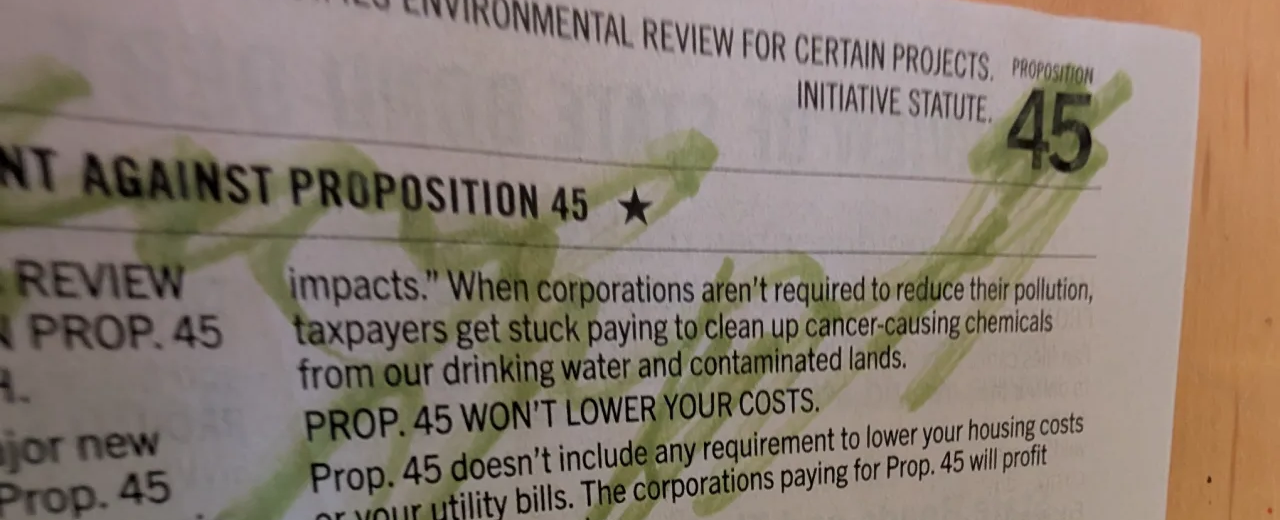
“Expedited Environmental Review Process for Certain Projects Initiative”
You should vote “no” on this one. Even if you didn’t know what “CEQA” is or understand how the proposition would affect CEQA, there are some big hints that “no” is the right vote. The California Chamber of Commerce and Howard Jarvis Taxpayers Association are supporting and/or funding it (the latter despite the Legislative Analyst’s Office’s assessment that it would cost state and local government—and thus, presumably, taxpayers—up to $100 million annually). Opponents include teachers, firefighters, the Democratic Party, and basically every environmental organization in the state. If passed, Proposition 45 would prevent the legislature from amending it without a two-thirds vote, which is a big honking hint that the proponents are appealing to the public to the exclusion of elected representatives on a highly technical issue. This is never a good sign. Finally, it purports to benefit “essential” projects without defining what counts as an essential project or meaningfully limiting what falls into that category (it’s basically everything except prisons and oil and gas extraction and, tellingly, high-speed rail). You could probably stop there and feel comfortable with a “no” vote.
 Oakland Review of Books
But let’s take the opportunity afforded us by various business interests putting this thing on the ballot to learn what, exactly, CEQA is, and why it’s so important and should not be gutted (as this proposition would do).
CEQA stands for the California Environmental Quality Act. It was signed by Ronald Reagan, of all people, the same year the first major federal environmental protection statute (NEPA) was enacted (1970) and it does more or less the same thing: require state and local governments to study the environmental impacts of a project before beginning it. Importantly, “project” in this context includes issuing permits or otherwise approving nongovernmental projects. Like its federal twin, CEQA does not tell governments what projects they can and cannot do. Instead, it requires them to study, report to the public, and get public comment on those projects before they begin. Its teeth, such as they are, comes from the ability of members of the public to sue governments or government agencies that did not adequately study projects before beginning them.
CEQA is, well, not especially popular. Various governors have blamed it for California’s housing shortages, for slowing renewable energy buildout, for a whole multitude of sins. (California ranks eleventh in overall renewable energy production as a percentage of generation, by the way.) And look, I’m not going to lie to you and say that CEQA isn’t abused: Just last month a group of folks in the Far North Oakland region known as Berkeley filed a lawsuit to try and stop the construction of a bike lane. But while the busybody suits get attention (gee, I wonder who is interested in making sure of that), they have to be weighed against the fact that, a mere week later, a federal judge halted construction of an ICE detention facility for failure to conduct an environmental analysis of a detention camp (which opponents say will, in addition to perpetrating human rights violations, include an undersized septic tank system). Environmental review requirements may have stopped the construction of a concentration camp in our midst. Not bad for a purely procedural requirement!
But even if you think CEQA needs some kind of reform to avoid the busybodies, the particulars of Proposition 45 are, in all their wonky specificity, quite terrible. They are also specifically terrible for the use of environmental review as a climate protection tool. The headline from proponents is that Proposition 45 will force governments to complete environmental reviews more quickly, which sounds good. But it will also prevent agencies from asking additional questions of a developer during the course of the review. So: Learn something new after looking at the flood maps of the area where the project is? Too bad, can’t ask for more info. No, anyone studying environmental effects will have to know, in advance, every possible environmental effect to ask about before starting to look at them. The proposition limits agencies to examining whether a project would comply with existing environmental laws. Reasonable, you say, right? Well, if you’re not interested in learning about any environmental effects beyond the ones that are prohibited anyhow. Which includes, ya know, climate impacts.
The case for Proposition 45 from the quote-unquote left argues that California needs higher-density housing and more clean energy development and that CEQA, ironically, stands in the way of such things. This argument is misleading: AB 130, passed the regular ol’ normal way in 2025, creates a statutory exemption for infill housing of less than twenty acres, meaning the CEQA boogeyman of the indefinitely postponed apartment building in a coastal city is not a thing anymore. If they tell you they need this for infill housing, they’re lying to cover up the fact that what they do want to fast-track is not so widely popular. But more broadly, the argument that that there’s a climate imperative to gut CEQA because CEQA is holding up all the climate-friendly projects is perverse: The point of CEQA is to figure out whether a given housing development or transmission line will actually lead to reduced greenhouse emissions and what tradeoffs, if any, will need to be made to achieve those reductions. If government officials want to decide, in good faith, whether a project will have negative or positive climate impacts, environmental review under CEQA is how they do that. And Proposition 45 would, specifically, prevent cities from studying climate impacts because there aren’t laws limiting the climate impacts of new development.
But, Prop 45 proponents might say, the problem is that CEQA isn’t just a statute about studying things; it’s a mechanism by which groups can use lawsuits to delay those things. To which we say: Yes and good. Under existing law, organizations and the attorney general can use the leverage created by such public information to negotiate measures to reduce pollution from projects, including by forcing agencies to study less damaging alternatives that accomplish the same developer goals. Proposition 45 would prevent cities, counties, and state agencies from studying alternatives to a private developer’s proposal and instead only require the developer to identify a single alternative to their project. An alternative that, no doubt, will be cherrypicked to ensure the developer’s preferred option comes out looking better.
That sounds great in theory, you say, but all I hear about is Berkeleyites suing over student dorms and bike lanes. Well, yes, because that is the story various news outlets are interested in telling. But there are other stories that cast CEQA in quite a different light. Here’s one example: Fulfillment centers for all those Amazon Prime deliveries in inland southern California have become a major environmental justice issue as increased truck traffic in relatively impoverished neighborhoods increase asthma rates. These impacts are indirect (from the trucks themselves, not the facility), cumulative (from the number of trucks, not any one truck), and don’t implicate any existing emission limits (because each individual truck is presumed to be in compliance). There’s no on-the-books environmental law that bans opening up a neighborhood to thousands of new truck trips per year because each individual truck complies with emission requirements. CEQA is how local residents can compel their county or city leadership—who have no doubt been listening to lobbyists sing sweet songs of jobs and economic development—to actually consider these cumulative health impacts, and make them known to the community, before agreeing to let Amazon build a megawarehouse. Eliminate the requirement that local governments consider anything other than whether the warehouse and trucks will comply with legal limits on air pollutants (as Prop 45 would), and all of this environmental racism just disappears from public view like so much particulate matter dissipating across a neighborhood.
What about closer to home? Perhaps you have been following the fight against a proposed coal terminal in West Oakland. (ORB has.) The Environmental Impact Report for the terminal development was originally completed in 2002, and updated in 2012, before Phil Tagami admitted that coal would be the primary product shipped through the terminal. Which means the impact of coal dust on the communities surrounding the terminal and along the train tracks used to transport the coal to the terminal has never been studied. Seems like a problem! Fortunately, the Bay Area Air District could require such a study before issuing any permits to construct the terminal and, even more fortunately, the California legislature just enacted a bill that would require the Bay Area Air District to do so. (The bill applies to any agency considering a “large-volume bulk coal facility.”)
Now here’s where things get interesting and we get a bit ad hominem. Among the people who voted via AB 40 to strengthen CEQA requirements for a specific type of facility that would increase pollution in their own community is Buffy Wicks, high-profile proponent of Proposition 45 who claims it is necessary for climate and affordability reasons. (Her district includes much of the route coal trains would traverse on their way to the terminal.) Would Proposition 45’s provision nullifying any statute that conflicts with it effectively eviscerate AB 40, rendering Wicks’s support for that bill meaningless? Is the coal terminal an “essential project” within Proposition 45’s expansive definition? Has someone asked Buffy Wicks if she knows the answer to these questions?
But this is not an essay about Buffy Wicks (who is, we’ll note, up for reelection). Our point is that when the pollution is in one’s own neighborhood, understanding how much of it a project might cause and yes, creating a legal lever by which local activists can stop or at least mitigate that pollution, starts to look much more sympathetic. (It’s not the focus of either support or opposition to the proposition, but as an indicator of its general attitude toward historically overburdened communities, you should know that Proposition 45 would eliminate the current requirement that developers consult with sixty non-federally recognized Indian tribes. These tribes were targeted for elimination of federal recognition under a policy literally called “Termination” in the 1950s and many have fought valiantly since then for state or federal recognition as a means of reestablishing political autonomy.)
We could go on, but I suspect at this point you feel you have met your quota for policy minutiae on this particular measure. You may have noticed we haven’t spent much time on the motivations of Proposition 45’s financial backers because, well, that’s pretty obvious: Developers generally do not like having the environmental impacts of their projects scrutinized or publicized. Like we said, this one could be easy just by looking at the advocates. But you’re going to encounter op-eds supporting Proposition 45 and people claiming the mantle of climate action weighing, heavily or ambivalently, in favor. So here’s our earnest, in-the-weeds take: Proposition 45 would make the evaluation of environmental impacts of major projects weaker, less informative, and harder for governments. Vote no.
Find more of our voting guide here.