Yes on FF, obviously
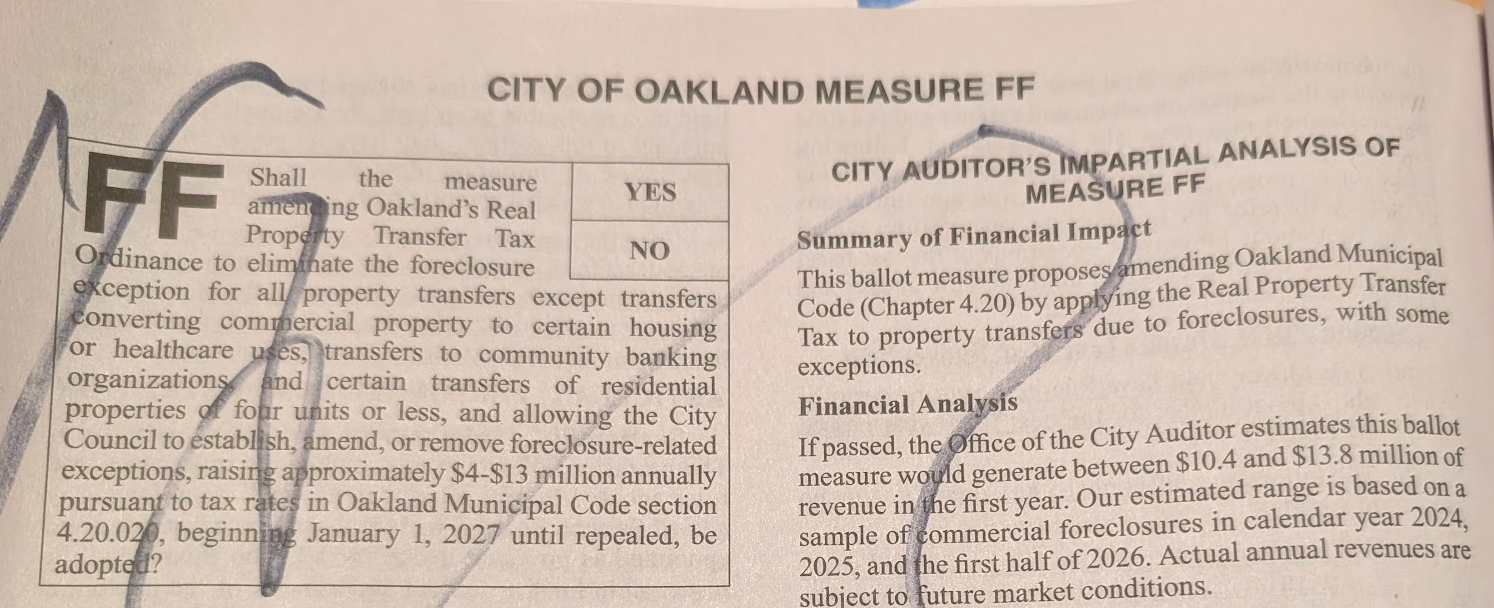
“Real Property Transfer Tax Foreclosure Exemption Changes”
FF closes a loophole that hedge funds have been using—the name “BlackRock” will be thrown around—to avoid paying the Real Property Transfer Tax (RPTT) that they’d otherwise pay, if they just rolled up and bought the property. RPTT is what they call “sales tax” when it pertains to real estate, and who wants to pay that, right?
Certainly not BlackRock. So what they do is acquire houses headed to foreclosure by buying the debt—usually at a discount, because it’s bad debt—and, then, when the foreclosure happens, they take possession of the property itself in lieu of repayment on the debt. This way they get the property, pretty cheaply, and never even have to pay sales tax on it. (Sorry, the “Real Property Transfer Tax.”)
Anyway, everybody is for closing this loophole, except BlackRock. Fuck BlackRock. Vote YES on FF.
 Oakland Review of Books
That was easy! So while we’re here, some fun facts about the Real Property Transfer Tax. In 2018, Oakland passed Measure X, which made the RPTT a bit more progressive. Instead of a flat 1.5 percent, properties sold for under $300k pay only 1 percent, while properties above $2 million pay 1.75 percent and above $5 million pay 2.5 percent. Good for us!
That means, for example, that this $22,500,000 property, if sold in Oakland in 2017, would have netted the city approximately $337,500 in tax revenue. If sold in Oakland in 2026, it would, instead, get the city about $562,500. That difference of $225,000 means that instead of only being able to pay Barbara Lee’s salary for almost two years, you’d have been able to pony up to the bar and pay for more than half of one year of Lieutenant Timothy Dolan. (And remember, OPD officers only increase in cost over time!)


Of course, you’ve obviously noticed that I played a little trick on you there. There are not that many houses that sell for $22.5 million in Oakland; this one is actually located in Piedmont.
That means that the lucky devils buying and selling it—and we do mean lucky devils, in the sense that, still being alive, they are lucky to not yet be in hell for whatever sins and crimes they committed to have that much money—will pay a good bit less than they would if they were located in Oakland. That’s because the Piedmont RPTT is only 1.3 percent, and is not graduated or progressive.
We were shocked, shocked to learn that buying a really expensive house in Piedmont means paying a lot less in taxes than in Oakland. Oaklanders were, generally, fine with raising the RPTT tax on very expensive properties—since the vast majority of us will never pay that higher tax—but Piedmont is, after all, a place where renting is considered at least a civil infraction, if not an actual mortal sin, and the median property value is well north of $2 million. And so the $562K that would have been taken from some plutocrat purchasing that house, were it in Oakland, is instead only about $292k, in Piedmont, barely a third of one Timothy Dolan.
(They’d better sell it quick, before we annex those fuckers.)
Of course, the real shovel to the face is that “Real Property Transfer Tax” are the words they use so you don’t call it sales tax, which is what we would call it, if we didn’t tax one kind of transaction many times higher than the other. You will be startled to learn that it’s the one that everybody pays, and for things they need, instead of just comparatively more affluent homebuyers. But if you look at it that way, Oakland’s retail sales tax is 10.75 percent while Oakland’s “sales tax” on houses is only 1 to 2.5 percent.
Of course I shouldn’t say “Oakland’s” sales tax. I should say “The sales tax you pay in Oakland,” because almost all of that money goes to the state and county. After you pay a six percent sales tax to California and a bit more than a four percent sales tax to Alameda County, you’ll pay only about 0.5 percent to the city of Oakland.
One way to think about that is that the city of Oakland actually taxes the sale of houses a lot more than the sale of food; it’s the state and county that charge sales taxes only on the stuff that poor people also buy. Another way is that the median household in Oakland—a $100k household income—spends about 3–4 percent of their income on retail sales tax, but the kind of rich person who buys a $22 million house not only pays a much smaller proportion of their income on sales tax generally—and might have paid a much lower rate in income tax, too, if they got paid in untaxed equity—but when they decide to drop some cash on a Real Property, well, damn! Doesn’t that 1.3 percent RPTT for a house in Piedmont hit so much better than the 10.75 percent their housekeeper pays for a gallon of milk in Oakland?
So vote YES on FF, and also YES on Proposition 40, and also let’s annex Piedmont while we’re at it.
Find more of our voting guide here.