Comfortable masks
What’s the dress code for a community theatre production in the suburbs? El Cerrito is such a small town that I was sure I would run into someone I knew, so I wasn’t sure what to wear. My sleek, San Francisco theatre night black cocktail dress felt too formal, but the black velvet romper with enormous sleeves a friend of mine gave me in Beijing ten years ago was too outlandish (seriously, you have got to see this thing, it’s so fun). Ultimately, I settled on a little bit of professor drag (oversized blazer, confusingly-shaped shirt, skinny jeans, standard Blundstones) that I have left from my days in academia.
Standing outside the Contra Costa Civic Theatre in El Cerrito for the opening night of Eureka Day, I can see that while I was thinking about what kind of costume made sense, everyone else was focused on feeling comfortable. People are wearing newsboy caps with zip-up hoodies, or draping shawls with practical, fully enclosed sandals that would work for a nice meal out at Tigon on San Pablo Ave (or a hike in the Hillside Natural Area less than a quarter mile away). This is the suburbs, after all. You don’t move to Contra Costa County because you want to be uncomfortable.
Our friends pull up on an expensive brand of ebikes—that I like but can’t ride because I’m too short—and they tell us how they saw the original production of Eureka Day in 2018 at Berkeley’s now-closed (but reopening?) Aurora Theater. Aurora was lovely and small, they say. As my husband and I start reminiscing about Cutting Ball—our favorite tiny theatre that didn’t survive the pandemic—it becomes clear that we mean different things by “tiny”: Aurora could seat at least 200, they say, but in my memory, Cutting Ball audiences never had more than 50 people. Can that be right? But the thing about theatre is that the play I take home is never the same one my husband takes with him, never even the same one they put on the next day.
When the doors open (a little late, since it is opening night), we all drift inside as a clump, making it as challenging as we can for the volunteer ushers to figure out whose tickets they’ve checked and whose they haven’t. Five years ago, I lived right next to this theatre when it was closed for COVID, so this is my first time inside. After the more sensible seats near my friends got snatched up, I got tickets for the front row, and I am already coaching my neck through the craning it’s going to do over the next two hours. Sequins drift by me, but also dozens of complicated, stiff, vaguely ethnic textiles. (“I love those details in the back,” one woman tells another and the complimented woman draws attention to the large buttons in the front.) Our friends pull a set of N95 masks from their pockets, and so do we—why not? What COVID numbers one can find are allegedly climbing, and there will be no ventilation as soon as they shut the theatre doors. People like to complain about how uncomfortable masks make them now that they’re not mandatory, but it always feels like they are actually uncomfortable about something else; I barely notice my mask anymore. Since I’ve read nothing about the play—not even the synopsis on the website, I don’t know why choosing to mask or not might be loaded in this context.
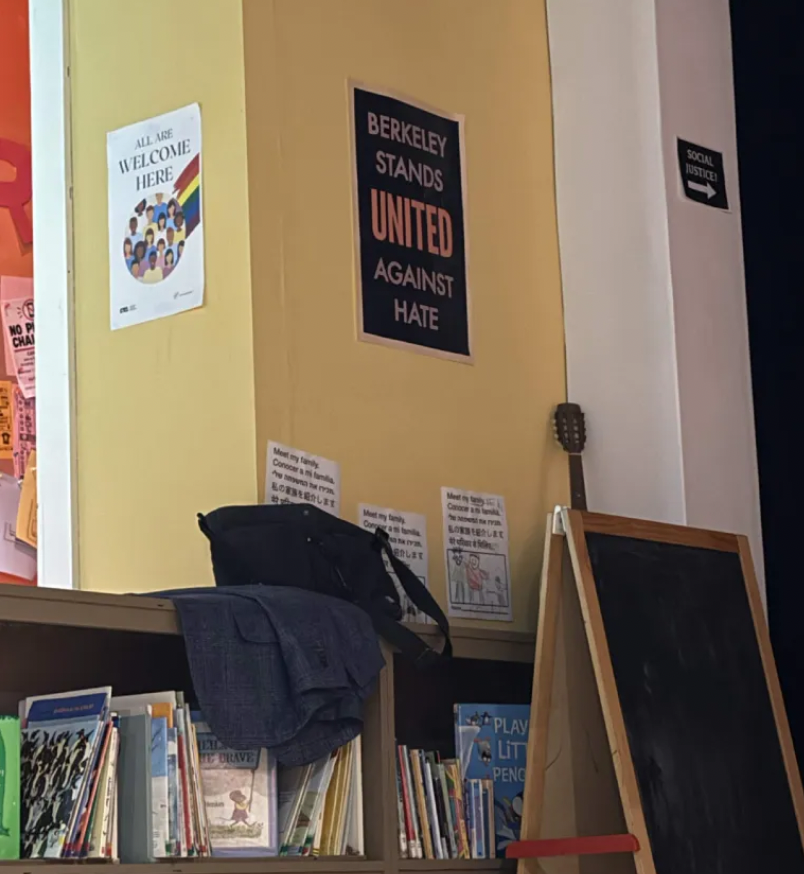
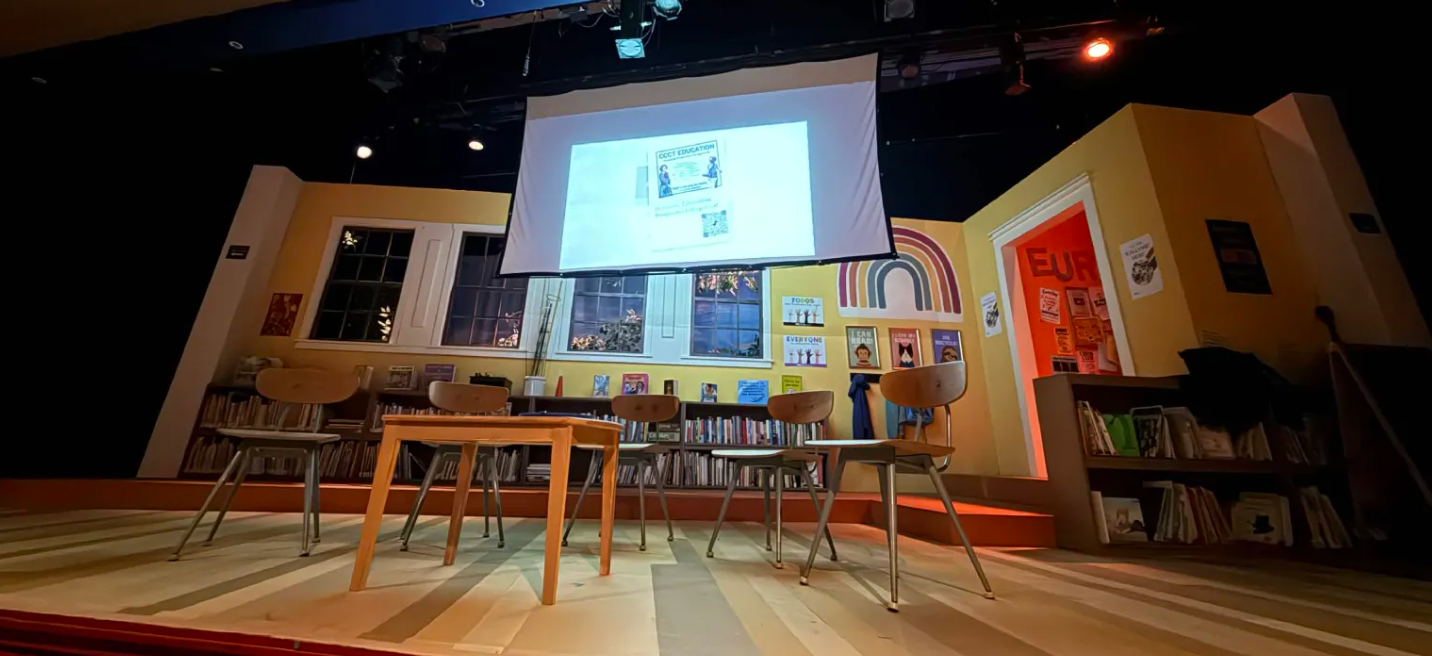
On stage, there are small wooden children’s chairs, and a projector rolls through school-esque invitations to support CCCT. Even if you never went to a school like this, the details are meant to draw you in, to make you believe you could have, or at least that you can imagine what it must have been like. There’s a large rainbow on the wall, I CAN READ posters, shelves that only rise two rows above the ground, and a collection of impractical beanbag devices in the corner. The ubiquitous BERKELEY STANDS UNITED AGAINST HATE poster hangs ominously on one end of the stage, bookended by a smiling photo of Obama on the other.
The managing director of CCCT addresses the audience. “You are our best marketing team,” he reminds us. I think about how my husband and I sat through every production for two seasons at Cutting Ball and how I’d still be doing it if only there hadn’t been a pandemic, if only I hadn’t had children and moved to the suburbs, if only, if, if, if.
\O/
When the lights go down, the sounds of laughing children fill the space, and actors hurry onto the stage, one in a familiar hunch, his face illuminated by the light of his phone. As it will turn out, Eureka Day is the story of how a private school executive committee made up of East Bay stereotypes navigates a “mumps” outbreak, through endless consensus-oriented meetings, when it becomes clear that half the school (and half the committee) are anti-vaxxers. After the show, my friends will all praise Austin Bean’s extremely familiar performance as Eli, the “full-time dad” (and tenth employee at Facebook), in a dubiously ethical nonmonogamous marriage, and whose obvious desperation for approval means he will never shut the fuck up. Bean does a tremendous job, but it’s Alicia Rydman’s performance as Suzanne—the sanctimonious, implicitly white mother who treats the school as if it belongs to her because she was one of the founding families—that immediately sucks me in. Like Bean’s quarter zip Patagonia fleece with shorts, Rydman’s ostentatious feathered earrings, embroidered blouses, and skintight polyester slacks with nude heels make her instantly recognizable.
“Social justice is at the center of everything we do,” she declares, and then manages to imply that Carina—the Black, new member of the executive committee, played with perfect exasperation and restraint by Ashley Jaye—isn’t a “full-pay family.” And I don’t think I’m spoiling anything by letting you know now that, of course, Carina’s family is full-pay. In 2026, is the “twist” that the white liberal woman is both racist and uninformed really a twist? (Would it have been in 2018? I can’t remember). When Suzanne continually interrupts Carina all while insisting she values Carina’s “unique perspective,” someone a few rows behind me snorts with laughter (“‘Unique perspective!’”) This is not the only outburst during the performance. Shrieks of horror drowned out the sound of the actors’ voices in a scene where the executive committee hosts an ill-advised Zoom call with the school’s parents. “Let’s take our hands off our keyboards and imagine we’re part of one conversation,” pleads David Bogdonoff as Don, the school’s headmaster and the only character who it’s clear is at work. (But even as the conversation goes horribly and typically awry, I find myself thinking: This is kids stuff. These people wouldn’t last a day on El Cerrito Nextdoor.)
During intermission—while the piped-in sound of kids laughing and playing reminds us all that, in theory, the drama we’re watching is all happening for the children—my friends will tell me I’m lucky to be sitting so close to the front because it’s hard for them to even hear the actors over all the laughter and cross-talk. We get the joke, the audience seems to be saying. We’re in on it!. We don’t mind or feel implicated! We didn’t come to this play because we wanted to be uncomfortable!
The second half of the play opens in the hospital: Eli’s son is in a medically induced coma after contracting mumps from another executive committee member’s daughter during a playdate they arranged as part of their standing affair. “Thanks for letting me visit,” Meiko (played by Kye Gahyun Kim) tells Eli; he immediately centers himself and his own needs as his child lies intubated somewhere offstage: “I didn’t want to be alone.”
But is it my imagination or is the audience’s laughter beginning to weaken and trail off? There are still moments of ridiculousness. A decision to convert all the bathrooms to gender neutral has decimated the school’s finances, meaning that the pro-vaccine families’ threat to leave if vaccine mandates aren’t enforced has become existential for the adults, all sitting in tiny plastic kindergarten chairs. But the physical comedy is getting overshadowed by denser, darker conversations. During one scene in particular, Carina begins a series of sentences she cannot finish, because the conflict they signify is simply not surmountable through consensus.
“I wish there was a way this could work out for the both of us,” Carina tells Suzanne at one point, the two of them decked out in fabulous, expensive-looking coats, “For all of us.”
This naive, childlike wish is what makes the play feel so deeply East Bay. After spending my twenties zipping back and forth between the East Coast and the People’s Republic of China, I’m always shocked at how bad certain pockets of the East Bay are at conflict, how open disagreement can feel so terrible that people mistake it for harassment. Do we lack the muscle for disagreement? For being uncomfortable?
Maybe it’s something deeper. Maybe agreeing that everyone’s perspective is valid also means agreeing never to be changed by each other, and being told you are wrong is a personal attack. It takes a certain amount of courage to admit that not everything can work out for all of us, all of the time. Sometimes someone is wrong. Sometimes someone has to lose. And losing well takes practice; losing is a practice in and of itself.
“No one in this room is a villain,” Don reminds the committee (and the audience) in the play’s penultimate scene. Well, right: no one is a villain, but someone will have to be a loser. The stage is filled with a familiar, endless series of mortified I’m sorry’s from every character, especially the ones that aren’t really sorry.
\O/
When it’s over, I am suddenly exhaling, remembering where I am and feeling the stiffness in my neck, noticing how much care went into the details of the sets, how a shelf is now empty, how an in-progress scarf was completed. At the opening night reception, in another room, Bogdonoff gives a short speech where he reminds us how much community theatre relies on all of us to keep going: “If you liked the play, tell people to come see it. If you didn’t like the play, tell people to come to see it.”
(I think, again, about Cutting Ball; are my friends thinking about the Aurora?)
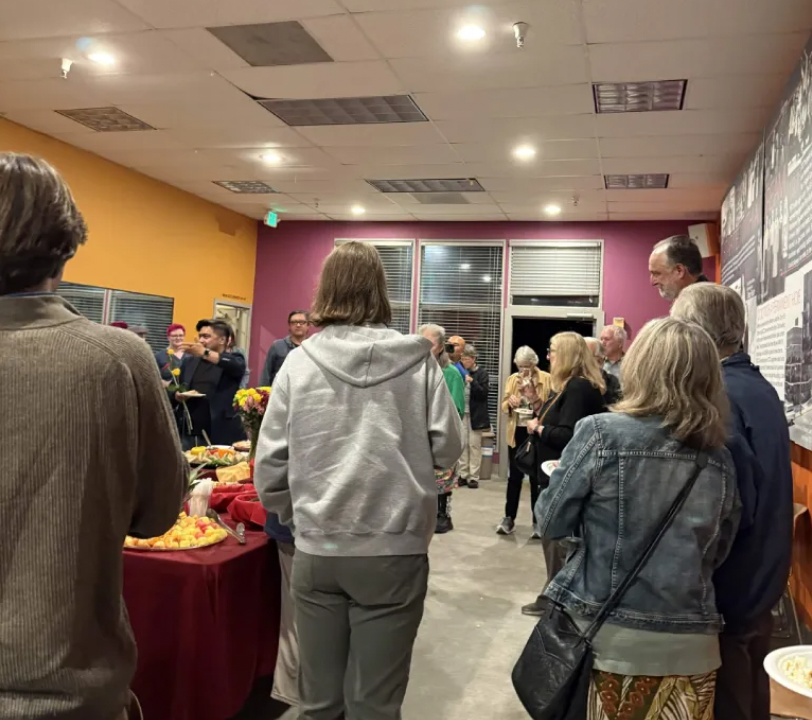
We eat from an impossibly large charcuterie board, tell the director and the actors they did an amazing job, swap horror stories from consensus-governed organizations and the Zoom chat during the El Cerrito Democratic Club’s Library Tax debate. “This is the play El Cerrito needs right now,” one of my friends says, and I agree. And allow me to take my critical mask off and be sincere for a moment: It doesn’t matter if I liked the play or not. I did, but even if I didn’t, you should go see it, because it is an incredible gift to have an institution like CCCT, in our midst, putting on a play like Eureka Day. It gives us the language and perspective we need to look at our lives sideways and discuss them more analytically, as examples of something bigger. Because we’re all part of something bigger; we’re all in this together, whether we like it or not.
And truthfully, I don’t always like it. It’s uncomfortable. After I see two other women wearing very-slight variations on the signature quirky, red glasses that I wear, as an individual, I decide it’s time to leave. No one can stay immune from their surroundings forever.
Eureka Day is playing at the Contra Costa Civic Theatre in El Cerrito through September 27. You can purchase tickets here.