Oakland Review of Voting Guides
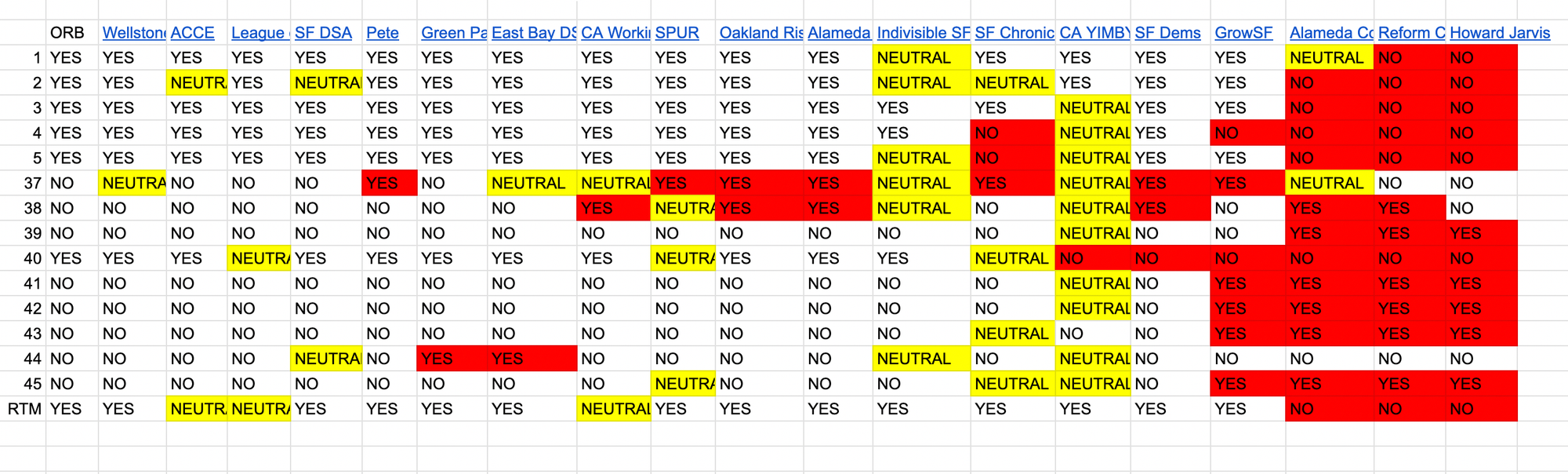
You’ve obviously already drunk our voting guide down to the dregs, savoring every one of the more than fifteen thousand words we’ve so far published (with more to come!). But imagine you wanted more. What if what you wanted was an ORB-bot that would scan the other voting guides and produce a collective wisdom from them, deriving and deducing what the total social intelligence would advise you to do?
Welcome to the ORB Review of Voting Guides.
The first thing to say is that you can learn a lot from your enemies. Knowing who to be mad at is praxis, as Mariame Kaba has it, and you can do a lot worse than just voting the opposite of the Howard Jarvis Taxpayers Association, with its old-school Republican red-white-and-blue finery. Reform California’s is another voting guide you can comfortably contradict, to more or less the same effect; because it’s essentially a cult of personality centered on Assemblymember Carl DeMaio, it gives a blaring and cheap YouTube-podcast vibe, possibly reflecting how DeMaio has either been driven mad by being a San Diego Republican in the great blue of California politics, or how our current media environment has quite successfully and algorithmically selecting for his specific brand of Trumpy-but-California lunacy. Finally, give a thought to voting the opposite of the Alameda County GOP: threadbare, tattered, and beleaguered, their website nevertheless trumpets that they’ve been “Fighting for freedom, opportunity, and prosperity in the East Bay since the 1850s,” and God bless them for it.
 Oakland Review of Books

It doesn’t matter much which enemy you do the opposite of. And if this is a reductive and limiting way to go about this glorious work of democracy—upon which we are lucky, nay, blessed, to be embarked—you’re absolutely right. But limiting is fundamentally what elections are, and what makes them distinct from real politics. An election is a machine that very concretely constrains the vast spectrum of political possibility into a simplistic “yes” or “no” question, while also suppressing any other questions one might ask. Think about how many actually good ideas, plans, and we shoulds there are out there in the world; think about how few of them are on the actual ballots. Making the decision to vote—to be a part of this process—means choosing from a very uninspiring menu.
But we do have to eat, don’t we? And a few things on there are good enough, if not nearly as good as they should be. You can say yes to a few things that are clearly better than a repugnant alternative; sometimes you can say no to things that will be worse than the already bad status quo. Mostly you just have to choose which dog’s breakfast you’re going to chow down on. That’s how it is; that’s how they get you. But what it does mean is that the choice itself is often not harder than “figure out who your enemy is and thwart them.”
At the same time, what we tell you to do is obviously correct, because of our keen political insight, wisdom, and selfless analytical labor—because the ORB central voting committee has labored nights and mornings and even put our own children to labor, unpaid, at illustrating and illuminating our voting materials (vastly improving them, in our opinion)—but also because our recommendations are almost exactly the same as the other left-leaning voting guides. You can randomly pick from among the voting guides offered by Wellstone, ACCE, League of Women Voters, CA Working Families, Alameda County Green Party, East Bay DSA, SPUR, Oakland Rising, or the Alameda County Dems, and they’ll mostly tell you to vote the same way as we will. Where there are exceptions, they’re to an otherwise pretty robust consensus shared by everyone to the left of GrowSF, including us.
Because you are a good citizen—bedeviled by complicated and compromising choices, by research and analysis that you really aren’t trained for or experienced in, and don’t have the time for anyway, and which often leave you throwing up your hands at the basic badness of the options, and also you’re exhausted—perhaps all you crave is something quick and easy, that will remove your burden of choice and knowledge, allowing you to act and then move on with your life. You can just vote like Pete, if you want. He’s a guy. He’s named Pete, which rhymes with Google Sheet.
If you’re a little more ambitious, you might look at a spreadsheet like ours, which collates and collects and compares other voting guides; instead of simply following a single authoritative perspective, like sheep, you can Do Your Own Research, and pick and choose your way through the wisdom of the crowds. Sean Oliver’s Bay Ballot is a bit overwhelming—and is clean and complete, in a real Anthropic Has Scraped the Web sort of way—but it has, we must confess, managed to put a lot of information in a place where you can get it. For our money, we prefer the old-fashioned smells-of-mimeograph vibe of Kehilla Community Synagogue’s Economic Justice Committee, which someone sent us.
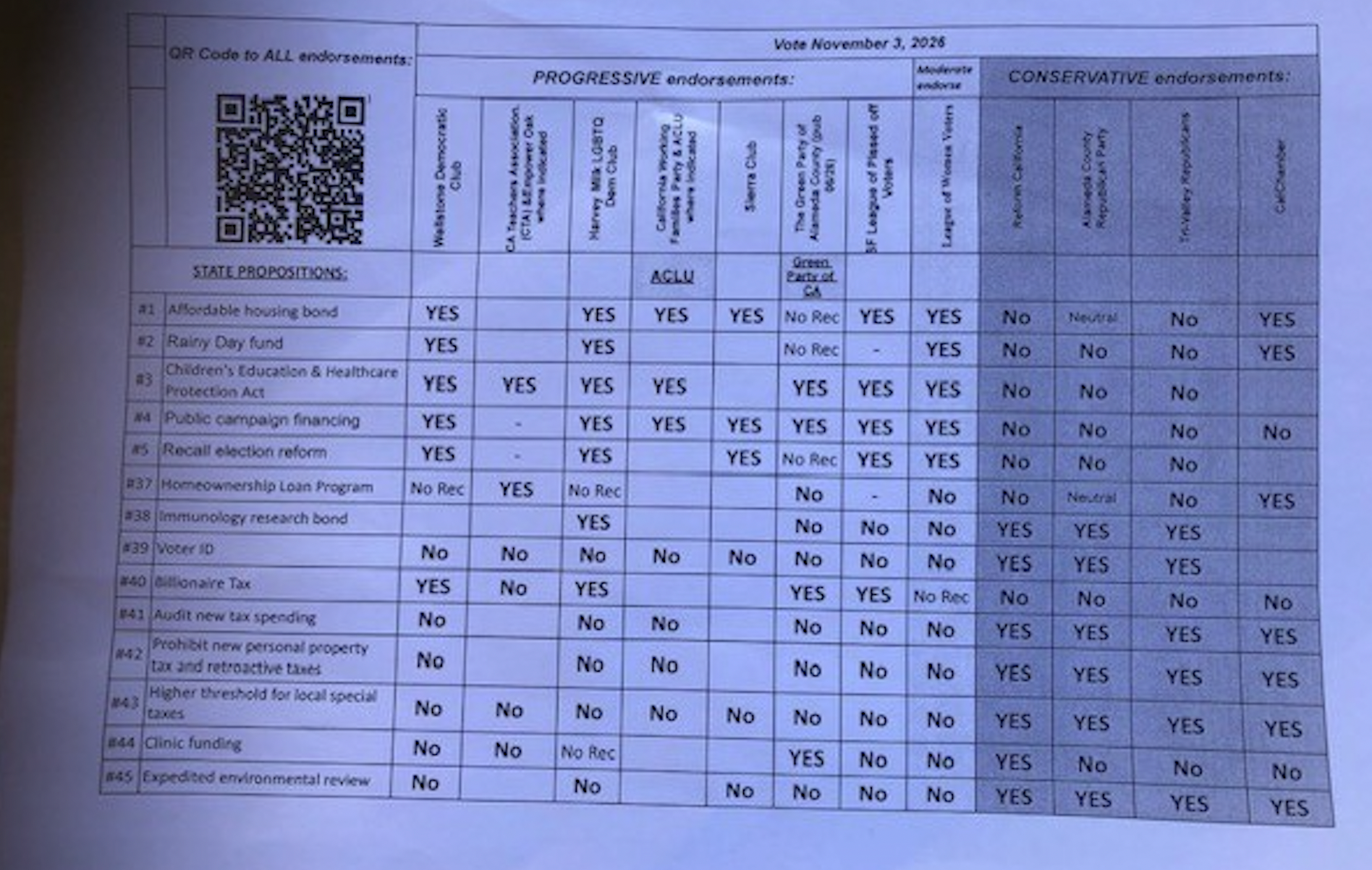
What all of this—what any of this—allows you to do is get the how to vote problem solved, in whichever expeditious way you’d prefer. A lot of voter guides stop there, with the actionable part of the actionable intelligence, and that’s fine. If you’re the Oakland Review of Books, however, which we are, your whole thing is not to stop there, but to instead get as lost in the weeds as you can, and as off-topic as necessary for a full perspective on how annoying this process’s necessity is.
So let us dig in.
Exceptions that don’t prove rules
Among the voting guides of the greater left, East Bay DSA and the Alameda County Green Party do stand out a bit for suggesting you should vote for Proposition 44. We’re a “hold your nose and vote no” on this one; 44 is an SEIU-UHW measure, and it’s not surprising that East Bay DSA is standing with organized labor (or that Jarvis, GrowSF, and the GOP are against it), though it’s notable that even SF DSA could manage only a “neutral.” But everyone else is opposed to it. Although the Greens bury their thick explanation for their recommendations in a (fairly extensive) pdf, seeing them declare that “The pro and con stances are like David and Goliaeth” (sic) made us feel a bit better about not bucking the tide with them (while the moderately fidgety red-and-orange architecture of the East Bay DSA’s regional specificity invariably dead-ends on an “Analysis coming soon,” for which we have ceased holding our breath).
We’ve lingered on 44 because it’s the rare example of a proposition with a true bipartisan consensus on no; our interpretation is that that’s because it’s built on a righteous fight that still looks about as much like what a good law should look like as the Green Party’s spelling of Goliath.
Where there is no consensus is with Props 37 and 38, which really are such special cases (derogatory) that you’ll get the same advice from ORB and from Howard Jarvis (a real metaphorical shovel to the fucking teeth). But it’s mostly because of how these propositions are crafted to blur otherwise clear lines. With 37, for example, there’s no real organized opposition, so it doesn’t matter that much that there’s not a ton of left enthusiasm for it (just SPUR, Oakland Rising, and Alameda County Dems). All the neutral recommendations, in fact, testify to a certain ambient HOUSING GOOD YIMBYism out there (as our man Pete’s explanation for his yes suggests), and a kind of disinclination to vote no on something that would seem to help people in this particular ideologically congenial way. Of course, we’re a no on it, because it “doubles down on basically everything that’s wrong with California housing policy,” but that’s the thing, right? Status quos are usually status quos because of how many people can live with things being the way they are. In this case, in particular, helping people borrow to buy a house is such a core American and California vibe. It’s just clearly going to pass, and so, perhaps, folks just couldn’t get excited about being against it.
As for 38, that one is just a real “wanna vote for medicine? For science? What, are you in favor of cancer?” bait and switch. Vote no, we say, but it feels telling that the yes votes on it really don’t try all that hard. AC Dems and CA Working Families offer no explanation for theirs, while Oakland Rising just says “would fund research to cure and prevent diseases,” which, okay, man, sure. It’s such a messy proposition that we’re a little surprised that SPUR is officially neutral; it feels like it would be a layup for them to observe that it’s just open-air corruption. (Note how happy the Chronicle was to call it “one of the most noxious deposits on California’s political dung heap.” The main thing is that whether or not to fund “Immunology” on a massive scale shouldn’t be a question the democratic masses use vibes to answer is our take. But given the length of our list of “shouldn’t be”s, I guess we can be okay with anyone who wants to throw money at medical funding.
(A quick aesthetic overview: SPUR’s information density is basically good—and I appreciate the varied yet not overdone color scheme—but you can always tell that they’re telling you, like, 50 percent of what they know, and a little bit because they think you can’t quite handle the truth. Graphic design is CA Working Family’s passion, and I feel like I’m reading a fanmade wiki page about the different houses in Game of Thrones; ACCE is the same, but with a little more information. I don’t like Oakland Rising’s wait-a-second-for-the-box-to-pop-up web thingy, and, on balance, I have decided that the League of Women Voters support-meter thing is also a bad idea, and condemn it. I refuse to have an opinion about Wellstone’s aesthetics, since neither did they.)
The rule
We’ve dispensed with the handful of slight exceptions, so let’s get into the sheep and goats of it all. There’s a very clear dividing line between the left and the not-left, and it’s Proposition 40. That’s why our voting guide goes six thousand words on it, and also why we maybe didn’t need to bother. Everyone to the left of GrowSF’s appropriately efficient-and-soulless voter guide gives you a yes on this one. Most of these propositions rearrange deck chairs—or tape a kludge over a failing kludge from a decade ago (that was papering over a kludge from before that)—but Proposition 40 is the one big and new idea with a lot of careful thinking and motivated expertise behind it, which is attracting the kind of opposition that tells you how and why it matters so much.
Of course, gobs and gobs of money are being spent to trick you into thinking that Prop 40 is what Prop 44 actually is, by raising wonkish, process-oriented objections to derail the basic clarity of what a Tax the Billionaires bill will do (the clue is in the name). For that reason, it’s worth reiterating that how you vote on Prop 40 is not really about your judgment of the law it proposes, because for all the uncertainties embedded in it (as there are in life itself), its outlines are crystal clear: This is a bill that will attempt to tax the billionaires, who are currently essentially untaxed, and if it passes but is thwarted, the worst-case scenario is only that billionaires will be taxed less than the proposed law intends to. If you think billionaires should be taxed more than the approaches-zero of their current situation, we would put to you that it’s not a hard decision. But if you forced us to speculate about the two neutrals (League of Women Voters and SPUR) within the greater left, we would guess that they probably would be for 40, because there’s otherwise such strong correlation between what orgs that vote for 40 also think you should vote for; LOWV and SPUR are firmly within the ranks of the Yes on Prop 40 crowd on absolutely everything else (including 41 and 42, which are really about 40). It’s easy to look at their process and suspect that a few no votes could really gum up a consensus-based system, and then give them the benefit of the doubt, so we’re choosing to do that.
We don’t give the benefit of the doubt to CA YIMBY (whose brown-beige and indistinct-blues color scheme sucks), SF DCCC (which makes blue and red looks significantly worse than usual), or GrowSF (evil green-blues against nothingy-blank). They do join the left when it comes to the RTM (and also Proposition 3, correctly recommending “yes” to not lower taxes on the rich). But their pro-billionaire no on 40 clusters them a lot closer than anyone should be comfortable with to the broader GOP and libertarian crowd: GrowSF has eight endorsements in common with Howard Jarvis—matching their eight with us—and while CA YIMBY is mostly neutral on everything but three housing bills, the fact that they couldn’t be neutral on 40, where it counts—and which simply is not a housing bill—places them with the billionaires, against the left. SF DCCC made news when it broke with the state Democratic Party on Prop 40, but it also wasn’t exactly news that the Lurie crowd was, similarly, more about standing with billionaires than with the left.
What about our friends at the San Francisco Chronicle, whose endorsements we’re going to have to jailbreak for you? Despite deeply uninspiring visual choices, they are doing something slightly different with their endorsements, trying to ride the middle while not quite breaking with the left. They haven’t yet weighed in on 40, though they’re officially no on 41 and 42, which is a much easier call, though not nothing. But since they otherwise vote with us on only six propositions—as opposed to the thirteen we have in common with LOWV and the ten we have with SPUR—we’re a little less certain about what they’re up to.
However, because we are courageous and foolhardy, we’re going to call it, now: In the next few days or weeks, they’re going to come out as a no on 40 (as did their fellow billionaire-owned newspaper, the LA Times). It’s not because you would otherwise call the Chronicle’s picks conservative. Their yes on 37 doesn’t mark a sharp diversion from the rest of the left, which is divided on that one, as we said, and although their no votes on 4 and 5 do, their explanations are finicky rather than ideological: They demand more study of public financing for elections before unbanning it—a strange objection, since 4 doesn’t mandate public financing, only allows it—and on 5, they have a “we might support…in isolation” position (except they don’t think recalled officials should be allowed to run in a subsequent special to replace them). In both cases, their official stance is basically that the problem is not so dire as to require an imperfect correction now, defaulting to a no in the interim. In other words, we suspect that those finicky stands are really about building a glide ramp to a similar negative recommendation on the much higher-stakes Prop 40, establishing a pattern of claiming that they might support a better wealth tax, in isolation—thus placating the broader left—while also putting forward the no vote that their billionaire owner prefers, without it quite looking like that.
The other main rule of the left is the Regional Transit Measure, which is a less controversial left–right dividing line, just located a bit further to the right. The only voter guides that actually counsel against it are the true reactionaries—Jarvis, Reform, and the GOP—while the center-right CA YIMBY, SF DCCC, and GrowSF are all very predictably for it. This is worth noting, because it is, after all, not a progressive tax, and it preserves a mass transit system that you’ll need if you’re gonna grow an abundance (and which is, for all its virtues, also structured around the kind of impulse to gentrification that so much city planning also inescapably is). We vacillated on whether to include a paragraph in our “vote yes” on RTM on left grievances against BART. We didn’t, in the end, but it’s one way to frame why the center-rights find it easier to be for RTM than for Prop 40, if that’s a question we need to answer.
But also, everyone is for this, definitely including us. A few voting guides don’t actively support it, but even calling them neutral is probably putting too much pepper on it; CA Working Families and League of Women Voters don’t take a stand on it, probably, mostly because it’s just too local for them. Meanwhile, while the lunatics at East Bay Times didn’t really produce a voter guide as such—their slate of endorsements is only no on 38 and 44, which we basically agree with—their opposition to the RTM does stand out, and is worth noting (along with their damnable website, which I hate, and would like to send back to 1998). For one thing, their argument is such a shallow collection of right-wing talking points and bad facts that we’re maybe a little glad they held their tongue on all the others? (We’ll let Darrell do the honors of eviscerating their reasons.) But it also speaks to the way the current owners of the Oakland Tribune brand are, alas, a bunch of Walnut Creek fuckos who regard all the things that make mass transit good (starting with “masses”) as bad. What we dislike about BART—the way it privileges other-side-of-Diablo commuters over Oakland, which it is built, essentially, to bypass—is what they should like about it. But like so many suburban conservatives, the one thing their brains can’t admit is that reality is built to favor them, and so they lash out, instead, at exactly that thing.
\O/
So what have we learned?
No one asked us to make a voting guide, but we made one because we can, and because we look good doing it. But not being a 501(c)(3)—like our friends at Oaklandside and our enemies at Oakland Report—maybe means we get to run our mouth a bit more freely, about stuff that might otherwise “constitute prohibited political campaign activity.” That’s not propositions, per se—SPUR is a 501(c)(3) and they certainly have opinions about the props—but “nonprofits can’t be partisan” is one of the ways the discursive field gets structured and warped. Especially when it comes to actual candidates for office, when nonprofits can’t have opinions about politics, officially, it means a lot of the guidance about voting falls to for-profit newspapers, advocacy orgs, partisan hacks, and, like, Pete.
Along with our own recommendations, we’ve explained why we agree on 90 percent of it with all the other left-of-center guides, as well as a couple picky little swerves. But along with explanation, we’ve also given free rein to our expressions of despair and frustration and rage at the state of our political compromises. Because we feel like the major takeaway here isn’t just “here is what to do and why” but “let’s not forget that it shouldn’t be this way.” Because if they’re going to make us vote on this shit—if they’re going to make voting on this shit our job, as citizens—then at least we’re going to malinger, be in a bad fucking mood about it, and say so in front of our coworkers.
We’ll be in a bad mood because the more we think and learn about this stuff, the clearer it gets that this isn’t and can’t be about Making the Right Choice, that these ballots don’t have The Right Choice on them, just forced choices between differently bad options. California’s governance—being just like the rest of the country, only more so—is so fundamentally hamstrung by reactionary antigovernment tax revolt (and general nihilist libertarian sabotage) that real choices are always already foreclosed. And so, it’s worth saying, again, that while there are a lot of good ideas out in the world, about how to make California a better place and how to fix all kinds of problems—such as Canceling Piedmont—you’ll find almost none of them on this ballot.
That means that, while it’s modestly important to vote and vote smart, that’s not the hard part. The harder part is how these propositions force us to reckon with exactly how willing we still are to defend and shore up the status quo. It’s still better than whatever the ghastly specter of Howard Jarvis has in mind for us, of course. And the best way past might still be through, so we’ll still do what we do, every election year, saying yes to the best attempts on offer at shuffling deck chairs and saying no to all the icebergs being served up. But when we were first thinking about how to write our voting guide, an early idea was simply to turn every proposition into its own bespoke essay on why Proposition 13 is the cause of all our problems, how it all started going wrong in that moment when so many Californians said, I’ll get mine and keep it. In the end, we didn’t do that—or only that—because along with looking to your enemies, another kind of praxis is digging into the complexities of a futile struggle, the better to imagine what the next, less futile struggle might look like (and how to get there). But if there’s an overarching vibe on this ballot, a general air to be clocked and counted and reviewed, it’s that there’s a real limit to how long people will be willing to do this. You can ask people only so many times to do this kind of reckoning with themselves and what they’ll put up with; eventually, they’ll say, Fuck it, let’s start a fire.
Find more of our voting guide here.